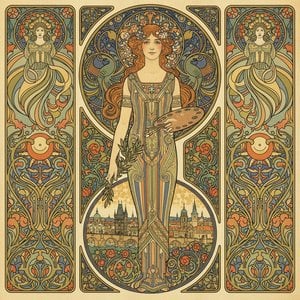
The Portraitist of Bijacovce
The light in Bijacovce settles heavily over the landscape, a quiet backdrop for the life of Andrej Bača. Born in 1874, he moves through the world not merely as a painter, but as a man of many lenses and tools. He is a portraitist, a graphic artist, and a photographer, a pedagogue who understands the mechanics of sight. His early training begins under Štefan Hegedűs in Košice, where the foundations of his visual language are laid through rigorous propedeutics. He does not merely observe; he captures the essence of his subjects through a disciplined eye.
His hands are rarely still. Whether holding a brush or a camera, Bača seeks the truth of a face. He navigates the transition from student to teacher, moving between the roles of artist and educator. His work is a study of presence, a way of pinning a moment to the canvas before it slips into memory.
A Record of Faces and Form
The evolution of his technique reveals a man deeply engaged with the likeness of his contemporaries. His output spans decades, moving from the youthful precision of his early years into a more settled, mature observation. His catalog reveals a specific focus on the nobility and the individual, documented through several key works:
- 1890: Countess Csákyová - Gallery of Spis Artists, Spišská Nová Ves
- 1898: Portrait of a Young Lady in a Hat - Vychodoslovenské Galéria, Košice
- 1923: Likeness of Countess Csákyová - Slovak National Gallery, Bratislava
These works represent more than mere likenesses. They are intersections of social standing and personal identity. In the 1890s, his brush captures the delicate details of fashion and status, while by the 1920s, his work reflects a different era entirely, yet maintains the core focus on the human subject.
The Final Chapter in Bijacovce
By the time 1933 arrives, the man known as Andrej Bača, or Andor Bacsa, or András Bacsa, returns to the place of his beginning. He dies in Bijacovce, leaving behind a legacy that bridges the gap between the traditional portraiture of the late nineteenth century and the shifting visual landscape of the early twentieth. He remains a figure of the Spis region, a man whose life was defined by the act of seeing and the necessity of teaching others to do the same.
Kérdések és válaszok
Hogyan fejlődött Andrej Bača művészete az idő múlásával?
Andrej Bača Krónika oldala egy görgetésre alapozott idővonal, amely a művész alkotásait kronologikus sorrendben, a pályafelvétetei szerinti fejezetekbe csoportosítva mutatja be.
Mely Andrej Bača művei a legnézettebbek?
Andrej Bača számára elérhető egy Statisztikák oldal, amely statisztikákat mutat be a művész alkotmányairól a ez a weboldal felületén.
Elérhető-e 3D virtuális túra Andrej Bača művei között?
Andrej Bača művei megtekinthetők a művész virtuális, 3D-s galériájában, a 3D Galéria oldalon.
Andrej Bača műveit színspektrum szerint is felfedezhetem?
Andrej Bača Színindex oldala a művész alkotásait színek szerint csoportosítja.