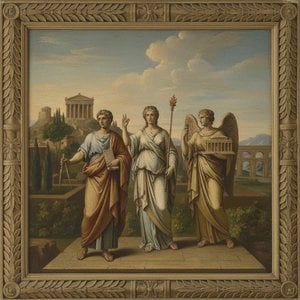
Adrien Dassier: A Portraitist of His Time
Adrien Dassier, a Swiss-born French painter, stands as a testament to the artistic fervor of the seventeenth century—a period dominated by classical ideals and royal patronage. Born in Geneva around 1629, Dassier’s formative years instilled within him an appreciation for meticulous observation and nuanced representation, skills that would ultimately define his distinctive style. His journey toward artistic mastery began with a formal apprenticeship under Charles Le Brun, arguably the most celebrated painter of Louis XIV's court, ensuring he absorbed the stylistic precepts of the era’s dominant aesthetic.
- Early Life and Training:
Dassier’s upbringing in Geneva exposed him to diverse artistic traditions—a blend of Swiss realism and burgeoning Baroque influences. This early exposure undoubtedly shaped his understanding of composition and technique, preparing him for the challenges posed by mastering the complexities of portraiture.
- Move to France and Royal Recognition:
Dassier’s relocation to Paris in 1675 proved pivotal, propelling him into the orbit of the French royal academy—a crucible of artistic innovation and prestige. His admittance as a member solidified his reputation and afforded him access to influential commissions that would propel his career forward.
A Painter’s Vision: Style and Technique
Dassier's artistic output is characterized by an unwavering commitment to anatomical accuracy combined with expressive handling of light and shadow—a hallmark of Baroque painting. He meticulously studied the human form, capturing subtle musculature and drapery folds with remarkable precision. However, Dassier’s genius extended beyond mere replication; he skillfully employed chiaroscuro—the dramatic interplay between light and dark—to imbue his canvases with emotional depth and dynamism. This technique is particularly evident in works like “Achilles Among the Daughters of Lycomedes,” where Dassier masterfully portrays heroic posture and conveys a palpable sense of movement.
- Notable Works:
Dassier’s oeuvre includes numerous portraits depicting nobility—members of royal families and prominent statesmen—each rendered with dignified solemnity and psychological insight. Beyond portraiture, he produced historical paintings that skillfully conveyed narratives of significant events, demonstrating his command of storytelling through visual media.
- “Achilles Among the Daughters of Lycomedes”:
Painted in 1669, “Achilles Among the Daughters of Lycomedes” exemplifies Dassier’s stylistic prowess. The composition—characterized by a pyramidal structure—guides the viewer's gaze toward Achilles, whose heroic stance is illuminated by radiant light, emphasizing his strength and determination.
Influence and Legacy
Adrien Dassier’s artistic influence resonated throughout the French Baroque landscape, largely due to his association with Charles Le Brun—a figure who profoundly shaped the aesthetic sensibilities of Louis XIV's reign. Dassier’s meticulous attention to detail and expressive use of light served as inspiration for subsequent generations of painters, cementing his place within the canon of seventeenth-century art. His contribution to the Royal Academy ensured that artistic excellence would continue to be championed in France.
Further Exploration
To delve deeper into Dassier’s artistic world and the broader context of Baroque painting, consider visiting Musée des Beaux-Arts Caen, France—a repository of masterpieces from the era. Explore online resources such as WahooArt.com for biographical information and detailed analyses of his artworks. Examining Charles Le Brun's paintings, like “Holy Family with the Adoration of the Child,” offers invaluable insight into Dassier’s artistic milieu.