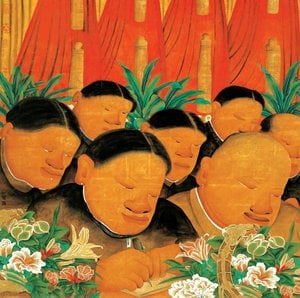
A Glimpse into Contemporary Chinese Life
Zhu Wei’s China Diary, No.52 transports the viewer directly into the vibrant, bustling artery of daily life in modern China. This painting is far more than a mere depiction of a street scene; it is a richly textured tableau vivant, capturing the confluence of tradition and relentless modernity. The eye is immediately drawn to the foreground where two placid cows stand side-by-side on the dusty road, their gentle presence anchoring the composition amidst the surrounding human activity. They seem to move with an unhurried rhythm, embodying a quiet continuity against the backdrop of passing time.
Mastery in Contemporary Ink Tradition
While the subject matter is deeply rooted in everyday realism—the scattered figures, the occasional horseman, the delicate placement of birds—the execution speaks to Zhu Wei’s profound command over contemporary Chinese painting techniques. His style manages a remarkable duality: it possesses the immediate accessibility of reportage art while retaining the sophisticated depth and subtlety characteristic of ink wash traditions. The brushwork is masterful, allowing details to emerge from washes of tone rather than being sharply delineated. This technique lends an ethereal quality to the scene, suggesting memories or fleeting moments caught just as they are passing.
Symbolism of Movement and Community
The composition itself is a meditation on community and passage. The scattering of people—some walking, some mounted—creates a dynamic flow that suggests the ceaseless energy of human endeavor. In art historical terms, such scenes often reflect a society in flux. The cows, perhaps symbolizing enduring pastoral life or simple sustenance, contrast beautifully with the movement of the crowd, inviting contemplation on what endures and what merely passes by. Zhu Wei invites us to observe not just the people, but the underlying rhythm that connects them all.
An Emotional Resonance for Modern Spaces
For collectors and designers alike, this piece offers an unparalleled emotional resonance. It is vibrant without being chaotic; it is narrative without being didactic. Reproducing China Diary, No.52 into a contemporary interior space introduces a layer of cultural depth and storytelling. The warm, earthy tones inherent in the painting ground a room, while the implied energy keeps the spirit lively. It serves as a magnificent focal point, whispering tales of Chinese life to anyone who pauses before its captivating surface.



 Megtekintés
 Áttérés Nyomtatványra
 Küldés
 Megosztás
 Részletek

 Letöltés
 Hasonló darabok
 X-ray felvétel
 Diavetítés
 Statisztika


 Összes részlet megjelenítése






































 Az üvegkeretes opció csak 110 cm alatti méretben érhető el