Megtekintés AR előnézet Kézzel festett másolat rendelése Áttérés digitális képre Küldés
Részletek Útmutató Kedvencekhez ad Letöltés Hasonló darabok X-ray felvétel Diavetítés Statisztika

The Rustics

Discover Winslow Homer’s ‘The Rustics,’ a serene 1874 oil painting capturing rural American life. Explore its realism, light & shadow, and timeless beauty – a captivating piece for art lovers.

Winslow Homer (1836-1910): Amerikai realista festőművész, aki tengeri tájakat, amerikai életképeket és a természeti erő ábrázolásával vált híressé. Fedezze fel műveit!

Giclée / Műnyomat

Múzeumi minőségű giclée vagy vászonnyomat, gyors gyártással és rugalmas finomítási lehetőségekkel. ( Kézzel festett másolat rendelése Áttérés digitális képre)

Corner sample of the P118B picture frame: formázott polisztirol, 5 cm wide and 3 cm thick
P118B Ft10
Corner sample of the P118H picture frame: formázott polisztirol, 5 cm wide and 3 cm thick
P118H Ft10
Corner sample of the P118W picture frame: formázott polisztirol, 5 cm wide and 3 cm thick
P118W Ft10
Corner sample of the P438Z picture frame: formázott polisztirol, 5.5 cm wide and 3.5 cm thick
P438Z Ft10
Corner sample of the P508JH picture frame: formázott polisztirol, 7 cm wide and 3.5 cm thick
P508JH Ft12
Corner sample of the P508YH picture frame: formázott polisztirol, 7 cm wide and 3.5 cm thick
P508YH Ft12
Corner sample of the P805H picture frame: formázott polisztirol, 5 cm wide and 3.5 cm thick
P805H Ft10
Corner sample of the P805Z picture frame: formázott polisztirol, 5 cm wide and 3.5 cm thick
P805Z Ft10
Corner sample of the P919BZ picture frame: formázott polisztirol, 7 cm wide and 3.5 cm thick
P919BZ Ft10
Corner sample of the P919G picture frame: formázott polisztirol, 7 cm wide and 3.5 cm thick
P919G Ft10
Corner sample of the P919XJ picture frame: formázott polisztirol, 7 cm wide and 3.5 cm thick
P919XJ Ft10
Corner sample of the P959ZH picture frame: formázott polisztirol, 5 cm wide and 3 cm thick
P959ZH Ft10
Corner sample of the P968JZ picture frame: formázott polisztirol, 6 cm wide and 4 cm thick
P968JZ Ft12
Corner sample of the W106C picture frame: tömörfa, 5 cm wide and 3 cm thick
W106C Ft8
Corner sample of the W218G picture frame: tömörfa, 5 cm wide and 3 cm thick
W218G Ft10
Corner sample of the W218JH picture frame: tömörfa, 5 cm wide and 3 cm thick
W218JH Ft8
Corner sample of the W218Y picture frame: tömörfa, 5 cm wide and 3 cm thick
W218Y Ft10
Corner sample of the W307PJ picture frame: tömörfa, 6 cm wide and 3 cm thick
W307PJ Ft10
Corner sample of the W316G picture frame: tömörfa, 6 cm wide and 3 cm thick
W316G Ft10
Corner sample of the W316PJ picture frame: tömörfa, 6 cm wide and 3 cm thick
W316PJ Ft8
Corner sample of the W316Y picture frame: tömörfa, 6 cm wide and 3 cm thick
W316Y Ft10
Corner sample of the W398PJ picture frame: tömörfa, 5 cm wide and 3 cm thick
W398PJ Ft8
Corner sample of the W4111J picture frame: tömörfa, 6.5 cm wide and 3.5 cm thick
W4111J Ft10
Corner sample of the W500HY picture frame: tömörfa, 7 cm wide and 5 cm thick
W500HY Ft15
Corner sample of the W500JH picture frame: tömörfa, 7 cm wide and 5 cm thick
W500JH Ft15
Corner sample of the W692G picture frame: tömörfa, 8 cm wide and 4 cm thick
W692G Ft12
Corner sample of the W849H picture frame: tömörfa, 5 cm wide and 3 cm thick
W849H Ft8
Corner sample of the W940BG picture frame: tömörfa, 7.5 cm wide and 4.5 cm thick
W940BG Ft15
Corner sample of the W953PJ picture frame: tömörfa, 6 cm wide and 3.5 cm thick
W953PJ Ft8

Standard méret
egyedi méretű
CM
INCH

Válasszon előre meghatározott méreteink közül, amelyek megfelelnek a műalkotás eredeti arányainak.

szélesség
magasság

Írja be a keretének vagy a falának megfelelő szélességet és magasságot. A nyomatot csak le lehet vágni, soha nem tehető nagyobbá, mint az eredeti kép, így egy eltérő alakú méretnél a kép egy része elveszik. Mielőtt bármit kinyatintanánk, küldünk egy digitális próbamodellt jóváhagyásra. Az oldalon látható kép nem tartalmazza a valós levágást — ezt csak a próbamodell mutatja meg.

Világszerte történő kiszállítás területére mindössze 2 hét alatt, a szokásos 4-5 hét helyett. (28 október)

Ingyenes globális expressz szállítás
Prémium minőségű len vászon
Teljes körű szállítási biztosítás
Vámvisszatérítési Garancia
Hiteles színarányosság garancia
100 napos visszaküldési lehetőség (csak hibás termékek esetén)
100% pénzvisszatérítési garancia
Több darab vásárlásakor kedvezmény

Összesített ár

Ft 21953

The Rustics

Giclée / Műnyomat

Reprodukció mérete

-

Összesített ár

Ft 21953

Gyors információk

  • subject: Rural life, solitude
  • title: The Rustics
  • year: 1874
  • style: American Realism, Luminism

Művészeti kvíz

Minden kérdésre csak egy helyes válasz létezik.

Kérdés 1:
In 'The Rustics,' Winslow Homer masterfully employs what artistic technique to create depth and dimension?
Kérdés 2:
To which art movements is Winslow Homer's style in 'The Rustics' most closely associated?
Kérdés 3:
What is the primary subject matter depicted in 'The Rustics'?
Kérdés 4:
What year was 'The Rustics' created?

A Moment of Rural Contemplation: Unveiling Winslow Homer’s *The Rustics*

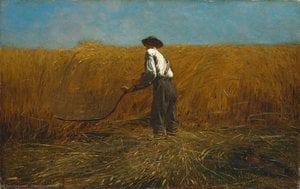
Winslow Homer's 1874 oil painting, *The Rustics*, offers a poignant glimpse into American rural life, radiating a quiet serenity that continues to captivate viewers today. More than just a depiction of a man and a house, this work embodies a specific moment – a pause before labor, a connection to the land, and an exploration of solitude within a pastoral setting. The painting invites us to consider the rhythms of 19th-century American existence, far removed from the burgeoning industrialization that was rapidly transforming the nation.

Subject & Composition: A Study in Simplicity

The scene is remarkably straightforward: a lone figure stands in a field before a modest dwelling distinguished by its vibrant red roof and crisp white window. This simplicity isn’t accidental; it's central to Homer’s artistic intent. The composition is carefully balanced, with the man positioned centrally, drawing our eye immediately. The house acts as an anchor on the right, grounding the scene and providing a sense of stability. The horizontal and vertical lines defining both the architecture and the landscape contribute to this feeling of order and calm. Homer masterfully uses negative space – the expanse of grassy field – to emphasize the figure’s isolation and his relationship with the surrounding environment.

Style & Technique: American Realism & Luministic Influences

*The Rustics* exemplifies elements of both American Realism and Luminism. Homer's commitment to depicting everyday life without idealization aligns with the realist movement, while the painting’s emphasis on natural light and atmospheric effects echoes Luminist principles. His brushwork is visible yet refined, creating a textured surface that suggests the roughness of the field and the weathered quality of the house. The diffused lighting, characteristic of Luminism, softens edges and casts gentle shadows, enhancing the overall sense of tranquility. Homer’s use of oil paint allows for rich color saturation and subtle gradations, contributing to the painting's atmospheric depth.

Historical Context & Artistic Development

Painted in 1874, *The Rustics* reflects a period when American artists were increasingly focused on depicting their own nation’s landscapes and people. Homer had begun to move away from his earlier work as an illustrator for *Harper's Weekly*, focusing more intently on oil painting and developing his unique artistic voice. This shift is evident in the increasing sophistication of his compositions and his growing mastery of light and color. Works like *Girl in the Orchard* (Columbus Museum of Art) and *Girl with Pitchfork* (The Phillips Collection), created around the same time, demonstrate Homer’s ongoing exploration of rural themes and his ability to imbue seemingly ordinary scenes with emotional resonance.

Symbolism & Emotional Impact

While ostensibly a straightforward depiction of rural life, *The Rustics* is imbued with subtle symbolism. The figure's posture – slightly turned away, perhaps lost in thought – suggests contemplation and introspection. The house itself represents shelter, home, and the enduring connection between people and the land. The overall effect is one of peaceful solitude, inviting viewers to reflect on their own relationship with nature and the simple pleasures of life. Homer doesn’t offer a narrative; instead, he presents a *mood*, an atmosphere that resonates deeply with our innate desire for tranquility and connection.

Key Features

  • Masterful Use of Light & Shadow: Creates depth, dimension, and a serene atmosphere.
  • Balanced Composition: Draws the eye to the central figure while grounding the scene with architectural elements.
  • Realistic Depiction of Rural Life: Captures the essence of 19th-century American existence without idealization.
  • Subtle Symbolism: Invites contemplation on themes of solitude, connection to nature, and the rhythms of rural life.
For those seeking to bring a touch of timeless serenity into their spaces, a reproduction of *The Rustics* offers a captivating focal point. Its harmonious color palette and evocative imagery complement a variety of interior styles, from farmhouse chic to contemporary minimalism.

Kérdések és válaszok

Megtekinthetném a(z) „The Rustics”, Winslow Homer alkotása röntgensugárzásos felvételét?

A „The Rustics”, Winslow Homer alkotása röntgensugár-nézetét a mű X-ray felvétel oldalán tekinthetjük meg: ez az alkotás interaktív vizsgálata eleven optikai rétegeken keresztül.

Milyen hangulatot kölcsönözne a "The Rustics" egy térnek?

A „The Rustics”, Winslow Homer alkotása Nostalgic hangulata tökéletesen illeszkedik a javasolt helyszínhez: egy Living Room.

Melyik szobához ajánlott a „The Rustics”, Winslow Homer alkotása, színei alapján végezve?

A Dark színeinek köszönhetően a „The Rustics”, Winslow Homer alkotása alkotást egy Living Roomba javasoljuk; ezt a választást éppen a színek harmóniája teszi lehetővé.


A művész életrajza

A Brush with the American Spirit: The Life and Art of Winslow Homer

Winslow Homer, born in Boston in 1836, wasn’t sculpted by the traditional European art academies that shaped so many of his contemporaries. Instead, he emerged from a distinctly American experience, one rooted in practicality and observation. His journey began not with grand historical canvases, but as a commercial illustrator at the tender age of twelve for Harper's Weekly. This early apprenticeship was formative, honing an exceptional ability to capture scenes with clarity and detail – skills that would become hallmarks of his mature work. He wasn’t learning perspective in Paris; he was learning to *see* America, its people, and its unfolding story. The bustling streets of Boston, the quiet dignity of rural New England life, these were his first subjects, rendered with a precision born of necessity for the demands of print media. This foundation allowed him to transition into painting, initially in watercolor, before fully embracing the expressive potential of oil paints.

Early Life and Artistic Beginnings

Homer’s childhood was marked by a close relationship between his parents—Charles Savage Homer, a merchant with restless ambitions, and Henrietta Maria Benson Homer, a gifted amateur watercolorist who instilled in him a lifelong appreciation for artistic observation. His father's entrepreneurial spirit propelled him to seek fortune abroad, leaving young Winslow largely under his mother’s tutelage. From Cambridge, Massachusetts, where he attended school, Homer developed an early fascination with drawing and sketching—skills that would prove invaluable throughout his career. He began honing his craft by copying the works of established artists, gaining experience in mastering technique and capturing visual impressions. This formative period instilled in him a disciplined approach to artmaking that would characterize his later work. His mother’s encouragement fostered his artistic talent and nurtured his innate sensitivity to beauty—traits that would become integral to Homer's distinctive style.

The Civil War Years: Witnessing History Through Art

The American Civil War profoundly impacted Homer’s artistic vision, transforming him from a painter of idyllic landscapes into a chronicler of the brutal realities of conflict. As a war correspondent for Harper’s Weekly, he documented the daily lives of soldiers and civilians—not grand battles or strategic maneuvers—but rather the quiet moments of grief, resilience, and human suffering amidst chaos. This experience instilled in him an unwavering commitment to portraying truthfulness and empathy—values that would permeate his paintings throughout his life. Homer eschewed romanticized depictions of heroism, focusing instead on capturing the psychological impact of war on ordinary people. His sketches for Harper’s Weekly are considered singular examples of wartime reporting, demonstrating his remarkable ability to convey emotion through visual imagery. The Civil War served as a catalyst for Homer's artistic evolution, prompting him to explore themes of trauma and vulnerability—themes that would become central to his oeuvre.

A Master of Watercolor and Oil: Exploring Diverse Techniques

Homer’s artistic versatility extended beyond watercolor; he excelled in oil painting, achieving remarkable textural depth and luminosity through a technique rooted in direct observation from nature. He embraced the expressive potential of oil paints while retaining the fluidity and spontaneity characteristic of watercolor—a duality that defined his distinctive style. Homer's studio was located primarily in New York City, yet he frequently traveled to Pennsylvania, the Catskills, and Gloucester, Maine, drawing inspiration from these varied landscapes. These excursions fueled his creativity and informed his artistic vision, resulting in paintings that captured both grandeur and intimacy. He meticulously built up layers of paint—often applying them with a palette knife—creating surfaces rich in texture and color—a technique that distinguishes Homer’s work from many of his contemporaries. His masterful handling of light—particularly the dramatic effects achieved during Maine summers—became a hallmark of his artistic style.

Legacy: An Icon of American Realism

Winslow Homer stands as one of America's most celebrated painters, recognized for his unflinching portrayal of the human condition and his profound engagement with the natural world. His paintings—particularly *The Gulf Stream*, *Breezing Up (A Fair Wind)*, and *Innocence*—remain enduring symbols of American artistic achievement. Homer’s influence extended beyond his own time, inspiring subsequent generations of artists who sought to capture the spirit of their nation with similar honesty and conviction. He rejected academic conventions in favor of a direct painting approach—a stylistic choice that cemented his place as a pioneer of American Realism. His legacy is defined by his ability to convey emotion through visual imagery—to communicate profound truths about human experience without resorting to sentimentality or embellishment. Homer’s enduring appeal lies in his unwavering commitment to portraying the beauty and complexity of America—a commitment that continues to resonate with audiences today. He remains a pivotal figure in the history of American art, ensuring his place as one of its most influential voices.
Winslow Homer

Winslow Homer

1836 - 1910 , Egyesült Államok

Rövid információk

  • Artistic Movement Or Style: Amerikai Realizmus
  • Artists Or Movements Influenced By This Artist: ['Amerikai festők']
  • Artists Who Influenced This Artist:
    • Barbizon Schule
    • Courbet
    • Millet
  • Date Of Birth: Feb 24, 1836
  • Date Of Death: Sept 29, 1910
  • Full Name: Winslow Homer
  • Nationality: Amerikai
  • Notable Artworks:
    • Breezing Up
    • A Szántóföldi Gyűjtő
    • A Gulf Stream
  • Place Of Birth: Boston, USA
Fedezze fel a műalkotásokat témák, stílusok és jellemzők szerint csoportosítva.