INGYENES MŰVÉSZETI TANÁCSADÁS

x
Nyomat vásárlása Nyomat vásárlásaKészíttetnék festményként Készíttetnék festményként MegosztásMegosztás
RészletekRészletek Kedvencekhez ad Kedvencekhez ad LetöltésLetöltés Hasonló alkotásokHasonló alkotások X-ray felvételX-ray felvétel DiavetítésDiavetítés

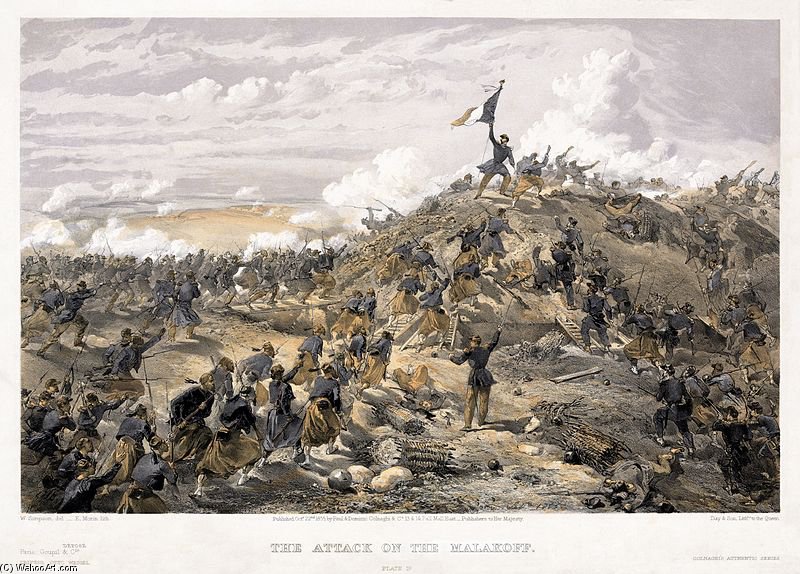
Attack On The Malakoff

Explore William Simpson’s "Attack On The Malakoff," a dynamic lithograph depicting Crimean War chaos. A detailed historical artwork showcasing realism & dramatic battle scenes.

William Simpson (1823-1899): A nagyszerű brit festő és újságíró, aki a Krím háború, India és más tájakat ábrázolt lenyűgöző vízfestményeken és litográfiaikon. Egyedi művészete a konfliktusok és kultúrák dokumentálásában tükröződik.

Vásároljon egy nagy felbontású, javított digitális képet, amely sokkal jobb minőségű, mint az online előnézet.

Minden fájlt szakembereink a legmodernebb eszközök és precíz, kézi retusálás segítségével készítenek el aprólékosan. Gondoskodunk arról, hogy minden kép kivételes tisztasággal, pontos színhelyességgel és részletgazdag finomsággal rendelkezzen.

A végleges fájl 72 órán belül e-mailben megérkezik, professzionális, szerkesztői és nyomtatási környezetbe optimalizálva az azonnali használathoz. Ez ugyanaz a minőség, amelyben a legmeghatározóbb tervezőstúdiók, kiadók és galériák is megbízhatnak.

Digitális alkotás

Töltsön le nagy felbontású fájlt személyes kiállításokhoz, nyomtatáshoz és kreatív projektekhez.

Összesen

$9.99

Minden digitális kép rendeléséhez tartozó extrák

Szakértői digitális kézbesítés, garantáltan

Amikor a WahooArt.com weboldalt választja, nem csupán egy képet kap – professzionálisan felmagasított digitális műalkotást kap, amely precizitással készült, és amelyet megelégsedési gwarancia tesz biztoslássá. Az alábbiakban automatikusan minden benne 】

shipping_icon
Gyors e-mail teslimítés

A nagy felbontású digitális képmásolatát a megrendelést követő 72 órán belül e-mailben elküldjük Önnek – azonnal használható formátumban.

canvas_icon
MI-alapú digitális feldolgozású fájl

Műve professzionális módon kerül optimalizálásra fejlett mesterséges intelligencia eszközök és manuális szerkesztés segítségével, biztosítva a maximális részletességet, tisztaságot és színpontosságot.

insurance_icon
Örök életű ingyenes újradelivery

Véletlenül törölted vagy elvesztetted a fájlodat? Ne aggódj – bármikor ingyenesen újra megküldjük neked.

tax_icon
Nincs importköltség – soha

Élvezze műalkotásait azonnal, vám, illeték vagy szállítási költség nélkül – a digitális letöltések mindig adamentesek.

color_icon
Színpontosság Garancia

Professzionális eszközök és színkezelés segítségével garantáljuk, hogy digitális képe a lehető legpontosabban tükrözze az eredeti színeket.

return_icon
60 napos elégedettségi garancia

Ha nemມີ elégedett a digitális képpel, 60 napon belül átmunkáljuk azt, vagy 100% visszatérítjük az amountot – kérdés nélkül.

guarantee_icon
100% Pénzvisszatérítési garancia

Nem érheted el a teljes elégedettséget? 60 napon belül teljes visszatérítést kapsz a digitális fájlod megérkezése után – kérdés बिना.

discount_icon
Tömegrendelési kedvezmények

Vásároljon 3 képet, spóroljon 10%-et - Vásároljon 5-öt, spóroljon 15%-et - Vásároljon 10+ képet, spóroljon 20%-at. Kiváló kreatív projektekhez, galériákhoz és ügynökségekhez.


Művész életrajza

A Life Etched in Conflict and Culture

William Simpson, a name forever intertwined with the stark realities of the Crimean War—often whispered as “Crimean Simpson”—was far more than merely a war artist. He was a visual chronicler, an intrepid observer who meticulously documented a 19th-century world undergoing profound transformation. Born into the grinding poverty of Glasgow in 1823, his journey from hardship to recognition stands as a testament not only to innate artistic talent but also to unwavering tenacity and a remarkable capacity for empathy. His early years were shadowed by a difficult family situation; an abusive and alcoholic father led him to seek refuge with his grandmother in Perth at the tender age of ten—a move that, while offering stability, curtailed formal schooling yet ignited within him a lifelong dedication to self-directed learning and a deep fascination with the world beyond Britain’s shores. This pursuit of knowledge continued through apprenticeships at the Glasgow lithographic firm of Macfarlane, an experience he later described as utterly pivotal in shaping his artistic sensibilities and understanding of visual communication, and evening studies at the Andersonian University and Mechanics' Institute—institutions that fostered a spirit of intellectual curiosity and critical thinking. These formative years laid the bedrock for a career that would seamlessly blend artistic skill with an insatiable desire to understand and represent the complexities of human experience.

Witness to War: The Crimean Revelation

The outbreak of the Crimean War in 1853 irrevocably altered Simpson’s trajectory. Initially commissioned to create a lithograph based on secondhand accounts of the Battle of Alma, his exceptional talent quickly caught the attention of Colnaghi & Son, who swiftly dispatched him directly to Crimea in November 1854. This wasn't simply about producing illustrations for publication; it was about *experiencing* the war firsthand and translating that visceral reality onto paper with painstaking detail. Simpson didn’t shy away from depicting the brutal realities of conflict—the pervasive mud, the agonizing suffering etched on the faces of exhausted soldiers, the sheer, overwhelming sense of exhaustion. His watercolors weren't romanticized visions designed to elicit patriotic fervor; rather, they were unflinching records of a truly horrific and transformative event. These images, imbued with a remarkable sense of immediacy and authenticity, were subsequently transformed into lithographs for prominent publications like *The Illustrated London News*, bringing the horrors—and occasionally, the heroism—of the Crimean War directly into British homes and shaping public opinion about the conflict. He became known as “Crimean Simpson” not just because he was present at the front lines, but because of his ability to capture the essence of the war with such startling realism and emotional depth. His work provided a crucial visual narrative during a period when much of the public’s understanding of the war remained filtered through official reports and sanitized accounts—a testament to Simpson's courage and artistic skill under immense pressure. The Seat of War in the East, his seminal series of lithographs based on these sketches, remains a landmark achievement in war reporting and visual storytelling—a powerful example of how art can bear witness to history’s darkest moments.

Beyond Crimea: India, Exploration, and Artistic Ambition

Following his distinguished service during the Crimean War, Simpson's success with *The Illustrated London News* opened doors to further assignments as a special artist and correspondent for the publication. In the late 1850s, he embarked on an extensive and profoundly enriching journey to India, documenting the aftermath of the Sepoy Revolt of 1857—a period of immense upheaval and social transformation. This expedition wasn’t merely about recording military events; it was a deep dive into Indian landscapes, culture, and daily life—an attempt to understand a civilization vastly different from his own. He captured bustling marketplaces teeming with activity, serene temples radiating an aura of spiritual devotion, majestic palaces reflecting the grandeur of Mughal architecture, and portraits of local people with remarkable sensitivity and respect. His watercolors from India reveal a nuanced understanding of the subcontinent—a far cry from the often-simplistic and colonialist depictions prevalent at the time. Simpson envisioned a comprehensive illustrated volume on India, an ambitious project that unfortunately fell through due to financial difficulties faced by Day & Son, the intended publisher. Despite this setback, his Indian watercolors remain invaluable records of a pivotal moment in British colonial history—a testament to his artistic skill and his willingness to engage with a culture he initially knew little about. He continued to travel extensively throughout Asia and beyond, documenting scenes from Russia, China, and other exotic locales, always bringing back detailed observations rendered with remarkable precision and an eye for capturing the essence of each place.

Technique and Style

Simpson’s artistic style was characterized by a meticulous attention to detail, a masterful command of watercolor techniques, and a deep understanding of light and shadow. He wasn't interested in creating idealized or romanticized representations; instead, he sought to capture the *truth* of his subjects—the grime of battlefields, the weariness of soldiers, the vibrant colors of Indian textiles. His use of color was particularly noteworthy—he employed a wide range of hues to create depth and atmosphere, often layering washes of paint to achieve subtle gradations of tone. He also demonstrated a remarkable ability to render textures—from the rough bark of trees to the smooth surface of polished armor. Simpson’s work is not simply visually appealing; it's intellectually stimulating, inviting viewers to contemplate the complexities of the subjects he depicted and the historical context in which they existed. His meticulous approach to observation and his technical skill are hallmarks of his enduring legacy as a significant Victorian artist.

Legacy and Lasting Influence

William Simpson’s legacy extends far beyond his stunning visual documentation of 19th-century events. He played a crucial role in establishing the nascent profession of the “special artist”—an embedded observer who provided firsthand, visually compelling reporting from conflict zones and distant lands. His work wasn't just art; it was journalism, history, and cultural observation all rolled into one. Simpson enjoyed the patronage of Queen Victoria herself, a remarkable testament to the esteem his artistry garnered. He was elected an associate of the Institute of Painters in Water Colours in 1874 and became a full member five years later. His detailed watercolors and lithographs continue to be studied by historians and art enthusiasts alike, offering invaluable insights into the past. He was, as some called him, a “Prince of Pictorial Correspondents,” whose work continues to resonate with audiences today—a reminder that art can serve as a powerful tool for understanding and documenting the human experience across time and cultures.

Notable Works

  • The Seat of War in the East: A seminal series of lithographs based on his Crimean sketches, offering a detailed visual record of the conflict.
  • Retreat of the Russians from Sebastopol: A powerful watercolor capturing a pivotal moment in the fall of Sevastopol, showcasing Simpson’s skill in depicting dramatic scenes.
  • Mongolia. Group Near The Great Wall Of China.: Demonstrates his ability to capture cultural exchange and landscapes with realism and romanticism.
  • Akalis at the Holy Tank, Umritsar: A vibrant depiction of Sikh devotion, rich in historical and cultural detail.
  • Camp of the Fourth Division: An evocative painting depicting a 19th-century military encampment.
Crimean Simpson

Crimean Simpson

1823 - 1899 , Egyesült Királyság

Rövid tények

  • Artistic Movement Or Style: Viktoriána
  • Artists Or Movements Influenced By This Artist: ['Egyéb információ nem található']
  • Artists Who Influenced This Artist: ['Egyéb információ nem található']
  • Date Of Birth: 1823
  • Date Of Death: 1899
  • Full Name: William Simpson
  • Nationality: Nagy-britanniai
  • Notable Artworks:
    • A Végvár a Kelet
    • Sebastopol visszavonulása
    • Mongolia a Nagy Fal közelében
    • Az Akalisok a Szent Tengelyen
    • A negyedik divízió tábora
  • Place Of Birth: Glasgow, Nagy-Britannia