Az ezen az oldalon megjelenített műalkotások szerzői jogi védelem alatt állnak, ami azt jelenti, hogy törvényileg nem készíthetünk és nem adhatunk el belőlük pontos másolatokat. Ez a védelem olyan nemzetközi megállapodások alapján érvényesül, mint például a Berni Egyezmény és a nemzeti jogszabályok által, beleértve azokat is, amelyeket meghatározott Az USA szerzői jogi törvénye – 17. cím.
Ez a módszer teljes mértékben megfelel a szerzői jogi szabályozásnak, mivel nem tartalmazza a védett műalkotás másolását vagy duplikálását. Ehelyett ez egy kreatív újinterpretáció – egy új festmény, amely az eredetivel való összefüggései miatt hatással van rá, de nem az az.
Múzeumi minőségű giclée vagy vászonnyomat, gyors gyártással és rugalmas finomítási lehetőségekkel. ( Kézzel festett másolat rendelése Áttérés digitális képre)





























Válasszon előre meghatározott méreteink közül, amelyek megfelelnek a műalkotás eredeti arányainak.

Írja be a keretének vagy a falának megfelelő szélességet és magasságot. A nyomatot csak le lehet vágni, soha nem tehető nagyobbá, mint az eredeti kép, így egy eltérő alakú méretnél a kép egy része elveszik. Mielőtt bármit kinyatintanánk, küldünk egy digitális próbamodellt jóváhagyásra. Az oldalon látható kép nem tartalmazza a valós levágást — ezt csak a próbamodell mutatja meg.
Világszerte történő kiszállítás területére mindössze 2 hét alatt, a szokásos 4-5 hét helyett. (9 november)
Syry
Reprodukció mérete
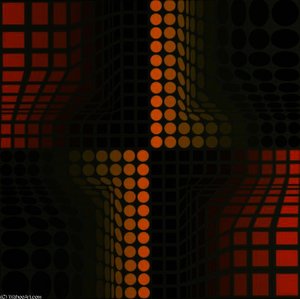
Victor Vasarely's "Syry" is not merely a painting; it’s an invitation – an invitation to question the very nature of visual perception. This vibrant artwork, dominated by a colossal sphere encircled by a constellation of smaller circles, embodies the core tenets of Op Art and represents a pivotal moment in 20th-century art history. Created by a man initially destined for a medical career, Vasarely’s journey reflects a profound fascination with geometry and its ability to manipulate our senses. Born Károly Vaszary in 1906 in Pécs, Croatia – then part of Austria-Hungary – his early life foreshadowed little of the groundbreaking artistic path he would ultimately forge. His initial studies in medicine were abruptly abandoned in favor of a pursuit far more captivating: the exploration of visual form and its impact on human perception.
Vasarely’s artistic evolution was inextricably linked to the intellectual currents of his time. His enrollment at Sándor Bortnyik’s “Műhely” workshop, profoundly influenced by the Bauhaus movement, proved instrumental. This environment fostered a deep understanding of functional design and geometric abstraction – principles that would become the bedrock of his signature style. The Bauhaus emphasis on reducing form to its essential elements—primarily lines, shapes, and colors—directly informed Vasarely’s approach. He wasn't interested in depicting recognizable objects; instead, he sought to create visual experiences that directly stimulated the viewer’s eye and challenged their assumptions about space and depth. “Syry,” with its meticulously arranged circles, is a quintessential example of this pursuit.
The creation of "Syry" exemplifies Vasarely's mastery of Op Art techniques. The large sphere, rendered in bold, contrasting colors – likely utilizing layering and glazing—appears to float within a dynamic field of smaller circles. These circles aren’t simply decorative elements; they are carefully calibrated to create an optical illusion. Through precise placement and color variations, Vasarely generates a sense of movement and depth that seems to defy the two-dimensional surface of the canvas. The technique relies heavily on the viewer's eye actively processing the visual information, creating a dynamic and shifting perception. Vasarely’s meticulous attention to detail ensures that the artwork is not static but rather an active participant in the viewing experience.
"Syry" transcends mere optical illusion; it carries symbolic weight. The sphere itself can be interpreted as representing wholeness, unity, or even the cosmos – a fundamental building block of existence. The surrounding circles evoke a sense of infinite expansion, mirroring the boundless possibilities of perception. Vasarely’s work isn't about creating beautiful images in the traditional sense; it’s about provoking thought and stimulating emotional responses through the manipulation of visual elements. The artwork’s vibrant colors and dynamic composition generate a feeling of excitement, energy, and perhaps even a slight disorientation – a deliberate effect designed to engage the viewer on a visceral level. It's a testament to Vasarely's belief that art could be both intellectually stimulating and emotionally resonant.
A "Syry" Vasarely pályájának a Op Art szakaszába tartozik. Ez a besorolás összekapcsolja a művet a művész fejlődésével.
A Op Art irányzatban a "Syry" alkotásnak Iconic népszerűségi szintje van.
A "Syry" alkotásban a Dark színek Calm érzetet kölcsönöznek.

1906 - 1997 , Kroatia

Explore the profound spiritual depth of geometric abstraction. From Malevich's Suprematism to modern masters, our expert guide reveals how pure form and color command presence in fine art collections.

Explore the profound evolution of Neo-Abstract art. Discover how bold geometric forms, vibrant chromatic depth, and tactile textures redefine modern expression for the discerning collector seeking sophisticated, high-impact masterpieces for contemporary interiors.

Discover the profound beauty of abstract art. Our expert guide explores geometric abstraction, Op Art, and Expressionism, offering connoisseurs deep insights into collecting and curating powerful, non-representational masterpieces for sophisticated interiors.
 Megtekintés
 Küldés
 Megosztás
 Részletek
 Útmutató

 Letöltés
 Hasonló darabok
 X-ray felvétel
 Diavetítés
 Kérdések és válaszok
 Statisztika

 Összes részlet megjelenítése









 Az üvegkeretes opció csak 110 cm alatti méretben érhető el