Múzeumi minőségű giclée vagy vászonnyomat, gyors gyártással és rugalmas finomítási lehetőségekkel. ( Kézzel festett másolat rendelése Kép letöltése)





























Válasszon előre meghatározott méreteink közül, amelyek megfelelnek a műalkotás eredeti arányainak.

Megadhat saját méreteket is egy konkrét kerethez vagy helyszínhez igazítva. Amennyiben a kiválasztott méret nem egyezik az eredeti kép arányokkal, a műalkotást le fogjuk vágni, vagy kiegészítjük a képet tükrözött vagy egyszínű szélekkel. A gyártás megkezdése előtt egy digitális tervezetet küldünk jóváhagyásra.
Kérjük, vegye figyelembe, hogy a képernyőn látható előnézet nem tükrözi a tényleges levágást vagy kiegészítést. Csak a tervezet mutatja pontosan a végső kompozíciót.
Bár az egyedi méretek is elérhetőek, az eredeti arányok megőrzése érdekében azt javasoljuk, hogy válasszon a előre meghatározott listából származó méretet.
Világszerte történő kiszállítás területére mindössze 2 hét alatt, a szokásos 4-5 hét helyett. (7 szeptember)


Quasar
Reprodukció mérete
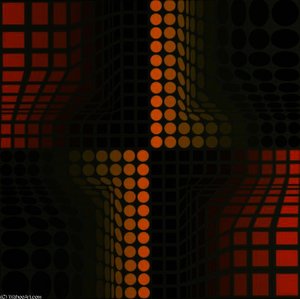
Victor Vasarely (1906-1997), a Hungarian-born artist who emigrated to France in 1938, stands as an undeniable titan amongst the pioneers of Op Art – Optical Art. This movement, flourishing in the mid-20th century, sought to challenge our fundamental understanding of visual perception by exploiting illusions created through repetitive geometric patterns. ‘Quasart,’ completed in 1966, exemplifies Vasarely’s distinctive approach perfectly: a mesmerizing circular composition dominated by interlocking triangles and squares that seem to shimmer and shift subtly as the viewer observes it.
The artwork's aesthetic is undeniably minimalist yet profoundly complex. Vasarely meticulously crafted ‘Quasart’ using acrylic paint on canvas, applying a technique known as “polygonal abstraction.” This method involved layering multiple overlapping geometric shapes – primarily equilateral triangles and squares – to generate an illusion of movement and depth without any actual physical distortion. The artist's systematic approach was rooted in mathematical principles; Vasarely believed that geometry could unlock the secrets of consciousness itself.
Historically, Op Art emerged from a confluence of influences including Bauhaus design philosophy and developments in psychoanalysis concerning Gestalt theory. Gestalt psychology posits that our brains actively organize visual information into meaningful patterns rather than passively receiving it as individual elements. Vasarely skillfully harnessed this concept to create artworks that stimulate the viewer’s senses and provoke contemplation about how we perceive reality.
Beyond its technical brilliance, ‘Quasart’ carries a symbolic resonance reflecting Vasarely's fascination with cosmic order and universal harmony. The circular form itself represents wholeness and infinity—ideas central to many spiritual traditions. Furthermore, the repetition of geometric shapes symbolizes stability and rhythm, mirroring the underlying structure of the universe as envisioned by scientists of the time.
The emotional impact of ‘Quasart’ is subtle yet powerful. It invites viewers into a meditative state, encouraging them to consider the interplay between perception and reality. The artwork's hypnotic visual qualities transcend mere decoration; it prompts introspection and stimulates an awareness of the beauty inherent in mathematical precision.

1906 - 1997 , Kroatia

Explore the mesmerizing world of Victor Vasarely. Discover how his Bauhaus-inspired Op Art masters the science of perception through geometric abstraction and vibrant color. A sophisticated guide for discerning art collectors seeking to understand the legacy of optical illusion.

Embark on a visual journey through the mesmerizing world of Op Art. Discover the masters of optical illusion, explore geometric abstraction, and learn how to curate high-impact kinetic works for your private collection with expert guidance from art professionals.

Explore the profound world of optical art and masterpieces that redefine perception. From Vasarely’s geometric illusions to Farndon’s sensory reality, discover how legendary works challenge the eye and transform the viewer's experience through sophisticated abstraction.

Explore the profound spiritual depth of geometric abstraction. From Malevich's Suprematism to modern masters, our expert guide reveals how pure form and color command presence in fine art collections.

Discover the profound beauty of abstract art. Our expert guide explores geometric abstraction, Op Art, and Expressionism, offering connoisseurs deep insights into collecting and curating powerful, non-representational masterpieces for sophisticated interiors.

 Megtekintés
 Küldés
 Megosztás
 Részletek

 Letöltés
 Hasonló darabok
 X-ray felvétel
 Diavetítés
 Összes részlet megjelenítése







 Az üvegkeretes opció csak 110 cm alatti méretben érhető el