A Dance of Circles: Exploring Victor Vasarely’s “Dia-Or”
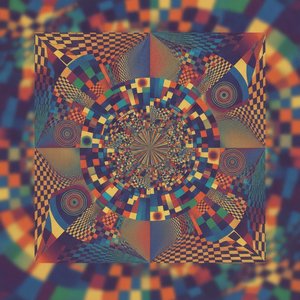
Victor Vasarely's "Dia-Or" is not merely a painting; it’s an invitation into the very fabric of perception. This captivating work, rendered in oil with meticulous attention to detail, embodies the core principles of Op Art – Optical Art – a movement that sought to challenge our understanding of how we see and experience the world. The image itself presents a mesmerizing arrangement: a dominant yellow circle, encircled by an intricate network of smaller circles, creating a visual effect reminiscent of both a honeycomb and a swirling swarm of bees. This duality speaks directly to Vasarely’s fascination with the relationship between order and chaos, a central theme throughout his career.
The Genesis of Geometric Abstraction
Born in 1906 in Pécs, Croatia – then part of Austria-Hungary – Károly Vaszary, as he was initially known, embarked on an extraordinary artistic journey. Initially drawn to medicine, he ultimately abandoned this path for the burgeoning world of painting in 1927, a decision profoundly shaped by his studies at the Podolini-Volkmann Academy and, crucially, Sándor Bortnyik’s “Műhely” workshop. This environment, steeped in the influence of the Bauhaus movement, instilled within him a rigorous approach to geometric abstraction – a deliberate exploration of form and its impact on visual perception. Vasarely wasn't simply creating pretty pictures; he was conducting an experiment with light, color, and the human eye.
Op Art: A Revolution in Visual Experience
"Dia-Or" is a quintessential example of Op Art’s revolutionary approach. Developed in the 1960s, this movement sought to create illusions of depth, movement, and vibration through purely abstract geometric forms. Vasarely, along with artists like Bridget Riley and Josef Albers, pioneered techniques that manipulated our visual system, exploiting optical effects to generate a dynamic and engaging experience for the viewer. The meticulous layering of circles in "Dia-Or" exemplifies this technique – each element contributes to the overall illusion, drawing the eye across the canvas in a constant state of subtle movement.
Symbolism and Emotional Resonance
While ostensibly abstract, “Dia-Or” resonates with deeper symbolic meanings. The circle itself is a universal symbol representing wholeness, unity, and eternity – concepts frequently explored by Vasarely. The surrounding smaller circles suggest interconnectedness, dynamism, and the constant flux of visual information. The vibrant yellow hue adds to the painting’s intensity, evoking feelings of energy, optimism, and perhaps even a sense of controlled chaos. This piece isn't just visually stimulating; it invites contemplation on the nature of perception itself.
Kérdések és válaszok
Ajánlott-e ajándékba „Dia-Or”, Vasarely alkotása, és kinek?
A „Dia-Or”, Vasarely alkotása ajándékajánlata ötvözi a Wedding lehetőséget a Accent céljával.
Hogyan építhető be „Dia-Or”, Vasarely alkotása a lakberendezésbe?
A "Dia-Or" művet Accent célokra javasoljuk, a legalkalmasabb helyszín pedig egy Living Room.
Milyen tónus felé hajlik a "Dia-Or"?
A „Dia-Or”, Vasarely alkotása domináns színe a Ochre to Sepia. Ez a szín a paletta alapvető tónusa.



 Megtekintés
 Váltás nyomtatványra
 Küldés
 Megosztás
 Részletek
 Útmutató

 Letöltés
 Hasonló darabok
 X-ray felvétel
 Diavetítés
 Q&A
Q&A Statisztika

 Összes részlet megjelenítése






































 Az üvegkeretes opció csak 110 cm alatti méretben érhető el