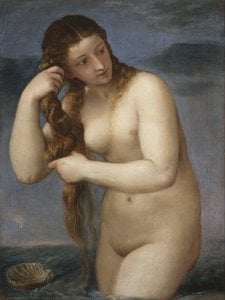
A Rediscovered Renaissance in American Art: Titian Ramsay Peale II’s “St Luke”
Emerging from the shadow of his celebrated father, Charles Willson Peale, and a lineage steeped in artistic endeavor, Titian Ramsay Peale II presents us with a quietly compelling work in “St Luke.” This painting isn't merely a depiction of the Gospel writer; it’s a testament to Peale II’s dedication to the High Renaissance aesthetic, a style he embraced with meticulous precision. The image centers on a man, clearly identified as St. Luke through historical context and artistic convention, holding a book – a symbol of knowledge, faith, and the written word itself. His gaze is direct, almost stern, conveying a sense of solemn responsibility and intellectual weight. The artist’s handling of light and shadow imbues the figure with a sculptural quality, reminiscent of masters like Raphael or Leonardo da Vinci, whom Peale II clearly admired.
Symbolism and Spiritual Resonance
Beyond the straightforward portraiture, “St Luke” is rich in subtle symbolism. The book held so close to his chest isn’t simply an attribute; it represents the very foundation of Christian doctrine, a treasure guarded with reverence. The inclusion of two sheep – one positioned near the upper left corner and another towards the bottom right – adds layers of meaning. In Christian iconography, sheep often symbolize followers or humanity guided by faith, subtly linking St. Luke not only to the act of writing but also to his role as a shepherd of souls. The overall composition isn’t flamboyant; it's deliberately restrained, fostering an atmosphere of contemplation and reverence. Peale II wasn’t aiming for dramatic spectacle but rather for a quiet, profound spiritual resonance.
Technique and Artistic Lineage
Titian Ramsay Peale II demonstrated a mastery of oil painting techniques inherited from his father and refined through dedicated study. The smooth application of paint, the careful modeling of form, and the nuanced use of color all point to an artist deeply versed in classical principles. While details regarding the specific size and materials remain unknown, it’s evident that Peale II prioritized precision and detail. His work stands apart from the more flamboyant Romantic styles gaining prominence during his lifetime; he remained steadfastly committed to the clarity, balance, and idealized forms of the Renaissance. This dedication positions him as a fascinating figure – an artist seemingly out of time, yet creating works of enduring beauty and spiritual depth.
A Legacy Rediscovered
For many years, Titian Ramsay Peale II remained somewhat overlooked in art historical narratives. However, recent scholarship has begun to illuminate his significant contributions, recognizing him not only as a skilled painter but also as a dedicated naturalist and explorer – a true Renaissance man in the American context. “St Luke” serves as an excellent example of his artistic prowess, offering a glimpse into a world where faith, intellect, and artistic skill converged. A reproduction of this work would bring a sense of quiet dignity and timeless beauty to any space, inviting contemplation and serving as a reminder of the enduring power of art and belief.



 Megtekintés
 Kézzel festett másolat rendelése
 Küldés
 Megosztás
 Részletek

 Letöltés
 Hasonló darabok
 X-ray felvétel
 Diavetítés
 Statisztika


 Összes részlet megjelenítése






































 Az üvegkeretes opció csak 110 cm alatti méretben érhető el