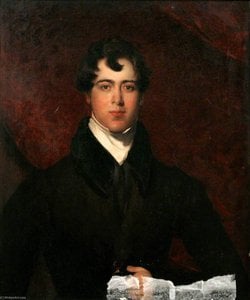
A művész életrajza
Early Life and Artistic Foundations
Thomas Phillips, born in Dudley, Worcestershire, in 1770, emerged from relatively modest beginnings to become a prominent figure in the British art scene of the late 18th and early 19th centuries. His initial artistic training wasn’t within the traditional confines of painting, but rather in the craft of glass-painting under Francis Eginton in Birmingham. This foundational experience instilled in him a meticulous attention to detail and an understanding of color and light that would later characterize his portraiture. The intricate patterns and vibrant hues he learned while working with stained glass undoubtedly shaped his visual sensibilities and his ability to render subtle tonal variations – skills that proved invaluable when capturing the nuances of human expression. A pivotal moment arrived in 1790 when Phillips journeyed to London, armed with an introduction to Benjamin West, a leading artist of the time and a key figure in the Royal Academy. West’s guidance opened doors for Phillips, securing him employment on the painted-glass windows of St George's Chapel at Windsor Castle – a project that allowed him to hone his skills within a grand architectural context. The scale of this undertaking demanded precision and an understanding of how light interacted with color across vast surfaces, further refining his technical abilities. This early exposure to large-scale decorative work undoubtedly shaped his compositional sensibilities and appreciation for narrative storytelling in art. In 1791, Phillips formally enrolled as a student at the Royal Academy, marking the beginning of his formal artistic education and his integration into the established art world.
A Rising Portraitist: Style and Subject Matter
Phillips quickly found his niche in portraiture, though not without navigating a competitive landscape already populated by renowned artists like Thomas Lawrence and John Hoppner. Initially, his sitters were largely unknown individuals – tradesmen, clergymen, and members of the gentry who sought to immortalize their likenesses on canvas. However, through dedication and skill, he steadily ascended the social ladder, attracting increasingly prominent figures to his studio. His style was characterized by a meticulous realism, reflecting both the influence of his early training in glass-painting and the prevailing artistic tastes of the era. He possessed an ability to capture not just physical likeness, but also something of the sitter’s character and intellect – a subtle suggestion of their personality that went beyond mere representation. This talent proved particularly valuable when portraying the “men of genius” – scientists, writers, poets, and explorers – who became a recurring theme in his work. He wasn't merely replicating appearances; he was attempting to distill the essence of his subjects onto the canvas, conveying their intellect, ambition, and perhaps even their inner turmoil. His portraits were often imbued with a quiet dignity and an air of contemplative seriousness, reflecting the intellectual currents of the Romantic era.
Royal Patronage and Academic Recognition
The year 1804 marked a significant turning point in Phillips’ career with his election as an associate of the Royal Academy, alongside William Owen. This recognition solidified his position within the artistic establishment and signaled a shift towards greater public acclaim. Shortly thereafter, he relocated to 8 George Street, Hanover Square, a prestigious address that would remain his home and studio for the next four decades – a location synonymous with success and refinement. His clientele continued to expand, encompassing members of the royal family, including Prince Frederick (later King William IV), as well as prominent figures from the world of politics, literature, and science. He painted portraits of the Prince of Wales (later George IV), the Marchioness of Stafford, and Lord Thurlow, among others – each portrait a testament to his skill and his ability to capture the essence of his subjects. A particularly celebrated portrait from this period is that of William Blake, now housed in the National Portrait Gallery – a work admired for its sensitive depiction of the poet’s intense gaze and visionary spirit. The painting captures not just Blake's physical appearance but also something of his restless intellect and spiritual intensity. In 1808, Phillips achieved full academician status, presenting his diploma work *Venus and Adonis*, considered one of his most imaginative compositions, demonstrating a departure from purely portraiture into more ambitious narrative painting. The mythological subject matter allowed him to explore themes of beauty, desire, and the power of nature – subjects that resonated deeply with the artistic sensibilities of the time.
Later Years: Professorship and Legacy
Phillips’s contributions to the art world extended beyond his own paintings. In 1825, he was appointed Professor of Painting at the Royal Academy, succeeding Henry Fuseli – a position he held until 1832. This role allowed him to share his knowledge and expertise with aspiring artists, shaping the next generation of British painters. He published *Lectures on the History and Principles of Painting* in 1833, offering insights into his artistic philosophy and pedagogical approach. His lectures were highly regarded for their clarity and erudition, reflecting a deep understanding of art history and technique. Despite a slight decline in public acclaim during his later years, Phillips remained a respected figure within the art community until his death in 1845. His legacy lies not only in the numerous portraits he created – capturing the likenesses of many notable figures of his time – but also in his dedication to artistic education and his contribution to the development of British portraiture. He left behind a body of work that reflects both the technical skill and the intellectual curiosity of an artist deeply engaged with the cultural landscape of his era. His attention to detail, combined with a sensitivity to character, ensures his place as a significant figure in 19th-century British art.



 Előnézet
 Kézzel festett másolat vásárlása
 Megosztás
 Megosztás
 Részletek
 Útmutató

 Letöltés
 Hasonló darabok
 X-ray felvétel
 Diavetítés
 Statisztika


 Tovább olvasom






































 Az üvegkeretes opció csak 110 cm alatti méretben érhető el