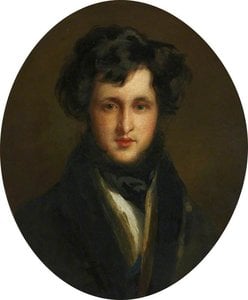
The Romantic Vision of Robert Scott Lauder
In the heart of nineteenth-century Edinburgh, a period defined by a profound reverence for heritage and the sweeping emotions of the Romantic movement, Robert Scott Lauder emerged as a vital voice in Scottish art. Born on June 25, 1803, at Silvermills, Lauder was the son of John Lauder, a respected proprietor of a local tannery. His upbringing in a prominent Edinburgh family provided him with a foundation of stability and cultural access that would eventually propel him toward the heights of academic recognition. While his early life was rooted in the industrious landscape of Scotland, his artistic soul was destined for the grander stages of Europe, seeking to translate the dramatic literary spirit of his era into enduring visual narratives.
Lauder’s intellectual formation began at the Royal High School, but it was his subsequent travels that truly refined his aesthetic sensibilities. Seeking to master the complexities of light and form, he immersed himself in the great artistic hubs of the continent, including Rome, Florence, Bologna, Venice, and Munich. These extended periods of study abroad allowed him to absorb the classical traditions of Italy and the rigorous academic techniques of Germany, blending them with a uniquely Scottish sensibility. This cosmopolitan education prepared him for his pivotal moment in 1830, when he was elected as one of the original members of the Royal Scottish Academy, a distinction that solidified his status among the intellectual and artistic elite of his nation.
Narratives of Legend and Literature
The true essence of Lauder’s work lies in its deep, symbiotic relationship with the literature of Sir Walter Scott. As the novelist’s tales of chivalry, tragedy, and national identity captured the Victorian imagination, Lauder sought to give these words a physical, painterly presence. He did not merely illustrate stories; he attempted to capture the very atmosphere of Scott's romanticized history. His canvases often serve as windows into a bygone era, where the boundaries between historical fact and poetic myth become beautifully blurred.
His oeuvre is marked by several monumental achievements that showcase his ability to handle grand-scale drama:
- The Poet: A poignant portrait of Sir Walter Scott himself, which transcends simple likeness to capture an aura of profound intellectual contemplation and the weight of a literary legacy.
- The Shepherd Boy: A tender and evocative scene drawn from the world of Ivanhoe, demonstrating his ability to find the sublime within intimate, genre-driven moments.
- The Battle of Flodden Field: One of his most ambitious works, this painting depicts the historic Scottish defeat with a mastery of dramatic lighting and expressive movement, embodying the tragic grandeur of Scotland's past.
Technique, Legacy, and the Romantic Spirit
To observe a Lauder painting is to witness the tactile power of the impasto technique. He favored a thick, vigorous application of paint, which allowed him to manipulate light and shadow in a way that heightened the emotional stakes of his subjects. This textured approach lent a sense of immediacy and life to his historical scenes, making the dust of battle or the soft glow of a pastoral afternoon feel palpable to the viewer. His brushwork was never merely decorative; it was an expressive tool used to convey the turbulent emotions central to the Romantic movement.
Beyond his technical prowess, Lauder’s significance resides in his role as a bridge between the classical traditions of the past and the burgeoning national identity of Scotland. Through his dedication to historical painting, he helped codify a visual language for Scottish heroism and romanticism. Though he passed away in 1869, leaving behind a legacy intertwined with the very fabric of the Royal Scottish Academy, his ability to breathe life into the legends of Sir Walter Scott ensures that his work remains a captivating testament to the power of the imagination.



 Megtekintés
 Váltás nyomtatványra
 Küldés
 Megosztás
 Részletek
 Útmutató

 Letöltés
 Hasonló darabok
 X-ray felvétel
 Diavetítés
 Statisztika

 Összes részlet megjelenítése