A Glimpse into Renaissance Nobility: Raphael’s Portrait of a Man (1502)
Raphael Sanzio da Urbino, known to the world as Raphael (RAF-ay-əl), stands as one of the titans of the High Renaissance—a period defined by an astonishing revival of classical ideals and a fervent pursuit of harmony, clarity, and idealized beauty. His *Portrait of a Man*, completed in 1502, embodies this spirit perfectly, residing within the hallowed halls of the Galleria Borghese in Rome and radiating an aura of quiet dignity that continues to captivate viewers centuries later.
Measuring just 45 x 31 cm, this oil on panel is more than merely a likeness; it’s a masterful distillation of humanist thought and artistic innovation. Raphael's skill lies not only in capturing the physical appearance of his subject but also in conveying an inner life—a contemplative gaze that speaks volumes about intellect and composure.
The Artist at the Height of His Early Promise
Born in Urbino in 1483, Raphael ascended rapidly to prominence amidst a vibrant cultural landscape shaped by Federico da Montefeltro’s court. This environment fostered an appreciation for literature alongside art, nurturing Raphael's formative years and instilling him with the refined manners considered essential by Baldassare Castiglione—whose *Book of the Courtier* became a seminal text documenting the virtues of Renaissance nobility.
Before achieving fame for his monumental frescoes in Vatican City, Raphael honed his craft through portraiture, demonstrating an exceptional ability to translate psychological depth onto canvas. His early training under Pietro Perugino instilled him with techniques that would inform his subsequent artistic endeavors—a legacy evident throughout his oeuvre.
Decoding the Portrait: Subject & Style
The sitter is depicted from the chest up, presenting a direct and unwavering gaze toward the viewer. He wears a dark black shirt accented by a striking black hat adorned with white feathers—a fashion statement reflecting the status of his era. Raphael’s stylistic approach—characterized by *sfumato*, a technique he adopted from Leonardo da Vinci—employs subtle gradations of light and shadow to soften contours and create an ethereal quality, lending the subject an almost palpable presence.
This masterful blending is further enhanced by meticulous modeling of the face—particularly around the eyes and mouth—revealing Raphael’s profound understanding of anatomy and illumination. The restrained palette—dominated by blacks, creams, and golds—contributes to the portrait's solemn mood and underscores its timeless elegance.
Technique & Materials: A Renaissance Masterclass
Raphael’s painstaking technique is evident in the layering of thin glazes of oil paint on panel—a process that demanded considerable patience and precision. This meticulous approach allowed him to build up color and form gradually, achieving remarkable depth and luminosity. The subtle modeling of facial features—particularly around the eyes and mouth—demonstrates Raphael's mastery of anatomy and light.
The inclusion of accessories like the gold chain wasn’t merely decorative; it served as a symbol of wealth and social standing—a conscious reflection of the sitter’s position within Venetian society. Consider also Raphael’s *Portrait of Agnolo Doni*, which showcases similar chiaroscuro techniques and a focus on psychological realism.
Symbolism & Historical Context
While the identity of the sitter remains debated among scholars, the portrait undeniably speaks to the burgeoning humanist ideals of the Renaissance. The man’s gaze conveys intelligence and self-assurance—qualities valued by intellectuals and artists alike. Comparing this work to other Raphael portraits—such as those of *Baldassare Castiglione*, *Francesco del Monte*, or even *Portrait of Pope Julius II*—reveals a consistent interest in portraying individuals who embody the cultural currents of their time.
The influence of Hans Holbein the Younger’s portraiture is palpable, particularly in the careful rendering of detail and the use of perspective. Raphael's artistic vision aligns with the broader Renaissance preoccupation with capturing human beauty and intellect—a legacy that continues to inspire artists today.
Emotional Resonance & Lasting Appeal
This portrait transcends its historical context, offering a timeless meditation on human character and the enduring power of art. The sitter’s quiet dignity, combined with Raphael’s unparalleled technical skill—particularly his mastery of *sfumato*—evokes a sense of contemplation and respect.
WahooArt.com offers exquisite handmade oil painting reproductions of this masterpiece. Experience the beauty and sophistication of Raphael’s *Portrait of a Man* in your home or office. A stunning addition to any collection, it's an investment in artistry and history.
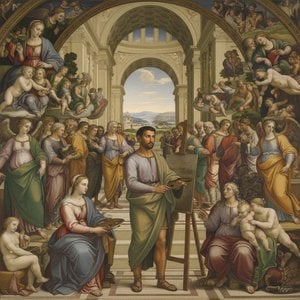
Photo Description: --Overall Impression-- The artwork is a portrait of a man depicted in a realistic style reminiscent of the Italian Renaissance. It’s a close-up view focusing primarily on his face and upper torso, set against a muted, indistinct background suggesting an outdoor setting. The composition is centered around the subject's head and shoulders, creating a direct and intimate connection with the viewer. The lighting appears to be soft and diffused, illuminating the man’s features while maintaining a sense of depth through subtle shading. Lines are used to define the contours of his face, hair, and clothing, contributing to the realistic depiction. Shapes are predominantly organic – the curves of his face, the folds in his hair, and the form of his hat. The texture appears slightly rough and layered, indicative of oil paint application. The color palette is dominated by browns, blacks, and creams, creating a somber and contemplative mood. Perspective is shallow, focusing on the immediate foreground. Depth is suggested through subtle gradations of tone rather than dramatic atmospheric effects. The subject matter is a single individual, presented with dignity and seriousness. Symbolically, the portrait likely represents wealth, status, or perhaps simply an attempt to capture the likeness of a prominent figure. The style aligns with Early Renaissance portraiture, emphasizing naturalism and human form.
Size: 45 x 31 cm
Date: 1502
Gyakran Ismételt Kérdések
Milyen színpaletta jellemzi a(z) „Raphael”, Raffaello Sanzio alkotása alkotást?
A „Raphael”, Raffaello Sanzio alkotása egy Földszínek színpalettát használ. A paletta összefoglalja a mű egészében megnyilvánuló színes karaktert.
Milyen technikával készült a(z) „Raphael”, Raffaello Sanzio alkotása?
Raffaello Sanzio a Olajfestmény panelre technikát alkalmazta a "Raphael" alkotáshoz. A technika határozza meg az eredeti mű anyagösszetételt.
Hol tekinthető meg az eredeti „Raphael”, Raffaello Sanzio alkotása?
A „Raphael”, Raffaello Sanzio alkotása eredeti darabja a Galleria Borghese, Rome, Italy gyűjteményében található. A reprodukció lehetővé teszi, hogy a mű otthonában is megjelenjen.



 Előnézet
 Kézzel festett másolat vásárlása
 Megosztás
 Megosztás
 Részletek
 Útmutató

 Letöltés
 Hasonló darabok
 X-ray felvétel
 Diavetítés
 Statisztika


 Tovább olvasom






































 Az üvegkeretes opció csak 110 cm alatti méretben érhető el