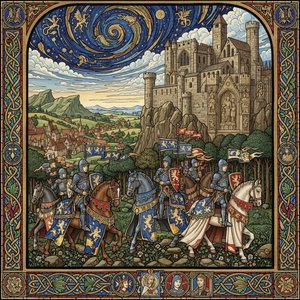
Pierre Révoil: The Romantic Echoes of the Middle Ages
Born in Lyon, France, in 1776, Pierre Henri Révoil’s life was a testament to perseverance and a deep-seated fascination with a bygone era. His father, a humble furrier, recognized his son's artistic potential, defying societal expectations to provide him with an education that extended beyond the practicalities of the trade. This early encouragement laid the foundation for a career dedicated to reviving the romanticized world of the Middle Ages – a period he would come to define through his distinctive “Troubadour Style.” Révoil’s journey was not without its hardships; poverty forced him into temporary employment as a wallpaper manufacturer, yet his determination and talent ultimately led him to the prestigious studios of Jacques-Louis David at the École des Beaux-Arts in Paris.
Initially drawn to the elegance of Greek vase paintings, Révoil quickly developed a passion for historical subjects. He found himself captivated by scenes of revolution, capturing their drama and intensity with remarkable skill. However, it was his exploration of medieval history that truly ignited his artistic spirit. He deliberately chose this subject matter, recognizing a growing public interest in the past and seeking to imbue these narratives with emotional resonance. This shift marked the beginning of what would become his signature style – a romanticized depiction of chivalry, courtly love, and heroic deeds, often imbued with a sense of melancholy and nostalgia.
The Troubadour Style and Artistic Development
Révoil’s “Troubadour Style” is characterized by its dramatic lighting, rich colors, and meticulously rendered details. He eschewed the rigid formality of Neoclassicism in favor of a more expressive and emotionally charged approach. His compositions are often dynamic, filled with movement and gesture, reflecting the energy and excitement of the historical events he depicted. He wasn’t simply recreating history; he was interpreting it through a romantic lens, imbuing his subjects with a sense of timeless beauty and moral significance. This style resonated particularly well with the burgeoning Romantic movement, which emphasized emotion, imagination, and individualism.
His early works, such as “The Tournament,” exemplify this approach perfectly. The painting depicts the climactic moment of a legendary tournament, capturing the tension, drama, and heroic spirit of the scene. The meticulous detail in the armor, the expressive faces of the knights, and the dynamic composition all contribute to the painting’s powerful impact. This work, now housed at the Museum of Fine Arts of Lyon, stands as a cornerstone of his oeuvre and a prime example of the Troubadour Style.
A Collector and Educator
Beyond his artistic output, Révoil cultivated an extraordinary personal museum within his own home. By 1811, he had amassed a vast collection of medieval armor, chests, vases, wall hangings, paintings, and manuscripts – a testament to his deep fascination with the Middle Ages. This collection wasn’t merely decorative; it served as a vital teaching tool for his students at the École des Beaux-Arts de Lyon. He meticulously curated this space, arranging the artifacts in a way that illuminated their historical context and artistic significance. The Magasin encyclopédique described his museum with great detail, highlighting its importance as a resource for art education.
Furthermore, Révoil expressed himself through medieval-style chansons – lyrical poems set to music – which gained popularity in the Lyon region. This demonstrated a desire to engage with and celebrate the culture he so passionately depicted in his paintings. His dedication extended beyond the purely artistic; he sought to immerse himself fully within the world of his subject matter.
Political Shifts and Legacy
The Napoleonic era brought significant political upheaval, and Révoil’s allegiance shifted with the times. He initially celebrated Napoleon's rebuilding efforts in Lyon, culminating in the allegorical drawing “Napoleon Rebuilding the Town of Lyon.” However, following the fall of the First Empire, he rallied to the cause of the Restoration and tragically destroyed his painting depicting Napoleon – a poignant act reflecting the turbulent political climate. Later, he married and moved to Provence, eventually returning to Lyon and serving as Director of the École until 1830.
Despite facing personal hardships in his later years, including financial struggles and the loss of his collection during the July Revolution, Révoil’s influence on French art remains significant. He played a crucial role in reviving interest in medieval history and establishing the Troubadour Style, which would inspire generations of artists. His work continues to be studied and admired for its romanticism, historical detail, and evocative power. He died in Paris in 1842, leaving behind a legacy as one of France’s most distinctive Romantic painters.



 Előnézet
 Kézzel festett másolat vásárlása
 Megosztás
 Megosztás
 Részletek
 Útmutató

 Letöltés
 Hasonló darabok
 X-ray felvétel
 Diavetítés
 Statisztika


 Tovább olvasom






































 Az üvegkeretes opció csak 110 cm alatti méretben érhető el