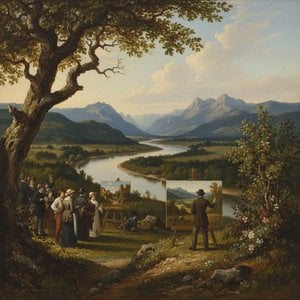
A Life Dedicated to the Northern School: The World of Jean-Baptiste Pierre Le Brun
Jean-Baptiste Pierre Le Brun (1748 – 1813) wasn’t a name etched in the annals of artistic creation, yet his influence on the landscape of 18th and early 19th century French art was profound. He wasn't a painter himself, but rather a remarkably astute dealer, a connoisseur of unparalleled depth, and ultimately, the architect who brought the vibrant world of the Northern School – encompassing Flemish, Dutch, and German masters – to the heart of Parisian society. Born into an established art trade family, Le Brun’s life was inextricably linked to the movement he so diligently championed, shaping its reception and solidifying its legacy through his astute dealings and meticulously compiled catalogues. His story is one of a man perpetually caught between a desire for artistic creation and the pragmatic realities of running a thriving business, a duality that profoundly informed his approach to art history and trade.Early Years and Family Legacy
Le Brun’s lineage was steeped in the world of art. His father, Pierre Le Brun (c. 1700 – 1771), was a respected dealer and painter himself, carrying on a family tradition that stretched back to his grandfather, Charles Le Brun (1619–1690), the *premier peintre du Roi* under Louis XIV. This familial connection provided Le Brun with an invaluable education in the intricacies of the art market – not just the mechanics of buying and selling, but also the subtle nuances of connoisseurship and the importance of provenance. Crucially, however, it also meant that young Jean-Baptiste was largely sidelined from pursuing his own artistic ambitions. His father’s business demanded his attention, effectively curtailing his early aspirations to become a painter. This enforced apprenticeship, while initially frustrating, ultimately instilled in him an intimate understanding of the art world – a knowledge far exceeding that of most contemporary dealers. He accompanied his father on numerous trips north, immersing himself in the collections and workshops of the masters he would later champion.The Rise of a Connoisseur: Catalogues and the Northern School
Le Brun’s true contribution to art history lies in his groundbreaking catalogues – particularly *La Galerie des peintres flamands, hollandais et allemands* (1792-1796). This monumental work wasn't simply a record of artworks available for sale; it was a meticulously researched and beautifully illustrated survey of the Northern School’s artistic development. He didn’t merely list paintings; he analyzed their stylistic evolution, tracing influences from Italian Renaissance masters to contemporary trends. Le Brun elevated the status of these often-overlooked artists – Jan Brueghel the Elder, Peter Paul Rubens, Rembrandt van Rijn – by providing a comprehensive and accessible narrative that brought them into the mainstream of French artistic discourse. His catalogues were revolutionary in their approach, shifting the focus from individual names to broader aesthetic categories and emphasizing the historical context of each work.Innovations in Art Trade and International Connections
Le Brun’s business acumen was as remarkable as his scholarly pursuits. He recognized that simply displaying paintings wasn't enough; he understood the importance of establishing their value and promoting them to a wider audience. He pioneered techniques for maximizing profits, optimizing auction operations, and presenting art not just as objects of beauty but also as investments. His catalogues, by highlighting earlier sales results, instilled confidence in collectors and encouraged them to acquire Northern School paintings with the assurance that they were making sound financial decisions. Furthermore, Le Brun expanded the scope of his trade beyond France, establishing connections with dealers and collectors across Europe – a significant step in disseminating the art of the Northern School throughout the continent. He essentially created a network that facilitated the international exchange of art, transforming it from a largely localized phenomenon into a truly global market.Legacy and Historical Significance
Jean-Baptiste Pierre Le Brun’s legacy is complex yet undeniably significant. He never painted himself, yet he profoundly shaped the perception and appreciation of the Northern School in France. His catalogues served as a vital bridge between generations of artists and collectors, ensuring that the works of these masters were not forgotten. He elevated the status of dealers from mere merchants to informed cultural commentators, demonstrating their crucial role in shaping artistic taste and disseminating knowledge. While he may have initially regretted sacrificing his own artistic ambitions, Le Brun’s dedication to understanding and promoting the art of the Northern School ultimately cemented his place as a pivotal figure in 18th and early 19th century French art history – a testament to the power of informed trade and passionate connoisseurship.Questions & Answers
How do I find works by Carlos Morel on a specific theme?
Carlos Morel's works can be explored by keyword on the artist's By Keywords page. Each keyword groups the related artworks.
Where is Carlos Morel from?
Carlos Morel was born in Argentina.
Can I browse Carlos Morel's works by movement?
The movements Carlos Morel worked in can be seen on the artist's All Movements page, which groups the artworks by movement.