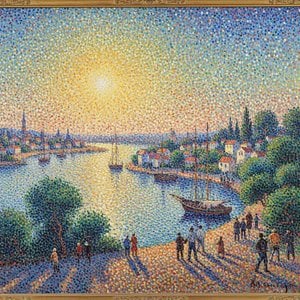
The Harmonious Vision of Paul Signac
Paul Victor Jules Signac, born in Paris in 1863, emerged as a pivotal figure in the evolution of modern art, inextricably linked to the birth and development of Neo-Impressionism. His early life, marked by a privileged upbringing within a successful merchant family, provided him with both financial security and exposure to the cultural elite of the time. However, it was a youthful encounter with Claude Monet’s exhibition in 1880 that truly ignited his artistic passion, setting him on a path far removed from the expected trajectory of a young man from a wealthy background. This initial fascination with Impressionism sparked a lifelong exploration of light, color, and the very science underpinning visual perception – a pursuit that would ultimately define his unique contribution to the art world. Signac wasn’t merely a painter; he was a dedicated explorer, driven by an insatiable curiosity about how we perceive the world around us.
A Dialogue with Seurat and the Birth of Neo-Impressionism
The meeting between Signac and Georges Seurat in 1884 proved transformative for both artists. They shared a deep admiration for Eugène Delacroix’s writings on color theory, particularly his exploration of complementary contrasts and the emotional impact of hue. This intellectual kinship fueled a rigorous investigation into these principles, leading them to develop a revolutionary painting technique – Pointillism. Signac wholeheartedly embraced Seurat's vision, abandoning the fleeting brushstrokes of Impressionism for the precise, calculated application of tiny, distinct dots of pure color intended to blend optically in the viewer’s eye. This wasn’t simply about aesthetics; it was an attempt to systematize painting, grounding it in scientific principles and challenging conventional artistic norms. The core idea was that by applying small strokes of complementary colors side-by-side, the human eye would naturally mix them, creating a richer, more vibrant image than could be achieved with traditional brushwork.
Boulevard de Clichy (1886) stands as an early and remarkably successful testament to this new approach, showcasing Signac’s meticulous style and his commitment to capturing the vibrancy of urban life through a scientific lens – a deliberate departure from the subjective impressions favored by many Impressionists. Their collaboration wasn't merely technical; it was intellectual, fueled by a shared desire to elevate painting to the level of a rigorous science.
Coastal Reveries and Artistic Independence
Following Seurat’s tragic early death in 1891, Signac continued to develop his artistic vision, deeply influenced by his profound love for sailing and the allure of the Mediterranean coast. He discovered Saint-Tropez in 1892, establishing a home there that became a haven for artists and a source of endless inspiration. The shimmering waters, sun-drenched harbors, and picturesque coastal towns provided an ideal setting to explore the interplay of light and color. *The Red Buoy, Saint-Tropez* (1895) exemplifies this period, showcasing his mastery of Pointillism in capturing the vibrant hues and dynamic energy of the sea. He experimented with larger brushstrokes and a broader palette, moving beyond strict adherence to Seurat’s precise dotting method, incorporating elements of Impressionistic spontaneity into his technique. His travels extended beyond France, encompassing Italy, Holland, and even Constantinople, each journey enriching his artistic vocabulary and broadening his perspective – he meticulously documented these experiences in watercolor notebooks, capturing the essence of each location through rapid sketches and washes of color.
A Patron of the Avant-Garde and Lasting Legacy
Beyond his own prolific output, Signac played a crucial role in fostering the development of modern art through his leadership within the Société des Artistes Indépendants. As president from 1908 until his death in 1935, he championed artistic freedom and provided a platform for emerging talents, including Henri Matisse, André Derain, and other pioneers of Fauvism and Cubism. He was among the first to recognize and support their groundbreaking work, exhibiting controversial pieces that challenged conventional aesthetic norms – often defying established tastes and pushing the boundaries of artistic expression. Signac’s commitment to inclusivity and his willingness to embrace innovation helped shape the trajectory of 20th-century art. His theoretical writings, notably *From Eugène Delacroix to Neo-Impressionism* (1899), further solidified his position as a leading intellectual figure in the art world, offering a systematic exploration of color theory and its application to painting. Paul Signac’s legacy extends far beyond his captivating paintings; he was a visionary artist, a dedicated theorist, and a generous patron who profoundly influenced the course of modern art, leaving an indelible mark on generations of artists to come.
Key Dates & Achievements
- 1863: Born in Paris, France.
- 1884: Co-founded the Société des Artistes Indépendants with Georges Seurat.
- 1886: Painted *Boulevard de Clichy*, a key example of early Pointillism.
- 1895: Created *The Red Buoy, Saint-Tropez*, showcasing his mastery of coastal scenes.
- 1899: Published *From Eugène Delacroix to Neo-Impressionism*, a seminal work on color theory.
- 1908 – 1935: Served as President of the Société des Artistes Indépendants, championing avant-garde artists.
- 1935: Passed away in Paris at the age of 72, leaving behind a rich artistic legacy.



 Megtekintés
 Áttérés Nyomtatványra
 Küldés
 Megosztás
 Részletek

 Letöltés
 Hasonló darabok
 X-ray felvétel
 Diavetítés
 Statisztika


 Összes részlet megjelenítése






































 Az üvegkeretes opció csak 110 cm alatti méretben érhető el