Az ezen az oldalon megjelenített műalkotások szerzői jogi védelem alatt állnak, ami azt jelenti, hogy törvényileg nem készíthetünk és nem adhatunk el belőlük pontos másolatokat. Ez a védelem olyan nemzetközi megállapodások alapján érvényesül, mint például a Berni Egyezmény és a nemzeti jogszabályok által, beleértve azokat is, amelyeket meghatározott Az USA szerzői jogi törvénye – 17. cím.
Mint tiszteletes és törvényes alternatívát, olyan egyedi, kézzel festett alkotásokat kínálunk, amelyek az eredetiből merítnek inspirációt. Tapasztalt és professzionális művészeink alaposan tanulmányozzák az eredeti stílusát, hangulatát és művészeti esszenciáját, hogy egy olyan új, egyedi alkotást hozzunk létre, amely ugyanazt az érzést kelti – miközben önálló, eredeti alkotásként létezik.
Ez a módszer teljes mértékben megfelel a szerzői jogi szabályozásnak, mivel nem tartalmazza a védett műalkotás másolását vagy duplikálását. Ehelyett ez egy kreatív újinterpretáció – egy új festmény, amely az eredetivel való összefüggései miatt hatással van rá, de nem az az.

Kézzel festett olajvastú vászon, az Ön által választott méretben és keretben, művészeink készítik meglévőre. ( Váltás nyomtatványra
Áttérés digitális képre)
Válasszon előre meghatározott méreteink közül, amelyek megfelelnek a műalkotás eredeti arányainak.
Írja be a kívánt szélességet és magasságot, hogy illeszkedjen a keretéhez vagy a falához. Mivel ez kézzel festett alkotás, egy eltérő formájú méret esetén a művész akár festhet is valamivel többet a kép körül, vagy korolathat is belőle — az Ön döntésének megfelelően. A festés megkezdése előtt küldünk egy digitális tervezetet jóváhagyásra. Az oldalon látható kép nem tartalmazza a végeredményt — csak a tervezet mutatja meg a valódi eredményt.
Világszerte elérhető szállítás () 3-4 hét alatt a szokásos 5 hét helyett. (30 október). A minőség nem kérdőjelezhető.
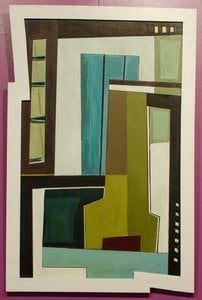
El Gran Ritmo
Reprodukció mérete
The life of Martin Blaszko was a profound odyssey of displacement, cultural immersion, and artistic evolution. Born in Berlin in 1920, his early years were marked by the shifting borders of a turbulent Europe. As his family moved from Germany to Poland in 1933, and subsequently to France in 19SB8, Blaszko was exposed to a tapestry of diverse environments that would later inform the rhythmic complexity of his work. This nomadic childhood instilled in him a unique perspective, one where identity was not tied to a single landscape but rather to the universal language of form and movement. The eventual migration to Argentina in 1939 provided a new horizon for his creative spirit, allowing him to settle into a period of intense artistic development that would eventually define his place in the annals of modern abstraction.
Blaszko’s artistic language is characterized by a masterful command of geometric abstraction and a deep preoccupation with the concept of order. His work often exists in a delicate balance between the monumental and the intimate. While his sculptures may possess a grandeur that commands the space around them, they are frequently built upon a foundation of precise, calculated movements that suggest a hidden, internal harmony. This duality is perhaps his greatest achievement; he managed to capture the kinetic energy of the modern world within the stillness of static objects. His paintings and sculptures serve as monuments to structural integrity, where every line and plane is a deliberate contribution to a larger, cohesive whole.
Throughout his prolific career, Blaszko remained deeply influenced by the prevailing abstract movements of the 20th century, yet he maintained a signature voice that was entirely his own. His ability to translate complex emotional states into structured, abstract compositions allowed him to transcend mere decoration, reaching instead for a deeper, more primal resonance. The significance of his work lies in this ability to find harmony within complexity—to take the fragmented experiences of a life lived across continents and synthesize them into works that feel both timeless and structurally rigorous.
The legacy of Martin Blaszko continues to resonate through the art world, serving as an inspiration for those who seek to explore the boundaries of shape and space. His contributions can be summarized through several key pillars of his artistic identity:
Though he passed away in Buenos Aires in 2011, Blaszko’s vision remains vibrant. His works stand as a testament to the power of perseverance and the capacity of the human spirit to find beauty and structure amidst the chaos of history.
1920 - 2011 , Germany