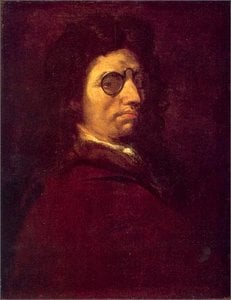
A Portrait of Persuasion: Luca Giordano’s ‘The Surveyor’
Luca Giordano's “The Surveyor,” a captivating work emerging from the vibrant heart of 17th-century Naples, transcends mere portraiture. It’s an arresting tableau of human vulnerability and determined resolve, steeped in the dramatic intensity characteristic of Ribera’s influence yet imbued with Giordano’s signature luminosity. The painting immediately draws the eye to its central figure – a man cloaked in shadow, his posture suggesting both weariness and unwavering conviction. He holds aloft a sheet of paper, not a document of legal decree or scholarly treatise, but rather an invitation, a plea for understanding, rendered with a palpable urgency.
The artist masterfully employs chiaroscuro – the dramatic interplay of light and dark – to sculpt the figure’s form. The strong contrasts emphasize his weathered face, etched with lines that speak of hardship and perhaps even drink, while simultaneously highlighting the resolute set of his jaw and the intensity in his eyes. This technique, deeply rooted in the Neapolitan Baroque tradition, was perfected by Giordano himself, allowing him to convey a profound sense of psychological depth within a relatively confined space. The dark background serves not as mere emptiness, but rather as a stage upon which this solitary figure commands attention, amplifying his presence and projecting an aura of quiet authority.
Echoes of Ribera & the Naples School
“The Surveyor” is inextricably linked to the artistic lineage of Luca Giordano. He spent formative years under the tutelage of Jusepe de Ribera in Naples, absorbing the master’s dramatic realism and penchant for intense emotion. However, Giordano swiftly developed his own distinct style – one characterized by a remarkable speed of execution and an unparalleled ability to capture fleeting moments of human expression. This painting exemplifies this evolution; while retaining elements of Ribera's starkness, it possesses a softer, more nuanced quality, reflecting the prevailing artistic sensibilities of Naples at the time.
The figure’s attire – a simple robe or coat adorned with a vibrant red sash – speaks to his status as a philosopher or perhaps even a beggar. The inclusion of the wine bottle on his belt is a subtle yet significant detail, hinting at a life lived on the margins, grappling with hardship and seeking solace in the fleeting pleasures of the moment. This juxtaposition of dignity and vulnerability creates a compelling narrative tension, inviting viewers to contemplate the complexities of human existence.
Symbolism & The Pursuit of Understanding
The act of presenting the paper is central to interpreting the painting’s meaning. It's not simply an offering; it’s a deliberate gesture – a final attempt at persuasion, a last stand against indifference. The very title, “The Surveyor,” suggests a man who observes, analyzes, and seeks to understand the world around him. He isn’t merely presenting information; he is attempting to impart wisdom, to share his perspective with an unseen audience.
Furthermore, the composition itself can be read as symbolic. The figure's outstretched hand mirrors the gesture of Euclid, the ancient Greek mathematician famed for his rigorous approach to geometry and logic. This allusion elevates the painting beyond a simple portrait, transforming it into a meditation on reason, knowledge, and the enduring human quest for understanding. The overall effect is one of poignant beauty and quiet contemplation – a timeless reminder of the power of observation and the importance of seeking connection in a world often characterized by isolation.
A Legacy Preserved: Research & Context
Luca Giordano (1634-1705) remains a pivotal figure in Neapolitan Baroque art. His prolific output, encompassing vast fresco cycles and numerous paintings, cemented his reputation as “Luca fa presto” – Luca the quick one – a testament to his extraordinary artistic speed and talent. Further research reveals that this work was created during a period of significant artistic experimentation within Naples, influenced by both Ribera’s dramatic realism and the evolving tastes of European patrons.
Several resources offer deeper insights into Giordano's life and oeuvre: The WahooArt website provides detailed information on “The Surveyor,” alongside related artworks and artist biographies. Academic studies, such as Andrés Úbeda de los Cobos’ comprehensive catalogue raisonné, delve into the intricacies of his artistic practice and the historical context surrounding his work. Exploring these resources allows for a richer appreciation of this remarkable painting and its place within the broader narrative of Neapolitan Baroque art.



 Megtekintés
 Áttérés Nyomtatványra
 Küldés
 Megosztás
 Részletek

 Letöltés
 Hasonló darabok
 X-ray felvétel
 Diavetítés
 Statisztika


 Összes részlet megjelenítése