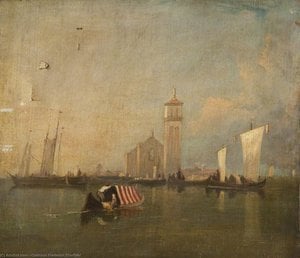
John Wilson Ewbank: A Scottish Master of Light and Water
Born in Darlington, England, in 1799, John Wilson Ewbank’s artistic journey took him from the humble apprenticeship of a house painter to the esteemed ranks of the Royal Scottish Academy. His life, though tragically cut short at the age of forty-nine, was marked by a profound connection with the natural world, particularly the dramatic landscapes and shimmering waters of Scotland. Ewbank wasn't merely a recorder of scenery; he possessed an almost preternatural ability to capture light and atmosphere, imbuing his paintings with a sense of movement, depth, and quiet contemplation – qualities that have secured his place as a significant figure in 19th-century Scottish art.
Ewbank’s early life was shaped by an unexpected shift. Initially destined for the priesthood, he abandoned theological studies to pursue painting, apprenticed to Thomas Coulson in Newcastle. This initial training provided a foundation in ornamental painting, but it was his relocation to Edinburgh and subsequent lessons with Alexander Nasmyth, a renowned landscape painter himself, that truly ignited his artistic passion. Nasmyth’s influence is evident in Ewbank's early works – a deliberate adoption of the Dutch Masters’ techniques, particularly their masterful use of light and color to create atmospheric effects.
Early Works and Influences
Ewbank’s initial style was heavily influenced by the Romantic tradition, drawing inspiration from artists like Jacob van Ruisdael and Jan Vermeer. His early paintings often depicted scenes of coastal landscapes, harbor views, and dramatic skies – characterized by a meticulous attention to detail and a restrained palette. The influence of the Dutch masters is particularly striking in his depictions of light reflecting off water, creating an illusion of shimmering brilliance. He meticulously studied the effects of weather on the sea, capturing the subtle shifts in color and texture that signaled changing conditions.
However, Ewbank’s artistic development wasn't static. As he matured, a shift occurred in his style – a move towards greater expressiveness and a looser brushstroke. This transformation coincided with a period of personal struggle, marked by bouts of drink and financial hardship. Despite these challenges, Ewbank continued to produce remarkable works, often depicting grand historical scenes or dramatic coastal vistas. The Visit of George IV to Edinburgh, the Entry of Alexander the Great into Babylon, and Hannibal crossing the Alps stand as testaments to his versatility and enduring talent.
Notable Works and Techniques
Among Ewbank’s most celebrated paintings are his series of drawings of Edinburgh, commissioned for James Browne's *Picturesque Views of Edinburgh* in 1825. These meticulously rendered sketches capture the city’s architectural grandeur and atmospheric charm with remarkable precision. His cabinet pictures – detailed depictions of riverbanks, coastlines, and marine subjects – also gained considerable recognition. Ewbank was particularly adept at portraying the interplay between light and water, creating a sense of dynamism and movement in his compositions.
A prime example of this skill is “Shipping in the Harbour, South Shields,” a monumental work from 1863 that exemplifies Ewbank’s mastery of atmospheric perspective and color. The painting captures the bustling activity of a busy harbor, with ships of various sizes navigating through the choppy waters. The use of light and shadow creates a dramatic effect, highlighting the movement of the waves and the reflections on the water's surface. This work, now held in private collection, showcases Ewbank’s ability to convey both the grandeur and the inherent drama of the natural world.
Legacy and Historical Significance
Despite his struggles with poverty and alcoholism, John Wilson Ewbank left a lasting legacy as one of Scotland's most accomplished landscape painters. His works are held in prestigious collections worldwide, including the British Museum, the Glasgow School of Art Archives and Collections, the Victoria and Albert Museum, and the Edinburgh Libraries and Museums and Galleries. His paintings offer a valuable glimpse into 19th-century Scottish life and culture, reflecting both the beauty and the challenges of the era.
Ewbank’s influence extends beyond his individual works. He played a significant role in the establishment of the Royal Scottish Academy, becoming one of its founding members in 1830. His dedication to capturing the essence of Scotland's landscapes helped to shape the artistic identity of the nation and inspired generations of artists to come. His work continues to be admired for its technical skill, atmospheric beauty, and profound connection to the natural world.



 Megtekintés
 Áttérés Nyomtatványra
 Küldés
 Megosztás
 Részletek

 Letöltés
 Hasonló darabok
 X-ray felvétel
 Diavetítés
 Statisztika


 Összes részlet megjelenítése