
Megtekintés AR előnézet Kézzel festett másolat rendelése Áttérés digitális képre Küldés
Részletek Útmutató Kedvencekhez ad Letöltés Hasonló darabok X-ray felvétel Diavetítés Kérdések és válaszok Letöltés Statisztika

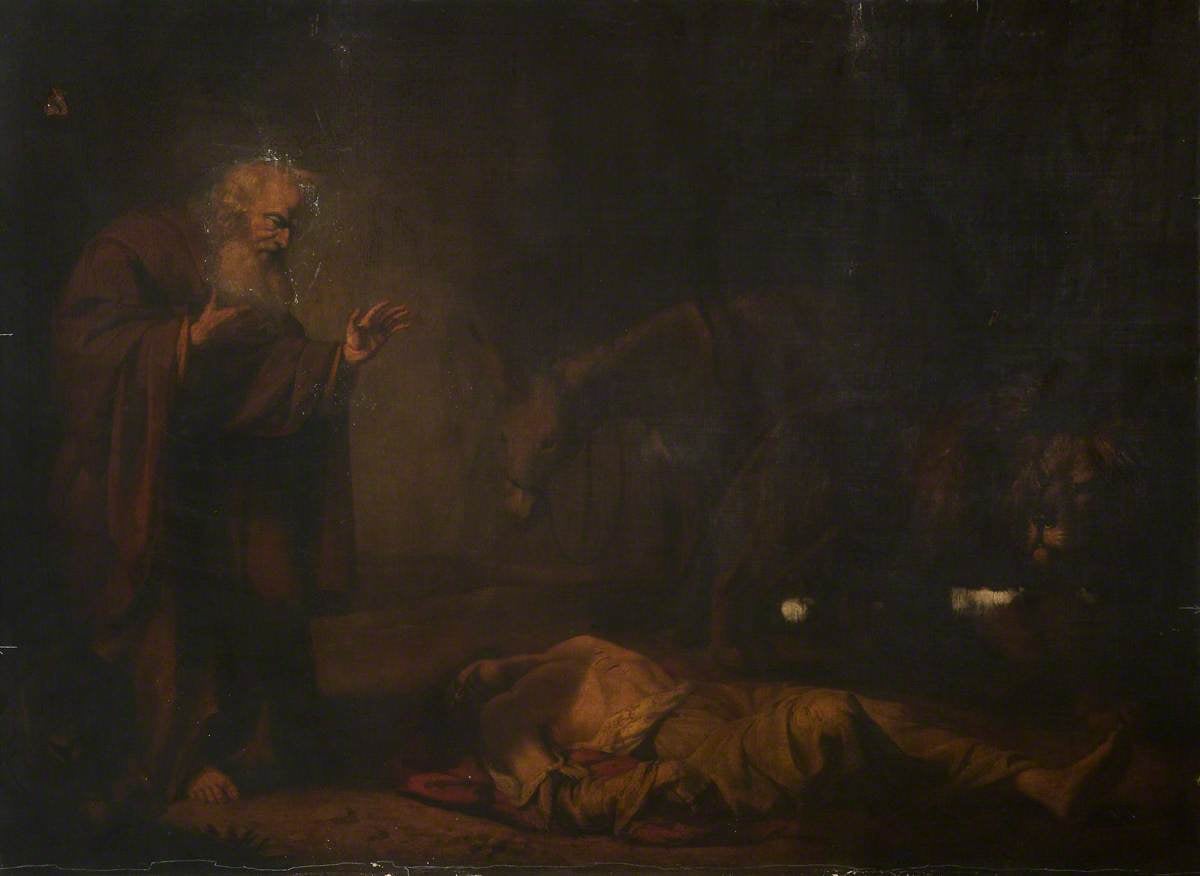
The Disobedient Prophet

Méretek
243.0 x 332.0 cm

Explore John Graham’s ‘The Disobedient Prophet,’ a dramatic 1790 oil painting of biblical proportions. Witness Baroque drama & intense emotion in this Scottish masterpiece – available as reproductions.

John D. Graham (1886-1961) was a Ukrainian-born American modernist painter, collector & pivotal mentor to Abstract Expressionists like Pollock & de Kooning. Known for figurative work, system theory of art & bridging European avant-garde with the NY S

Az ezen az oldalon megjelenített műalkotások szerzői jogi védelem alatt állnak, ami azt jelenti, hogy törvényileg nem készíthetünk és nem adhatunk el belőlük pontos másolatokat. Ez a védelem olyan nemzetközi megállapodások alapján érvényesül, mint például a Berni Egyezmény és a nemzeti jogszabályok által, beleértve azokat is, amelyeket meghatározott Az USA szerzői jogi törvénye – 17. cím.

Ez a módszer teljes mértékben megfelel a szerzői jogi szabályozásnak, mivel nem tartalmazza a védett műalkotás másolását vagy duplikálását. Ehelyett ez egy kreatív újinterpretáció – egy új festmény, amely az eredetivel való összefüggései miatt hatással van rá, de nem az az.

Giclée / Műnyomat

Múzeumi minőségű giclée vagy vászonnyomat, gyors gyártással és rugalmas finomítási lehetőségekkel. ( Kézzel festett másolat rendelése Áttérés digitális képre)

Corner sample of the P118B picture frame: formázott polisztirol, 5 cm wide and 3 cm thick
P118B Ft10
Corner sample of the P118H picture frame: formázott polisztirol, 5 cm wide and 3 cm thick
P118H Ft10
Corner sample of the P118W picture frame: formázott polisztirol, 5 cm wide and 3 cm thick
P118W Ft10
Corner sample of the P438Z picture frame: formázott polisztirol, 5.5 cm wide and 3.5 cm thick
P438Z Ft10
Corner sample of the P508JH picture frame: formázott polisztirol, 7 cm wide and 3.5 cm thick
P508JH Ft12
Corner sample of the P508YH picture frame: formázott polisztirol, 7 cm wide and 3.5 cm thick
P508YH Ft12
Corner sample of the P805H picture frame: formázott polisztirol, 5 cm wide and 3.5 cm thick
P805H Ft10
Corner sample of the P805Z picture frame: formázott polisztirol, 5 cm wide and 3.5 cm thick
P805Z Ft10
Corner sample of the P919BZ picture frame: formázott polisztirol, 7 cm wide and 3.5 cm thick
P919BZ Ft10
Corner sample of the P919G picture frame: formázott polisztirol, 7 cm wide and 3.5 cm thick
P919G Ft10
Corner sample of the P919XJ picture frame: formázott polisztirol, 7 cm wide and 3.5 cm thick
P919XJ Ft10
Corner sample of the P959ZH picture frame: formázott polisztirol, 5 cm wide and 3 cm thick
P959ZH Ft10
Corner sample of the P968JZ picture frame: formázott polisztirol, 6 cm wide and 4 cm thick
P968JZ Ft12
Corner sample of the W106C picture frame: tömörfa, 5 cm wide and 3 cm thick
W106C Ft8
Corner sample of the W218G picture frame: tömörfa, 5 cm wide and 3 cm thick
W218G Ft10
Corner sample of the W218JH picture frame: tömörfa, 5 cm wide and 3 cm thick
W218JH Ft8
Corner sample of the W218Y picture frame: tömörfa, 5 cm wide and 3 cm thick
W218Y Ft10
Corner sample of the W307PJ picture frame: tömörfa, 6 cm wide and 3 cm thick
W307PJ Ft10
Corner sample of the W316G picture frame: tömörfa, 6 cm wide and 3 cm thick
W316G Ft10
Corner sample of the W316PJ picture frame: tömörfa, 6 cm wide and 3 cm thick
W316PJ Ft8
Corner sample of the W316Y picture frame: tömörfa, 6 cm wide and 3 cm thick
W316Y Ft10
Corner sample of the W398PJ picture frame: tömörfa, 5 cm wide and 3 cm thick
W398PJ Ft8
Corner sample of the W4111J picture frame: tömörfa, 6.5 cm wide and 3.5 cm thick
W4111J Ft10
Corner sample of the W500HY picture frame: tömörfa, 7 cm wide and 5 cm thick
W500HY Ft15
Corner sample of the W500JH picture frame: tömörfa, 7 cm wide and 5 cm thick
W500JH Ft15
Corner sample of the W692G picture frame: tömörfa, 8 cm wide and 4 cm thick
W692G Ft12
Corner sample of the W849H picture frame: tömörfa, 5 cm wide and 3 cm thick
W849H Ft8
Corner sample of the W940BG picture frame: tömörfa, 7.5 cm wide and 4.5 cm thick
W940BG Ft15
Corner sample of the W953PJ picture frame: tömörfa, 6 cm wide and 3.5 cm thick
W953PJ Ft8

Standard méret
egyedi méretű
CM
INCH

Válasszon előre meghatározott méreteink közül, amelyek megfelelnek a műalkotás eredeti arányainak.

szélesség
magasság

Írja be a keretének vagy a falának megfelelő szélességet és magasságot. A nyomatot csak le lehet vágni, soha nem tehető nagyobbá, mint az eredeti kép, így egy eltérő alakú méretnél a kép egy része elveszik. Mielőtt bármit kinyatintanánk, küldünk egy digitális próbamodellt jóváhagyásra. Az oldalon látható kép nem tartalmazza a valós levágást — ezt csak a próbamodell mutatja meg.

Világszerte történő kiszállítás területére mindössze 2 hét alatt, a szokásos 4-5 hét helyett. (8 november)

Ingyenes globális expressz szállítás
Prémium minőségű len vászon
Teljes körű szállítási biztosítás
Vámvisszatérítési Garancia
Hiteles színarányosság garancia
100 napos visszaküldési lehetőség (csak hibás termékek esetén)
100% pénzvisszatérítési garancia
Több darab vásárlásakor kedvezmény

Összesített ár

Ft 22502

The Disobedient Prophet

Giclée / Műnyomat

Reprodukció mérete

-

Összesített ár

Ft 22502

Gyors információk

  • Movement: Baroque
  • Artist: John Graham
  • Influences: Classical art
  • Artistic style: Religious drama
  • Title: The Disobedient Prophet
  • Dimensions: 243 x 332 cm

Művészeti kvíz

Minden kérdésre csak egy helyes válasz létezik.

Kérdés 1:
What artistic style is predominantly associated with John Graham’s ‘The Disobedient Prophet’?
Kérdés 2:
Where is ‘The Disobedient Prophet’ currently housed?
Kérdés 3:
What biblical figure is depicted in ‘The Disobedient Prophet’?
Kérdés 4:
Which technique is John Graham known for employing in his paintings, contributing to their textural richness?
Kérdés 5:
What overarching theme does ‘The Disobedient Prophet’ convey regarding religious symbolism?
The Disobedient Prophet is a captivating oil on canvas painting created by John Graham in 1790. Measuring 243 x 332 cm, this stunning artwork is currently housed at the Royal Scottish Academy of Art - Architecture in Edinburgh, United Kingdom. The painting depicts a dramatic scene featuring a prophet or messenger of God standing over another person lying on the ground, with two horses present in the image.

Artistic Style and Composition

The composition of The Disobedient Prophet showcases John Graham's mastery of light and shadow, creating a sense of depth and tension. The dark background adds emphasis to the religious theme, while the use of oil on canvas brings a level of richness and texture to the painting. For art enthusiasts interested in similar works, John Graham's The Disobedient Prophet is a must-see.

Other Notable Works by John Graham Gilbert

In addition to The Disobedient Prophet, John Graham Gilbert has created other notable works, including John Gibson (1790–1866), An Italian Nobleman, and The Bandit’s Bride. These paintings demonstrate the artist's range and skill in capturing a variety of subjects and themes. For more information on these works, visit John Graham Gilbert's page on WahooArt.
  • Oil on canvas reproductions of The Disobedient Prophet are available for purchase on WahooArt, allowing art lovers to own a piece of history.
  • The Musée Réattu in Arles, France, is another notable museum featuring an impressive collection of artworks, including those by French painter Jacques Réattu.

For those interested in learning more about the art world and exploring other masterpieces, WahooArt's extensive collection of handmade oil painting reproductions is a valuable resource. With its rich history and cultural significance, The Disobedient Prophet by John Graham is a true masterpiece that continues to inspire and captivate art enthusiasts today.

Kérdések és válaszok

Milyen összefüggésben áll a "The Disobedient Prophet" témája John Graham megszokott motíveivel?

John Graham dokumentált témái – baroque drama & emotion, biblical narrative influence, religious piety & doubt, scottish cultural identity, moral allegory & judgment, graham's exploration of faith, complex figure gestures", system theory application – között a „The Disobedient Prophet” különös hangsúlyt fektet religious scene, biblical narrative, prophecy & faith, dramatic lighting, human suffering, historical painting, scottish art”-ra.

Milyen színpaletta jellemzi a(z) „The Disobedient Prophet”, John Graham alkotása alkotást?

A „The Disobedient Prophet”, John Graham alkotása színek palettáját úgy jellemzik, mint Monochrome. Ez a mű színeinek tömör leírása.

Ismer-e más neveket a "The Disobedient Prophet" alkotója, John Graham?

John Graham más néven is ismert: Ivan Gratianovitch Dombrowsky, Ivan Gratianovich Dombrowski.


A művész életrajza

A Life Forged in Revolution and Renaissance

The story of John Graham is one of profound transformation, a narrative that begins far from the bustling studios of New York, amidst the aristocratic elegance and subsequent political turbulence of Kyiv. Born Ivan Gratianovitch Dombrowsky in 1886, his early years were defined by a classical education and a lineage of privilege that seemed destined for a life of law or diplomacy. Yet, the winds of history had other plans. The seismic shifts of the Russian Revolution and the subsequent Bolshevik seizure of power thrust him into a crucible of conflict, leading to his imprisonment as a counterrevolutionary. This period of upheaval served as a spiritual and artistic catalyst; fleeing the chaos of his homeland, he eventually found refuge in the United States in 1920. It was during this migration that he shed his old identity, adopting the name John Graham—a moniker that would come to represent a bridge between the Old World's traditions and the New World's avant-garde energy.

Graham’s arrival in New York City marked the beginning of an extraordinary artistic awakening. Though he did not begin his formal studies in painting until his thirties, his late start was compensated by a voracious intellectual hunger. He immersed himself in the vibrant, gritty reality of the Ashcan School through the mentorship of John F. Sloan, yet his gaze was perpetually fixed on the horizon of modernism. His journey was not merely one of personal discovery but of cultural synthesis, as he navigated the complexities of Cubism, Surrealism, and Abstract Expressionism, weaving these disparate threads into a cohesive visual language that honored classical structure while embracing modern fragmentation.

The Architect of Modernist Dialogue

Beyond his own canvas, Graham functioned as a vital conduit for the burgeoning New York art scene. He was far more than a solitary painter; he was a collector, a writer, and a philosopher of form. His deep engagement with System Theory and dialectics allowed him to view art not just as an aesthetic pursuit, but as a structured argument—a belief encapsulated in his famous assertion that “an abstract painting is an argument drawn to conclusion.” This intellectual rigor made him a central figure in the development of the New York School. As a mentor and advocate, he provided the scaffolding upon which legends like Jackson Pollock and Willem de Kooning could build their revolutionary styles. He possessed the rare ability to champion the radical unknown while maintaining a profound respect for the masters of the past.

His artistic development was characterized by a fascinating tension between the figurative and the abstract. While he was deeply moved by the expressive potential of modern abstraction, his later works returned to a highly sophisticated figurative style. This period saw him drawing inspiration from classical masters to depict subjects such as Russian soldiers with an intensity that felt both ancient and immediate. His brushwork often carried a palpable emotional weight, utilizing vibrant color palettes and a sense of Baroque drama to navigate the tensions of a modern age. Through his work, the heavy shadows of history met the bright, fractured light of the twentieth century.

Legacy of a Cultural Conduit

The historical significance of John Graham lies in his role as a stabilizer and a provocateur within the whirlwind of mid-century modernism. He did not merely witness the birth of Abstract Expressionism; he helped cultivate the environment that made it possible. His legacy is found in several key areas:

  • The Synthesis of Traditions: He successfully bridged the gap between European avant-garde movements and the emerging American identity, ensuring that the lessons of the Old World informed the innovations of the New.
  • Mentorship and Community: Through his involvement with groups like the "Modernists" in Baltimore and his presence in the New York art circles, he fostered a collaborative spirit that defined an era.
  • Intellectual Framework: By applying philosophical and systemic thinking to the act of painting, he elevated the discourse surrounding abstract art from mere intuition to a structured, intellectual discipline.

Though he passed away in London in 1961, the echoes of Graham's influence remain embedded in the DNA of modern art. He remains a figure of immense mystery and brilliance—a man who survived revolution only to help orchestrate an artistic revolution of his own.

John Graham

John Graham

1886 - 1961 , Russia

Rövid információk

  • Artistic Movement Or Style: Modernist / Figurative Painting
  • Artists Or Movements Influenced By This Artist: ['New York School']
  • Artists Who Influenced This Artist: ['Ashcan School painters']
  • Date Of Birth: 1886
  • Date Of Death: 1961
  • Full Name: Ivan Gratianovitch Dombrowsky / John D. Graham
  • Nationality: Russian / American
  • Notable Artworks:
    • The Disobedient Prophet
    • Mrs John Jarvie
  • Place Of Birth: Kyiv, Russia


































