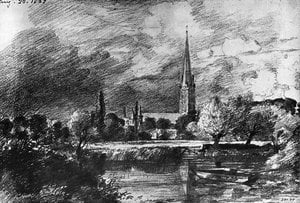
A Tempestuous Vision: John Constable’s “Beach in Brighton”
The painting "Beach in Brighton," executed by John Constable around 1820, isn't merely a depiction of a coastal scene; it’s a visceral embodiment of Romantic sensibility—a testament to the artist’s profound connection with the natural world and his ability to convey its turbulent grandeur. Situated within Dedham Vale, Constable’s birthplace and lifelong artistic inspiration, this landscape captures a moment of dramatic confrontation between humanity and elemental power. The canvas itself is dominated by an expansive sky ablaze with bruised purple hues and churning gray clouds—a visual representation of impending storm – mirroring the anxieties and aspirations inherent in the era's Romantic movement.
- Subject Matter: The artwork portrays a small group of figures huddled on Brighton Beach, attempting to brave the onslaught of a ferocious gale. Their presence serves as a poignant reminder of human vulnerability against the immensity of nature’s forces.
- Style & Technique: Constable's approach aligns closely with Romanticism, prioritizing expressive brushwork and atmospheric perspective over meticulous realism. Thick impasto—a technique where paint is applied in textured layers—dominates the sky and sea surfaces, creating a palpable sense of movement and conveying the raw energy of the storm.
The artist’s masterful use of color contributes significantly to the painting's emotional impact. Predominantly muted shades of gray, brown, and violet dominate the palette, reflecting the bleakness of the weather conditions but also hinting at a deeper contemplation on the sublime—the awe-inspiring beauty found within confronting overwhelming natural phenomena. Constable skillfully employs linear perspective to establish depth, albeit subtly flattened, guiding the viewer’s gaze towards the horizon line where the turbulent sea meets the stormy sky.
Symbolism: Beyond its visual splendor, “Beach in Brighton” carries symbolic weight. The figures on the beach represent humanity grappling with uncertainty and facing adversity—a motif prevalent throughout Romantic art. Simultaneously, the tempestuous seascape symbolizes the untamed spirit of nature, challenging conventional notions of order and control. Constable’s depiction isn't simply about recording a meteorological event; it’s about exploring profound philosophical questions concerning our relationship to the environment.
Historical Context: Painted during a period marked by intellectual ferment—the burgeoning Industrial Revolution alongside an increasing fascination with scientific inquiry—Constable’s work stands apart from its contemporaries. Unlike many artists of the time who sought to portray idealized landscapes, Constable aimed for authenticity, striving to capture the true essence of Dedham Vale and conveying its emotional resonance. His unwavering commitment to portraying nature as it truly is cemented his legacy as one of England's foremost landscape painters and profoundly influenced subsequent generations of artists.
- Interior Designers’ Note: The painting’s subdued palette and textured surface lend themselves beautifully to creating tranquil yet stimulating interior spaces. Consider incorporating shades of gray and violet into wall colors or selecting fabrics with similar textural qualities to evoke the mood of Constable's masterpiece.
Ultimately, “Beach in Brighton” transcends mere visual representation; it’s a conduit for experiencing the sublime—a profound appreciation for the grandeur and terror inherent in confronting the forces of nature. It remains an enduring emblem of Romantic idealism and continues to inspire artists and collectors alike with its evocative beauty and intellectual depth.
Gyakran Ismételt Kérdések
Ki készítette a "Beach in Brighton" alkotást, és milyen stílusú?
A „Beach in Brighton” alkotását John Constable készítette Romanticism stílusban. A művész és a műveszetség meghatározza a mű hagyományát.
Milyen technika és stílus jellemzi „Beach in Brighton”, John Constable alkotása alkotást?
A "Beach in Brighton" alkotás Oil On Canvas technikával készült, a Romanticism stílusban.
Hogyan javasolt a(z) "Beach in Brighton" kinyomtatása – milyen méretben, milyen elrendezésben?
Large méret, Panoramic elrendezés: ez a javasolt nyomtatási beállítás a(z) „Beach in Brighton”, John Constable alkotása alkotáshoz.
Elérhető-e a "Beach in Brighton" nagy felbontású letöltése?
A "Beach in Brighton" elérhető magas felbontású digitális kép letöltés formátumban, amelyet közvetlenül a ez az oldal oldalon vásárolhat meg.
Milyen helyiségbe javasolt a „Beach in Brighton”, John Constable alkotása?
A „Beach in Brighton”, John Constable alkotása számára a javasolt helyszín egy Living Room. Természetesen ez az ajánlás az Ön belső terehez is igazítható.
Milyen telítettséget és intenzitást mutat „Beach in Brighton”, John Constable alkotása?
A „Beach in Brighton”, John Constable alkotása alkotás Muted telítettségű és Monochromatic intenzitású.
Mi a(z) domináns színe a(z) „Beach in Brighton”, John Constable alkotása alkotásnak?
A „Beach in Brighton”, John Constable alkotása domináns színe a Gray (#6f6e60).
Milyen összefüggésben áll a "Beach in Brighton" témája John Constable megszokott motíveivel?
John Constable dokumentált témái – dedham vale series, landscape focus, emotional depth, claude lorrain, dutch masters, romanticism, coastal life, human resilience – között a „Beach in Brighton” különös hangsúlyt fektet stormy sea, coastal scene, landscape art, british coast, human figures, atmospheric mood, romantic painting, dramatic weather-ra.



 Előnézet
 Kézzel festett másolat vásárlása
 Megosztás
 Megosztás
 Részletek
 Útmutató

 Letöltés
 Hasonló darabok
 X-ray felvétel
 Diavetítés
 Statisztika
 Tovább olvasom






































 Az üvegkeretes opció csak 110 cm alatti méretben érhető el