x
MegtekintésMegtekintés Műalkotás AR előnézeteMűalkotás AR előnézete Kézzel festett másolat rendelése Kézzel festett másolat rendeléseKép letöltése Kép letöltése KüldésKüldés
RészletekRészletek Kedvencekhez ad Kedvencekhez ad LetöltésLetöltés Hasonló darabokHasonló darabok X-ray felvételX-ray felvétel DiavetítésDiavetítés

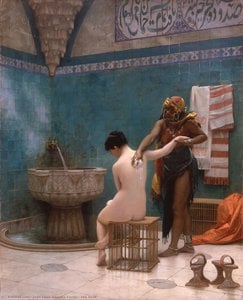
Moorish Bath

Delve into Victorian Orientalism with Jean-Léon Gérôme’s breathtaking *Moorish Bath*, a meticulously crafted Academic masterpiece capturing the opulent serenity of Ottoman bathhouses—a stunning visual journey for art lovers.

Gérôme Jean-Léon (1824–1904): A mester Francia egyik legkiemelkedőbb történelmi és orientális festője, aki a részletesség, a dráma és az egzotikum kombinációjával hódított közönséget. Népszerű művei a Colosseum jeleneteit, a szultánok világát ábrázolták.

Giclée / Műnyomat

Múzeumi minőségű giclée vagy vászonnyomat, gyors gyártással és rugalmas finomítási lehetőségekkel. (Kézzel festett másolat rendelése Kézzel festett másolat rendeléseKép letöltése Kép letöltése)

P118B $10
P118H $10
P118W $10
P438Z $10
P508JH $12
P508YH $12
P805H $10
P805Z $10
P919BZ $10
P919G $10
P919XJ $10
P959ZH $10
P968JZ $12
W106C $8
W218G $10
W218JH $8
W218Y $10
W307PJ $10
W316G $10
W316PJ $8
W316Y $10
W398PJ $8
W4111J $10
W500HY $15
W500JH $15
W692G $12
W849H $8
W940BG $15
W953PJ $8

Standard méret
egyedi méretű
CM
INCH

Válasszon előre meghatározott méreteink közül, amelyek megfelelnek a műalkotás eredeti arányainak.

szélesség
magasság

Megadhat saját méreteket is egy konkrét kerethez vagy helyszínhez igazítva. Amennyiben a kiválasztott méret nem egyezik az eredeti kép arányokkal, a műalkotást le fogjuk vágni, vagy kiegészítjük a képet tükrözött vagy egyszínű szélekkel. A gyártás megkezdése előtt egy digitális tervezetet küldünk jóváhagyásra.
Kérjük, vegye figyelembe, hogy a képernyőn látható előnézet nem tükrözi a tényleges levágást vagy kiegészítést. Csak a tervezet mutatja pontosan a végső kompozíciót.
Bár az egyedi méretek is elérhetőek, az eredeti arányok megőrzése érdekében azt javasoljuk, hogy válasszon a előre meghatározott listából származó méretet.

Világszerte történő kiszállítás területére mindössze 2 hét alatt, a szokásos 4-5 hét helyett. (4 szeptember)

why_choose_icon
Ingyenes globális expressz szállítás
why_choose_icon
Prémium minőségű len vászon
why_choose_icon
Teljes körű szállítási biztosítás
why_choose_icon
Vámvisszatérítési Garancia
why_choose_icon
Hiteles színpontosság garancia
why_choose_icon
60 napos visszaküldési lehetőség (csak hibás termékek esetén)
why_choose_icon
100% pénzvisszatérítési garancia
why_choose_icon
Több darab vásárlása esetén kedvezmény

Összesített ár

$ 68

reproduction

Moorish Bath

Giclée / Műnyomat

Reprodukció mérete

-

Összesített ár

$ 68

Gyors információk

  • Artistic style: Orientalist
  • Title: Moorish Bath
  • Artist: Jean Léon Gérôme
  • Location: Museum of Fine Arts Boston
  • Medium: Oil on canvas
  • Notable elements or techniques: Detailed realism, Light and color palette
  • Movement: Academicism

Művészeti kvíz

Minden kérdésre csak egy helyes válasz létezik.

Kérdés 1:
What artistic style is Jean-Léon Gérôme’s Moorish Bath primarily characterized by?
Kérdés 2:
Where was Jean-Leon Gerome's Moorish Bath originally exhibited?
Kérdés 3:
What inspired Gérôme’s fascination with Orientalist themes?
Kérdés 4:
The painting depicts a scene within a Moorish bathhouse. What is prominent in the setting?
Kérdés 5:
What does Gérôme’s use of light and color contribute to in Moorish Bath?

A Glimpse Into the Opulent Orient

In the heart of the nineteenth century, few artists possessed the ability to transport a Parisian salon to the sun-drenched, tile-clad sanctuaries of the Middle East as masterfully as Jean-Léon Gérôme. His 1870 masterpiece, Moorish Bath, serves as more than a mere painting; it is a meticulously crafted window into a world of exotic luxury and quiet intimacy. As a cornerstone of the Orientalist movement, this work captures a profound moment within a Hammam, where the boundaries between reality and romanticized fantasy blur. The scene unfolds with a breathtaking sense of stillness, inviting the viewer to step past the threshold of the everyday and into a space defined by cool shadows, shimmering water, and the rhythmic beauty of ancient rituals.

The composition is anchored by a delicate tension between the figures within the frame. A seated lady, often identified as Circassian, rests amidst the splendor of her surroundings, while an attendant prepares for the ritual of cleansing. This interaction is not merely a depiction of hygiene but a choreographed dance of service and grace. Gér erne’s ability to capture the soft textures of skin against the hard, glazed surfaces of the architecture creates a sensory experience that is almost tactile. For the discerning collector or interior designer, this piece offers an unparalleled depth, providing a focal point that commands attention through its narrative complexity and serene atmosphere.

Mastery of Academic Realism and Light

Technically, Moorish Bath represents the pinnacle of French Academicism. Gérôme was renowned for his photographic precision, a skill honed through rigorous training and fueled by his firsthand observations during travels to North Africa and Egypt. Every element in the painting—from the intricate Arabic calligraphy etched into the blue wall tiles to the subtle reflections dancing upon the surface of the stone basin—is rendered with an almost scientific accuracy. His use of color is particularly evocative; a palette dominated by tranquil blues and earthy tones creates a cooling effect, mirroring the literal temperature of the bathhouse itself.

The artist employs light not just to illuminate, but to sculpt. Light filters into the space as if through high, unseen apertures, catching the glint of gold jewelry and the moisture on the skin, lending the scene a luminous, ethereal quality. This mastery of chiaroscuro—the play between light and shadow—adds a layer of psychological depth to the work. The shadows are not merely dark voids but are filled with the suggestion of heat, humidity, and the heavy, fragrant air of an enclosed sanctuary. Such technical brilliance ensures that a high-quality reproduction of this work retains its ability to transform any room, adding a sense of historical weight and sophisticated texture to a modern interior.

Symbolism and the Legacy of Orientalism

To look upon Moorish Bath is to engage with the complex cultural dialogues of the Victorian era. While Gérôme’s work was deeply rooted in the Orientalist fascination with the "Exotic East," his approach transcends simple caricature. Through his meticulous attention to architectural detail and ethnographic observation, he provides a scholarly, albeit idealized, tribute to Ottoman aesthetics. The bathhouse itself symbolizes a sanctuary of privacy and ritual, a space where the social hierarchies of the era are momentarily suspended in favor of personal rejuvenation.

For those seeking to decorate with art that tells a story, this painting offers a rich tapestry of symbolism. It speaks of the intersection between the domestic and the divine, the private and the public, and the enduring allure of the unknown. Whether placed in a grand library or a contemporary living space, the emotional impact of Gérôme’s work remains potent. It evokes a sense of wanderlust and a deep appreciation for the craftsmanship of a bygone era, making it an essential acquisition for anyone looking to infuse their environment with culture, history, and an everlasting sense of wonder.


A művész életrajza

A Master of Narrative Detail: The Life and Art of Jean-Léon Gérôme

Jean-Léon Gérôme, a name inextricably linked to the academic painting of 19th-century France, was far more than simply a technically proficient artist; he was a masterful storyteller, captivating audiences with meticulously rendered scenes brimming with drama, exotic allure, and an almost cinematic quality. Born in Vesoul in 1824, his artistic journey began under the tutelage of local artist Claude-Basile Cariage, providing him with a foundational understanding that would ultimately shape his distinctive style. A pivotal moment arrived at sixteen when he moved to Paris, enrolling under the guidance of Paul Delaroche, a celebrated master of historical painting, and later benefiting from the rigorous training offered by the prestigious École des Beaux-Arts. However, Gérôme quickly distinguished himself not through mere imitation of established styles, but rather through an innovative synthesis – a seamless blend of painstaking realism with dramatic narrative, a combination that would become his hallmark. His early success with *The Cock Fight* in 1847 swiftly propelled him to prominence within the Neo-Grec movement, a revivalist trend dedicated to reinterpreting classical themes while incorporating meticulous attention to archaeological detail and historical accuracy.

From Historical Grandeur to Orientalist Visions

Gérôme’s artistic range was remarkably expansive, demonstrating an impressive ability to tackle diverse subjects with equal skill. He frequently engaged with historical narratives, imbuing them with a palpable sense of immediacy and psychological depth—as evidenced by his monumental mural commission, *The Age of Augustus, the Birth of Christ*, intended as a grand allegory for Napoleon III. This ambitious work showcased Gérôme’s exceptional capacity to manage complex compositions and orchestrate sweeping historical narratives. Yet, it was perhaps in his depictions of the Orient that he truly captured the public imagination. Inspired by extensive travels throughout Turkey, Egypt, and North Africa, Gérôme created a series of paintings that transported viewers to distant lands, portraying scenes of harems, bustling marketplaces, and vast desert landscapes with an exoticism that simultaneously fascinated and, viewed through a modern lens, occasionally perpetuated problematic stereotypes. Paintings such as *Harem Women Feeding Pigeons in a Courtyard* became immensely popular, offering European audiences a glimpse into a world perceived as mysterious, sensual, and profoundly different from their own. These works weren’t simply straightforward representations; they were carefully constructed fantasies—a deliberate fusion of observation, imagination, and artistic license designed to evoke powerful emotional responses. He wasn't merely documenting the Orient; he was actively *creating* it for Western consumption, a practice that would later invite critical scrutiny but undeniably contributed significantly to his widespread acclaim.

A Pedagogue and Influential Teacher

Beyond his prolific output as a painter, Gérôme exerted considerable influence as an educator at the École des Beaux-Arts in Paris. His atelier became a vibrant hub for aspiring artists from across Europe and America, attracting students eager to learn under his guidance. Among those who benefited most from his tutelage were Thomas Eakins, John Singer Sargent, and Mary Cassatt—artists whose individual styles were profoundly shaped by Gérôme’s rigorous training, emphasizing meticulous draftsmanship, masterful composition, and a deep appreciation for the study of life. He instilled in them not only technical proficiency but also a profound understanding of artistic principles and the importance of careful observation. While his conservative artistic views sometimes clashed with the burgeoning avant-garde movements of the time, Gérôme’s impact on the development of American art—particularly through his students—was undeniably significant. His legacy extended far beyond his own studio, as these artists carried his teachings and techniques across the Atlantic, establishing their own ateliers and perpetuating the academic tradition he championed.

Key Moments in a Remarkable Career

  • 1824: Born in Vesoul, France.
  • 1840: Moves to Paris to study under Paul Delaroche.
  • 1847: Achieves early recognition with *The Cock Fight* at the Paris Salon.
  • 1852-1854: Receives commission for *The Age of Augustus, the Birth of Christ* and travels to Constantinople, Greece, and Turkey.
  • Late Career: Transitions to sculpture, creating polychrome works inspired by classical antiquity.
  • 1904: Dies in Paris, leaving behind a significant artistic legacy.

Legacy and Controversy: A Complex Artistic Inheritance

Jean-Léon Gérôme passed away in Paris in 1904, leaving behind an impressive body of work that continues to be subject to ongoing discussion and critical assessment. While his technical mastery is undeniable—his meticulous realism consistently lauded for its precision and detail—Gérôme’s artistic legacy remains complex and layered. His unwavering commitment to academic conventions, once celebrated as the pinnacle of artistic achievement, has been re-evaluated through a contemporary lens, prompting questions about the potential stifling effects of such a rigid approach. The Orientalist paintings, while visually arresting and undeniably popular during his lifetime, have also faced criticism for their tendency to exoticize and perpetuate colonial stereotypes—a reflection, perhaps, of the prevailing attitudes and prejudices of 19th-century European society. However, it is crucial to understand Gérôme within the historical context in which he lived and worked. He was a product of his era, reflecting the dominant cultural values and artistic trends of the time. His art offers valuable insights into the anxieties, fantasies, and social dynamics of 19th-century Europe—a testament to both the power and the limitations of artistic representation. Today, Gérôme’s paintings are admired not only for their technical brilliance but also for their ability to transport viewers to different times and places, inviting them to contemplate the complexities of history, culture, and the very nature of visual storytelling.

Gérôme

Gérôme

1824 - 1904 , Francia

A művészről röviden

  • Artistic Movement Or Style: Akadémiai, Orientalista
  • Artists Or Movements Influenced By This Artist: ['Neo-Grec']
  • Artists Who Influenced This Artist: ['Paul Delaroche']
  • Date Of Birth: 1824. május 11.
  • Date Of Death: 1904. jan. 10.
  • Full Name: Jean-Léon Gérôme
  • Nationality: Francia
  • Notable Artworks:
    • A Kakasviadal
    • Pollice verso
    • Harem nők
  • Place Of Birth: Vesoul, Francia
Fedezze fel a műalkotásokat témák, stílusok és jellemzők szerint csoportosítva.