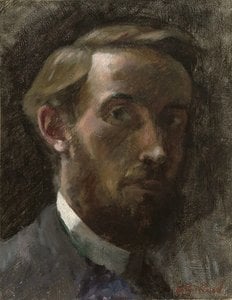
A művész életrajza
**early life and artistic beginnings**
Jean-Édouard Vuillard, a luminary of French painting, was born on November 11, 1868, in the quaint village of Cuiseaux, nestled within the Saône-et-Loire region of France. His early years were marked by a quiet domesticity—his father, a retired ship captain, and his mother, a seamstress, provided a stable yet modest upbringing. The family’s relocation to Paris when he was just ten years old proved pivotal, thrusting him into the vibrant, often challenging, atmosphere of the capital city. This move, though initially difficult due to their limited resources, ultimately laid the foundation for his artistic journey. Vuillard's education began at the Condorcet Lycée, a prestigious institution where he encountered and forged friendships with future artistic figures like Pierre Roussel, destined to become a prominent photographer, and Maurice Denis, whose influence would resonate throughout Vuillard’s career. These early connections fostered a shared intellectual curiosity and a nascent appreciation for art that would shape his future direction. He enrolled at the École des Beaux-Arts, immersing himself in the traditional techniques of academic painting while simultaneously absorbing the burgeoning avant-garde currents circulating within Parisian artistic circles. It was during this period that Vuillard began to develop his distinctive style, characterized by an intuitive understanding of color and form—a departure from the rigid conventions of the time.
**the nabis movement and its influence**
Vuillard’s artistic trajectory took a significant turn with his involvement in the Nabis group – a collective of young artists who sought to redefine the boundaries of painting in the late 1890s. The term “Nabis,” derived from the Hebrew word for prophet, reflected their ambition to forge a new path, one that moved beyond the constraints of Impressionism and Academic art towards a more symbolic and expressive language. Inspired by Japanese woodblock prints—their flattened perspectives, bold colors, and simplified forms—the Nabis embraced a radical approach to composition. Vuillard’s interiors, in particular, became canvases for exploring spatial relationships and the interplay of light and shadow. He meticulously rendered the textures of wallpaper, fabrics, and furniture, creating richly layered scenes that seemed to shimmer with an inner life. The group's philosophy, rooted in the positivist theories of Auguste Comte and Hippolyte Taine, emphasized observation and the representation of reality through a subjective lens—a belief that art should capture not just what was seen but also what was felt. This intellectual framework profoundly influenced Vuillard’s artistic practice, encouraging him to delve deeper into the emotional resonance of his subjects.
**vuillard's later work and legacy**
Following the dissolution of the Nabis in 1900, Vuillard continued to paint with remarkable consistency, though his style evolved subtly over time. He moved away from the overtly experimental techniques of his earlier years, adopting a more grounded approach that emphasized detail and realism. During the 1920s and 30s, he produced a series of portraits of prominent figures in French industry and the arts—a testament to his ability to capture the essence of his subjects within their familiar surroundings. These portraits were not merely likenesses; they conveyed a sense of intimacy and understanding, revealing Vuillard’s keen eye for capturing character and personality. In his later years, Vuillard found renewed inspiration in landscapes and interiors, returning to the techniques that had defined his early work but imbued with a newfound maturity and sophistication. His paintings from this period are characterized by their luminous colors, delicate brushwork, and an almost dreamlike quality—a reflection of his profound sensitivity to the beauty of everyday life. Vuillard’s legacy extends far beyond his individual works; he is considered a pivotal figure in the development of modernism, influencing generations of artists with his innovative use of color, form, and space.
**key works and exhibitions**
Vuillard's artistic output has been meticulously documented and exhibited throughout the world. His paintings are proudly displayed in prestigious museums such as the Musée de la Révolution Française (France), a repository of historical artifacts and artworks related to the French Revolution, offering a unique perspective on Vuillard’s artistic journey. Notable works include “La Patrie en Danger” (1893), a poignant depiction of a young man condemned to death for blasphemy during the Ancien Régime—a powerful commentary on social injustice; and "Jean de la Barre" (1894), portraying a young man facing execution for heresy, capturing the drama and tragedy of the event. Furthermore, Vuillard’s later portraits, including those of figures from French industry and the arts, are showcased in various galleries across France and beyond. These works provide valuable insights into the social and cultural landscape of his time.
**conclusion**
Jean-Édouard Vuillard remains a captivating figure in the history of art—a master of intimacy, color, and form. His unique vision, born from a confluence of influences—from Japanese prints to the philosophical currents of the Nabis movement—continues to resonate with audiences today. As a pioneer of modernism, Vuillard’s legacy endures as an inspiration for artists seeking to explore the depths of human experience through their art. To further immerse yourself in his world, we encourage you to discover more about the *intimism* art movement and explore Vuillard's extensive body of work on WahooArt.



 Megtekintés
 Kézzel festett másolat rendelése
 Küldés
 Megosztás
 Részletek

 Letöltés
 Hasonló darabok
 X-ray felvétel
 Diavetítés
 Statisztika


 Összes részlet megjelenítése






































 Az üvegkeretes opció csak 110 cm alatti méretben érhető el