Jarosław Miklasiewicz: Bridging Flemish Tradition and Rural Observation
Jarosław Miklasiewicz, born in Poznań, Poland, in 1948, embarked on his artistic journey in 1972, establishing himself as a prolific painter who has graced numerous exhibitions both domestically and internationally. His distinctive style—characterized by a profound connection to the landscapes of rural Poland and an unmistakable homage to Bruegel the Elder—has garnered recognition within Polish art history and secured a place among esteemed collections worldwide.
- Early Influences: Miklasiewicz’s formative years were marked by exposure to European artistic traditions, particularly the masterful depictions of Pieter Bruegel the Elder, whose meticulous attention to detail and evocative portrayal of everyday life served as a cornerstone for his own creative vision.
- Notable Exhibitions: He participated in significant art fairs such as Ghent and Cologne, showcasing his talent alongside fellow artists. Furthermore, he was honored with second prize at the National Competition of Painting XIV them. John Spychalski in Poznan in 1987 and awarded the City of Poznań Prize for Culture and Art in 1988—testaments to his artistic merit and contribution to Polish cultural landscape.
- Museum Collections: Miklasiewicz’s artworks are proudly displayed in museums across Poland, including the National Museum in Poznan, Warsaw Museums, Krakow Museums, Radom Museums and Bratislava Museums – demonstrating their enduring appeal and scholarly importance.
A Painter's Perspective: “I Practice Painting…”
Miklasiewicz eloquently articulated his artistic philosophy: "I practice painting, for which inspiration is the world of the ordinary, sometimes funny, reality caught up in their own delusions, bizarre dreams and magic spells, which often take the form of a grotesque and ambiguous. At the same time I show in his paintings a temporal constancy, accompanied us sanctity of ancient and modern myths, and profane everyday life." This statement encapsulates his core artistic impulse—a desire to explore the complexities of human experience through the lens of seemingly mundane subjects, imbued with symbolic resonance and layered narratives.
- Critical Acclaim: Professor Marian Golka lauded Miklasiewicz’s work, stating that “It is a mystery of this painting, which I see in the two questions that accompany the art of J. Miklasiewicza. First is the question of how much of our daily life is contained unusual situation that we do not notice or do not want notice. second question is the reverse of the previous and concerns on how much of our extraordinary myths supposedly contained the banality and ordinariness.”
- Symbolic Depth: Golka’s observation underscores Miklasiewicz's masterful ability to juxtapose sacred and profane elements—ancient myths alongside everyday realities—creating artworks that provoke contemplation and invite viewers to reconsider their perceptions of existence.
Style and Technique: The Influence of Bruegel
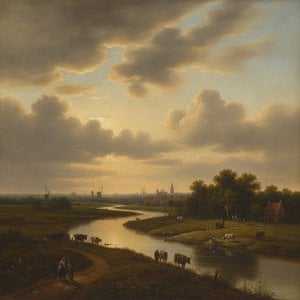
Miklasiewicz’s artistic style is undeniably rooted in the stylistic conventions of Bruegel the Elder, whose landscapes are characterized by a remarkable blend of realism and grotesque humor. He meticulously renders rural scenes with painstaking detail—capturing textures, colors, and atmospheric conditions—yet simultaneously introduces elements of distortion and caricature to convey social commentary and psychological insight.
- Impasto Texture: Miklasiewicz employs impasto technique—applying thick layers of paint—to achieve a tactile surface that enhances the visual impact of his canvases. This method lends depth and dimensionality to his landscapes, mirroring Bruegel’s masterful use of chiaroscuro (light and shadow) to heighten dramatic tension.
- Color Palette: His color palette leans heavily on earthy tones—ochres, browns, greens—reflecting the muted hues of Polish countryside—a deliberate stylistic choice that aligns with Bruegel's preference for naturalistic coloration.
Recognition and Legacy
Miklasiewicz’s dedication to his craft has resulted in numerous prestigious awards and inclusions within prominent art collections across Poland and internationally, including those housed in the United States, Germany, Belgium, Netherlands, Portugal, Ireland and Great Britain. His enduring presence in museums serves as a testament to the lasting significance of his artistic vision—a singular blend of Flemish tradition and astute observation of rural life that continues to inspire admiration and scholarly inquiry.
Source: Aleksander Jackowski: “Sztuka zwana naiwna; zarys encyklopedyczny tworczosci w Polsce”. Warszawa 1995. pp. 126-127.



 Megtekintés
 Switch to Print
 Küldés
 Megosztás
 Részletek

 Letöltés
 Hasonló darabok
 X-ray felvétel
 Diavetítés
 Stats
Stats


 Összes részlet megjelenítése






































 Az üvegkeretes opció csak 110 cm alatti méretben érhető el