Megtekintés AR előnézet Váltás nyomtatványra Áttérés digitális képre Küldés
Részletek Útmutató Kedvencekhez ad Letöltés Hasonló darabok X-ray felvétel Diavetítés Q&A Statisztika

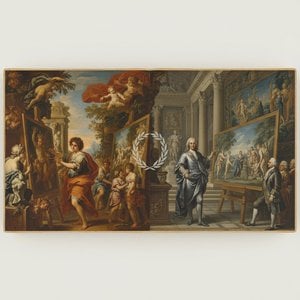
GERARD EDELINCK Hand-painted oil painting reproduction

Admire Hyacinthe Rigaud's masterful portrait of Gérard Edelinck, a stunning example of 18th-century French Baroque art. Explore the details and legacy of this iconic painter.

Fedezze fel Hyacinthe Rigaud lenyűgöző, 17./18. századi francia barokk portréit! A nemesség és a divat mesteri részletességgel való ábrázolásáról ismert művész örökségét istražoljuk!

Kézzel készített olajfestmény reprodukció

Kézzel festett olajvastú vászon, az Ön által választott méretben és keretben, művészeink készítik meglévőre. ( Váltás nyomtatványra Áttérés digitális képre)

Corner sample of the P118B picture frame: formázott polisztirol, 5 cm wide and 3 cm thick
P118B Ft10
Corner sample of the P118H picture frame: formázott polisztirol, 5 cm wide and 3 cm thick
P118H Ft10
Corner sample of the P118W picture frame: formázott polisztirol, 5 cm wide and 3 cm thick
P118W Ft10
Corner sample of the P438Z picture frame: formázott polisztirol, 5.5 cm wide and 3.5 cm thick
P438Z Ft10
Corner sample of the P508JH picture frame: formázott polisztirol, 7 cm wide and 3.5 cm thick
P508JH Ft12
Corner sample of the P508YH picture frame: formázott polisztirol, 7 cm wide and 3.5 cm thick
P508YH Ft12
Corner sample of the P805H picture frame: formázott polisztirol, 5 cm wide and 3.5 cm thick
P805H Ft10
Corner sample of the P805Z picture frame: formázott polisztirol, 5 cm wide and 3.5 cm thick
P805Z Ft10
Corner sample of the P919BZ picture frame: formázott polisztirol, 7 cm wide and 3.5 cm thick
P919BZ Ft10
Corner sample of the P919G picture frame: formázott polisztirol, 7 cm wide and 3.5 cm thick
P919G Ft10
Corner sample of the P919XJ picture frame: formázott polisztirol, 7 cm wide and 3.5 cm thick
P919XJ Ft10
Corner sample of the P959ZH picture frame: formázott polisztirol, 5 cm wide and 3 cm thick
P959ZH Ft10
Corner sample of the P968JZ picture frame: formázott polisztirol, 6 cm wide and 4 cm thick
P968JZ Ft12
Corner sample of the W106C picture frame: tömörfa, 5 cm wide and 3 cm thick
W106C Ft8
Corner sample of the W218G picture frame: tömörfa, 5 cm wide and 3 cm thick
W218G Ft10
Corner sample of the W218JH picture frame: tömörfa, 5 cm wide and 3 cm thick
W218JH Ft8
Corner sample of the W218Y picture frame: tömörfa, 5 cm wide and 3 cm thick
W218Y Ft10
Corner sample of the W307PJ picture frame: tömörfa, 6 cm wide and 3 cm thick
W307PJ Ft10
Corner sample of the W316G picture frame: tömörfa, 6 cm wide and 3 cm thick
W316G Ft10
Corner sample of the W316PJ picture frame: tömörfa, 6 cm wide and 3 cm thick
W316PJ Ft8
Corner sample of the W316Y picture frame: tömörfa, 6 cm wide and 3 cm thick
W316Y Ft10
Corner sample of the W398PJ picture frame: tömörfa, 5 cm wide and 3 cm thick
W398PJ Ft8
Corner sample of the W4111J picture frame: tömörfa, 6.5 cm wide and 3.5 cm thick
W4111J Ft10
Corner sample of the W500HY picture frame: tömörfa, 7 cm wide and 5 cm thick
W500HY Ft15
Corner sample of the W500JH picture frame: tömörfa, 7 cm wide and 5 cm thick
W500JH Ft15
Corner sample of the W692G picture frame: tömörfa, 8 cm wide and 4 cm thick
W692G Ft12
Corner sample of the W849H picture frame: tömörfa, 5 cm wide and 3 cm thick
W849H Ft8
Corner sample of the W940BG picture frame: tömörfa, 7.5 cm wide and 4.5 cm thick
W940BG Ft15
Corner sample of the W953PJ picture frame: tömörfa, 6 cm wide and 3.5 cm thick
W953PJ Ft8

Standard méret
egyedi méretű
CM
INCH

Válasszon előre meghatározott méreteink közül, amelyek megfelelnek a műalkotás eredeti arányainak.

szélesség
magasság

Írja be a kívánt szélességet és magasságot, hogy illeszkedjen a keretéhez vagy a falához. Mivel ez kézzel festett alkotás, egy eltérő formájú méret esetén a művész akár festhet is valamivel többet a kép körül, vagy korolathat is belőle — az Ön döntésének megfelelően. A festés megkezdése előtt küldünk egy digitális tervezetet jóváhagyásra. Az oldalon látható kép nem tartalmazza a végeredményt — csak a tervezet mutatja meg a valódi eredményt.

Példák arra, mit lehet módosítani: az arc kicserélése az ügyfél fotójára; háziállat hozzáadása (pl. macska helyett kutya); rejtett üzenet elhelyezése a háttérben; a háttér tájának vagy elemeinek megváltoztatása.
A rendelést követően a WahooArt.com csapata e-mailt küld az ügyfélnek az instrukciókért, és biztosít egy előnézeti képet (mockup).

Világszerte elérhető szállítás () 3-4 hét alatt a szokásos 5 hét helyett. (30 október). A minőség nem kérdőjelezhető.

Ingyenes globális expressz szállítás
Prémium minőségű len vászon
Teljes körű szállítási biztosítás
Vámvisszatérítési Garancia
Hiteles színarányosság garancia
100 napos visszaküldési lehetőség (csak hibás termékek esetén)
100% pénzvisszatérítési garancia
Több darab vásárlásakor kedvezmény

Összesített ár

Ft 88935

GERARD EDELINCK

Reprodukciós technika

Reprodukció mérete

-

Összesített ár

Ft 88935

Gyors információk

  • Medium: Line engraving
  • Artistic style: Formal, Classicism
  • Movement: Baroque
  • Location: Louvre Museum
  • Dimensions: 43.50 x 35.90 cm
  • Influences:
    • Rubens
    • Van Dyck

A Portrait of Prestige: Hyacinthe Rigaud’s Masterpiece of Gerard Edelinck

Hyacinthe Rigaud's "Portrait of Gérard Edelinck," painted circa 1698, is more than just a likeness; it’s a meticulously crafted window into the opulent world of 18th-century French nobility. This captivating work, now residing within the Louvre Museum in Paris, exemplifies Rigaud’s signature style – a harmonious blend of Baroque grandeur and refined realism that secured his place as one of France's most celebrated portrait painters. The painting immediately draws the eye with its rich palette dominated by warm reds, deep browns, and subtle golds, creating an atmosphere of wealth and authority. Rigaud masterfully employs light to sculpt Edelinck’s face, highlighting the contours of his features and conveying a sense of dignified composure.

The composition itself is a testament to Rigaud's skill. The subject, Gérard Edelinck, a prominent calligrapher (a ‘Caligraphus’ as indicated by inscriptions on the painting), occupies a central position within a relatively shallow space. His gaze meets the viewer directly, establishing an immediate and engaging connection. The arrangement is remarkably symmetrical, reflecting the formal conventions of portraiture at the time while simultaneously imbuing the scene with a sense of balance and stability. Notice how Rigaud subtly incorporates textual elements – Latin inscriptions framing the piece – that further elevate Edelinck’s status and underscore the painting's purpose as a commemorative artwork.

The Baroque Brushstroke: Technique and Detail

Rigaud’s technique is characterized by an extraordinary level of detail and a masterful manipulation of light and shadow. He achieves this through layers of carefully applied oil paint, creating smooth transitions between tones and subtly modeling the forms of Edelinck's face, clothing, and wig. The wig itself—a towering confection of curls and powdered hair—is rendered with remarkable precision, showcasing Rigaud’s ability to capture texture and volume. Observe how he uses delicate brushstrokes to define the folds of the coat, the sheen of the fabric, and the subtle wrinkles around Edelinck's eyes – details that contribute significantly to the painting’s lifelike quality.

The use of color is equally impressive. Rigaud doesn’t simply apply pigments; he orchestrates them, creating a harmonious interplay of hues that enhances the overall effect. The warm tones evoke feelings of warmth, wealth, and sophistication, while the cooler shades in Edelinck's skin provide a subtle contrast. Furthermore, Rigaud expertly employs chiaroscuro – the dramatic use of light and shadow – to create depth and volume, drawing attention to key features and adding a sense of drama to the scene.

Symbolism and Context: A Reflection of Status

Beyond its technical brilliance, “Portrait of Gérard Edelinck” is rich in symbolism. The elaborate attire—the richly embroidered coat, the ornate wig—is not merely decorative; it’s a visual declaration of status and wealth. In 18th-century France, clothing was a powerful symbol of social standing, and Rigaud meticulously rendered these symbols to convey Edelinck's position within society. The inclusion of the Latin inscription further reinforces this message, elevating Edelinck’s importance and commemorating his achievements.

The painting also reflects the broader cultural context of the time. Rigaud was a court painter, deeply embedded in the world of French aristocracy. His portraits were commissioned to celebrate individuals of prominence – nobles, diplomats, scholars, and artists—and served as powerful tools for asserting social influence and commemorating important events. The portrait’s meticulous detail and formal composition reflect the prevailing artistic standards of the Baroque period, which emphasized grandeur, drama, and a celebration of human achievement.

A Timeless Masterpiece: Emotional Impact and Legacy

“Portrait of Gérard Edelinck” transcends its historical context to offer a profound insight into the human condition. Edelinck’s direct gaze invites us to connect with him on a personal level, while his dignified posture conveys a sense of self-assurance and authority. Rigaud masterfully captures not only Edelinck's physical appearance but also his inner character—his intelligence, ambition, and social standing. The painting is a testament to the power of portraiture to immortalize individuals and preserve their legacy for posterity.

Today, this remarkable work continues to captivate viewers with its technical brilliance, historical significance, and emotional resonance. It stands as a shining example of Hyacinthe Rigaud’s genius—a masterpiece that embodies the spirit of 18th-century France and remains a source of inspiration for artists and art lovers alike.

Kérdések és válaszok

Elérhető-e a "GERARD EDELINCK" minőségi nyomtatványként?

A "GERARD EDELINCK" minőségi giclée nyomat pamutvászonon vagy archiváló vászonpapíron formátumban is elérhető. A rendelést a Művészeti nyomtatvány oldalon lehet megtenni, a kívánt méretben.

Mely művészeti irányba tartozik a „GERARD EDELINCK”, Hyacinthe Rigaud alkotása?

A "GERARD EDELINCK" a Baroque Portraiture egyik alkotása. A művészeti irány meghatározza azt a művészeti hagyományt, amelybe a mű beágyazódik.

Milyen színpalettát és milyen hangulatot ábrázol a "GERARD EDELINCK"?

A "GERARD EDELINCK" alkotásban a Dark színek Reflective érzetet kölcsönöznek.


A művész életrajza

Hyacinthe Rigaud: Élet és örökség

Hyacinthe Rigaud (1659-1743) a katalán származású francia barokk festőművész volt, akit mesteri portréi miatt tiszteltek, amelyek képesek voltak megörökíteni a 18. századi francia nemesség és divat lényegét. Művészete ma is jelentős hozzájárulást jelent a portretúra történetéhez.

Korai élet és képzés

Rigaud 1659. július 18-án született Perpignan városában, Franciaország Pyrénées-Orientales megyéjében. Családja mélyen gyökerezett a művészetben – nagymestere festő-aranyozó volt. Bár kezdetben apja műhelyében szabónőként vette fel a szakmát, hamarosan felfedezte szenvedélyét a festészet iránt. 1671-től Antoine Ranc tanítványaként csiszolta készségeit Montpellierban, majd 1675-ben Lyonba költözött, ahol flamand, holland és olasz mesterek műveivel találkozhatott.

Művészi fejlődés és hatások

Rigaud művészi fejlődése mélyen meghatározottát a régi mesterek ismerete. Nagy csodálattal tekintett rájuk, és inspirációt merített következő művészekből:

  • Peter Paul Rubens: dinamikus kompozíciói és gazdag színpalettái miatt.
  • Anthony van Dyck: elegáns portrézásai és kifinomult technikája miatt.
  • Rembrandt: a fény és árnyék mesteri használata, valamint pszichológiai mélysége miatt.
  • Tizian: vibráló színei és kifejező ecsetvonásai miatt.

1681-ben érkezett Párizba, majd 1682-ben elnyerte a tekintélyes *prix de Rome* ösztöndíjat, azonban úgy döntött, nem utazik Olaszországba, inkább Franciaországban válik tovább művészi feladású nagymesterré.

Karrier és főbb eredmények

Rigaud gyorsan kitértette magát Párizs vezető portréfestőjévé. Festményei híresek voltak aprólékos részletességük miatt, amelyek nemcsak az alakok hasonlatát örökítették meg, hanem a ruhák textúráját és a környezet pompáját is. 1700-ban felvették őket a Académie royale de peinture et de resTmp testületébe, és végül magas rangú pozícióba emelkedett az intézményben, mielőtt 1735-ben nyugdíjba vonult volna.

Legkiemelkedőbb művei közé tartozik:

  • Louis XIV portréja (1701): Talán leghírnevesebb alkotása, amely a Napkirályt mutatja be teljes királyi pompájában.
  • Madame Rigaud két különböző alakzatban: Egy duó portré, amely demonstrates képességét az egyéniség és a kecsesség megörökítésében.
  • Számos francia nembesi portré, amelyek felbecsülhetetlen dokumentumok a korabeli divatról és társadalmi státuszról.

Stílus és technikák

Rigaud stílusát az alábbi jellemzők határozzák meg:

  • Realizmus: Az elkötelezettség a tárgyak pontos ábrázolása mellett.
  • Részletesség: Meglepő figyelme a szövetekre, ékszerekre és egyéb kiegészítőkre.
  • Dicsőítés: Gyakran idealizált módon ábrázolta modelljeit, növelve ezzel státuszukat és megjelenésüket.
  • Barokk pomp: Gazdag színek, drámai fények és üloxus környezet alkalmazása.

Történelmi jelentőség

Hyacinthe Rigaud portréjai egy egyedülálló ablakot nyitnak a 18. századi Franciaország világába. Művei nem csupán hasonlatok; történelmi dokumentumok, amelyek rengeteget rivelálnak a kor szokásairól, politikai hatalmáról és művészeti ízléséről. A francia elit portréfestőjévé vált, ezzel is megszilárdítva helyét a művészettörténet kulcsfontosságú alakjaként.

A perpignani Musée Hyacinthe Rigaud őrzi és ünnepli örökségét, lehetőséget adva a látogatóknak, hogy részletesen felfedezzék életét és munkásságát. Festményei ma is csodálatos technikai brillanciájuk, történelmi jelentőségük és maradandó szépségük miatt örökké élnek.

Hyacinthe Rigaud

Hyacinthe Rigaud

1659 - 1743

Rövid információk

  • Birth Date: 1659. július 18.
  • Birth Place: Perpignan, Franciaország
  • Death Date: 1743. december 29.
  • Influenced By:
    • Rubens
    • Van Dyck
    • Rembrandt
    • Tizian
  • Movement: Barokk
  • Name: Hyacinthe Rigaud
  • Nationality: Francia
  • Notable Works: ['XIV. Louis portréja']
Fedezze fel a műalkotásokat témák, stílusok és jellemzők szerint csoportosítva.