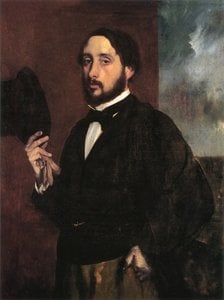
A Life Immersed in Movement
Edgar Degas, born Hilaire-Germain-De Gas in Paris on July 19, 1834, remains one of the most intriguing and complex figures in French art history. Often associated with Impressionism, a label he actively resisted, Degas was fundamentally a realist—a meticulous observer of the world around him, dedicated to portraying it with startling honesty and a unique visual language. His early life, comfortably bourgeois thanks to his banker father’s wealth and his mother's Creole background, provided him with access to education and artistic training, though he often felt constrained by academic expectations. Initially enrolled at the Lycée Louis-le-Grand, Degas’s true education began in the Louvre, where he spent countless hours copying works by masters like Raphael and Rembrandt, honing his skills and developing a deep appreciation for classical form. However, this wasn't simply imitation; it was a process of intense study and critical engagement with artistic tradition—a foundation upon which he would later build his own distinctive style. His father’s encouragement, recognizing his son’s innate talent, allowed him to establish a studio within their grand home, providing a space for experimentation and self-discovery.
Beyond Impressionism: A Unique Artistic Vision
While many of his contemporaries, including Monet and Renoir, sought to capture the fleeting effects of light outdoors, Degas largely worked within the confines of his Parisian studio. His subject matter was decidedly modern—a departure from the historical or mythological scenes favored by traditional academic painters. He found inspiration in the vibrant, often overlooked details of everyday Parisian life: the bustling activity of laundresses at the Seine, the alluring figures of cabaret singers and dancers, the quiet elegance of milliners crafting their creations. It is this fascination with ballet that defines much of his oeuvre—a world of grueling rehearsals, physical strain, and fleeting moments of grace amidst a demanding profession. Degas didn’t simply paint beautiful ballerinas; he captured the *reality* of their lives, revealing both their beauty and their hardship. His compositions are often unconventional, cropping figures in unexpected ways, utilizing asymmetrical arrangements, and employing a dynamic sense of movement that draws the viewer into the scene. He was particularly adept at capturing the subtle nuances of gesture and expression, conveying not just what he saw but also *how* it felt to be present in those moments. His work is characterized by an intimate, almost voyeuristic perspective, as if he were a silent observer privy to private dramas unfolding before him.
Influences and Artistic Development
Degas’s artistic journey was shaped by a remarkably diverse range of influences. His early training emphasized classical principles, particularly the meticulous draftsmanship championed by Jean-Auguste-Dominique Ingres, whose emphasis on precise form and idealized beauty left an indelible mark on his work. However, he also admired the Realist movement, spearheaded by artists like Gustave Courbet, who challenged academic conventions and sought to depict contemporary life with unflinching honesty. A pivotal moment in his development came through his association with Camille Pissarro, a leading Impressionist who encouraged him to experiment with new techniques and broadened his artistic horizons. Degas was deeply captivated by Japanese prints—
Ukiyo-e—which exerted a profound influence on his compositions, color palettes, and use of asymmetrical arrangements. He studied the bold lines, flattened perspectives, and decorative patterns of these woodblock prints, incorporating them into his own work to create a sense of dynamism and visual interest. Furthermore, Degas embraced photography as a tool for studying movement and capturing fleeting moments in time—a technique he skillfully integrated into his paintings, particularly his depictions of dancers. He wasn’t simply copying what he saw; he was actively synthesizing diverse influences into something entirely new and uniquely his own.
Major Works and Techniques
Degas's artistic output spanned a remarkable range of subjects and media. His paintings of ballet dancers—such as *The Dance Class*, *Little Dancer on the Bar* (bronze sculpture), and *L’Étoile*—are arguably his most famous works, capturing the intensity of rehearsals and the fleeting beauty of performance with unparalleled skill. He also produced a significant body of pastel drawings, often depicting scenes from Parisian life—laundresses at work, milliners displaying their wares, and street vendors hawking their goods. His use of pastels was particularly innovative, employing a loose, expressive technique that captured the immediacy of observation. Beyond painting and sculpture, Degas also experimented with monotypes (unique prints) and drypoint etchings, further expanding his artistic repertoire. His ability to capture movement—not through blurred lines or hazy effects, but through precise observation and careful rendering of form—is a hallmark of his work.
Legacy and Lasting Impact
Edgar Degas died in Paris on September 27, 1917, leaving behind a vast and influential body of work that continues to captivate audiences today. He paved the way for future generations of artists who sought to break free from traditional conventions and explore new ways of representing the world around them. His innovative approach to composition, his masterful draftsmanship, and his unflinching portrayal of modern life have had a profound impact on the course of art history. He wasn’t merely a painter of dancers or racehorses; he was a keen observer of human nature, a master of form and movement, and a true innovator who redefined the possibilities of art. His influence can be seen in the work of Pablo Picasso and Henri Matisse, among others, solidifying his place as one of the most important figures in modern art.
- Innovative Composition: Degas frequently employed unconventional cropping and asymmetrical arrangements.
- Capturing Movement: He masterfully depicted movement through precise observation and rendering.
- Diverse Subject Matter: His work encompassed ballet, Parisian life, and horse racing.



 Megtekintés
 Kézzel festett másolat rendelése
 Küldés
 Megosztás
 Részletek

 Letöltés
 Hasonló darabok
 X-ray felvétel
 Diavetítés
 Statisztika

 Összes részlet megjelenítése






































 Az üvegkeretes opció csak 110 cm alatti méretben érhető el