


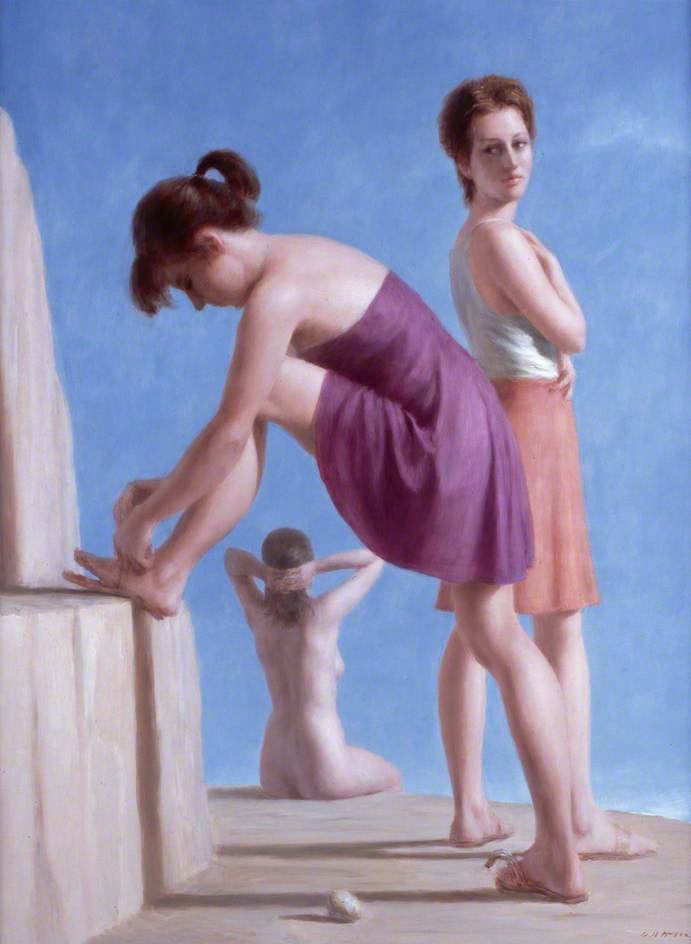
 1998
1998 106.0 x 77.0 cm
 Llyfrgell Genedlaethol Cymru / The National Library of Wales
Kézzel festett olajvastú vászon, az Ön által választott méretben és keretben, művészeink készítik meglévőre. ( Nyomat rendelése Kép letöltése)
Válasszon előre meghatározott méreteink közül, amelyek megfelelnek a műalkotás eredeti arányainak.

Ön megadhat saját méreteket egy adott kerethez vagy térhez igazításhoz. Ha a kiválasztott méret nem egyezik az eredeti kép arányával, akkor a műalkotást levágjuk, vagy további kézzel festett elemekkel meghosszabbítjuk a festményt. A gyártás megkezdése előtt küldünk Önnek egy digitális előnézetet jóváhagyásra.
Kérjük, vegye figyelembe, hogy a képernyőn megjelenő előnézet nem tükrözi a tényleges vágást vagy kiterjesztést. Csak az előnézet fog pontosan mutatni a végső kompozíciót.
Bár egyedi méretek állnak rendelkezésre, javasoljuk, hogy válasszon egy méretet az előre meghatározott listából az eredeti arányok megőrzése érdekében.
Világszerte elérhető szállítás () 3-4 hét alatt a szokásos 5 hét helyett. (7 szeptember). A minőség nem kérdőjelezhető.


Milieu
Reprodukció mérete

In the vast landscape of British figurative painting, few artists possess the ability to bridge the gap between the venerable traditions of the Old Masters and the psychological complexities of the modern era as seamlessly as Harry Holland. Born in Glasgow in 1941, Holland’s journey is one of profound observation and technical devotion. His early years, spent moving through various parts of the United Kingdom before settling in London, provided a rich tapestry of experiences that would later inform his narrative depth. This formative period laid the groundwork for an artist who does not merely paint subjects, but seeks to capture their very essence through a lens of classical realism and meticulous execution.
Holland’s formal artistic identity began to crystallize during his studies at the prestigious Saint Martin's School of Art between 1965 and 1969. It was here that his foundational skills in draughtsmanship and painting were refined, a process further enriched by his early work as a copyist and illustrator. This period of intense study allowed him to absorb the techniques of the past, particularly the luminous oil traditions of masters such as Titian and Velazquez. His academic path also led him to teaching positions at Coventry College of Art, Stourbridge, and Hull, before his move to Cardiff in 1973, a city that would become his creative home for decades to come.
The trajectory of Holland’s career reached a pivotal moment in the late 1970s. His emergence as a significant voice in contemporary art was cemented when the renowned collector Charles Saatchi purchased his work, providing him the freedom to commit himself solely to the practice of painting. This period of professional ascent saw him recognized by the influential critic William Packer as one of the "painters of promise for the 1980s," a distinction that placed him at the forefront of a new generation of British talent. Throughout the 1980s, his reputation expanded far beyond the borders of Wales, with exhibitions spanning the cultural hubs of New York, Brussels, and Paris.
Holland’s oeuvre is a masterful exploration of several recurring themes that speak to the timelessness of the human condition:
What distinguishes a Holland painting is the palpable sense of history embedded within every brushstroke. His style is not merely an imitation of the past but a conscious homage to it. By integrating classical design elements—such as anatomical accuracy and balanced composition—with a keen eye for modern life, he creates works that feel both ancient and immediate. Whether rendering the evocative details of a horse-drawn carriage in Tally-Ho or capturing the quiet stillness of a contemporary figure, his command over color theory and light remains unparalleled.
Today, Harry Holland stands as a singular figure whose work continues to resonate within prestigious collections and galleries, including the Martin Tinney Gallery in Cardiff. His ability to distill complex emotions into powerfully resonant images ensures his place in the lineage of great figurative painters. He remains an artist who does not just observe the world, but interprets it through a timeless, painterly language that honors the heritage of art while embracing the spirit of his own era.

1941 -

 Megtekintés
 Küldés
 Megosztás
 Részletek

 Letöltés
 Hasonló darabok
 X-ray felvétel
 Diavetítés
 Összes részlet megjelenítése




































 Az üvegkeretes opció csak 110 cm alatti méretben érhető el


