Early Life and the Call of the Frontier
George Catlin, born in Wilkes-Barre, Pennsylvania, in 1796, was destined for a life profoundly shaped by the frontier—a world both alluringly romantic and relentlessly dangerous. His childhood wasn’t one of quiet refinement but rather steeped in tales spun by his mother, Polly Sutton, a woman who herself bore the indelible mark of an Indian raid, vividly recounting her harrowing capture and eventual escape. These stories ignited within young Catlin a deep fascination with the West—a land perceived as simultaneously forbidding and brimming with an untamed beauty he felt compelled to understand and preserve. Initially pursuing a career in law, he found himself drawn not to the courtroom but to the act of capturing fleeting moments and enduring traditions. After only two years, recognizing this inner calling, he abandoned legal practice, driven by an artistic impulse and a growing conviction that the unique cultures of Native American tribes were rapidly disappearing, demanding meticulous documentation for posterity. This wasn’t merely a pursuit of aesthetic appreciation; it was a sense of urgency—a premonition that westward expansion would irrevocably alter these vibrant societies. His early work began with engravings depicting scenes along the Erie Canal, showcasing his developing technical skill and an eye for detail – qualities that would later become hallmarks of his ambitious projects. These initial endeavors served as a crucial foundation, honing his observational abilities and solidifying his commitment to visual storytelling as a means of preserving a vanishing world.
Documenting a Vanishing World: The Indian Gallery
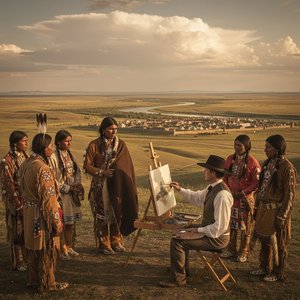
Catlin’s most enduring legacy is undoubtedly “The Indian Gallery,” an extraordinary collection comprising over 500 paintings dedicated to portraying the lives, customs, and spiritual beliefs of Native American tribes across North America. Beginning in the 1830s, he embarked on five extensive expeditions into the vast territories of the American West—ascending the Missouri River and venturing deep into lands inhabited by diverse tribes such as the Mandan, Sioux, Blackfeet, and Choctaw. Crucially, Catlin didn’t simply observe from a detached perspective; he immersed himself within these communities, participating in ceremonies, witnessing daily life, and forging genuine relationships with tribal leaders. His paintings are not merely portraits but vibrant windows into a world on the brink of transformation. Consider *Sham Fight, Mandan Boys* (1832-1833), a dynamic depiction of a playful mock battle among young Mandan warriors—a scene brimming with youthful energy and cultural significance. Similarly, *Medicine Buffalo of the Sioux* (1839) captures the dignity and power of a prominent Sioux leader, conveying not just his physical presence but also his spiritual authority. Catlin’s meticulous attention to detail extends beyond mere likeness; he often incorporates elaborate backgrounds—landscapes, tipis, ceremonial objects—that provide crucial context for understanding his subjects and their environments. His work stands as a testament to his belief that accurate representation was essential to preventing the misrepresentation and ultimately, the erasure of Native American cultures.
The Journey West: Challenges and Artistic Evolution
Catlin’s expeditions were far from easy. He faced immense logistical challenges—navigating treacherous rivers, enduring harsh weather conditions, and overcoming the skepticism and sometimes hostility of settlers and government officials. Financially, he struggled throughout his career, often relying on the sale of prints and paintings to support himself and his family. Despite these difficulties, Catlin remained steadfast in his commitment to documenting Native American life. He meticulously recorded his observations in a series of detailed letters and books, including *Letters and Notes on the Manners, Customs, and Conditions of North American Indians* (1841) and *Last Rambles Amongst the Indians of the Rocky Mountains and the Andes* (1868). These writings provided invaluable insights into tribal customs, social structures, religious beliefs, and artistic traditions—information that would have been lost to history without his dedicated efforts. His style evolved over time, moving from more literal engravings to increasingly expressive oil paintings. He experimented with color and composition, striving to capture not just the outward appearance of his subjects but also their inner spirit and connection to the land.
Recognition and Legacy
Despite facing considerable resistance and a lack of widespread recognition during his lifetime, Catlin’s work eventually gained acclaim in Europe, particularly in London and Paris, where exhibitions of “The Indian Gallery” drew large audiences and sparked significant interest in Native American cultures. His paintings were lauded for their realism, emotional depth, and the way they challenged prevailing stereotypes. However, financial difficulties persisted, leading to a period of hardship and ultimately, the loss of his collection to creditors. In later years, he attempted to recreate over 400 of his most important paintings in a smaller “cartoon collection,” hoping to recoup some of his losses, but this effort proved largely unsuccessful. George Catlin died in 1872, leaving behind a remarkable body of work that continues to be studied and appreciated today. His legacy extends beyond the artistic realm—he is remembered as a passionate advocate for Native American rights and a pioneer in documenting a culture on the brink of extinction. His paintings serve as powerful reminders of the importance of cultural preservation and the need to challenge biased perspectives about indigenous peoples, ensuring that their stories are not forgotten.
Key Works
- Sham Fight, Mandan Boys (1832-1833): A lively depiction of a playful mock battle among young Mandan warriors.
- Mrs. George Catlin (Clara Bartlett Gregory) (1850): A portrait showcasing the artist’s wife, offering insight into his personal life.
- Pipestone Quarry, Coteau Des Prairies (1848): Illustrates a sacred site for many tribes and their spiritual connection to the land.
- Medicine Buffalo of the Sioux (1839): A striking portrait capturing the dignity and power of a prominent Sioux leader.
- Prairie Meadows Burning (1832): Depicts a dramatic scene of controlled burning, highlighting the relationship between Native Americans and their environment.
- Little Wolf, A Famos Warrior (1844): A powerful portrait of a Native American warrior, symbolizing strength and resilience.



 Megtekintés
 Kézzel festett másolat rendelése
 Küldés
 Megosztás
 Részletek

 Letöltés
 Hasonló darabok
 X-ray felvétel
 Diavetítés
 Statisztika


 Összes részlet megjelenítése






































 Az üvegkeretes opció csak 110 cm alatti méretben érhető el