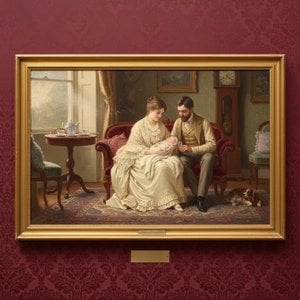
A Life Immersed in Victorian Domesticity
Frederick Daniel Hardy, born February 13th, 1827, in Windsor, Berkshire, was a painter who dedicated his life to capturing the quiet intimacy of Victorian England. He wasn’t a chronicler of grand historical events or sweeping landscapes; instead, Hardy found beauty and meaning within the walls of homes, portraying everyday moments with remarkable detail and sensitivity. Coming from a family steeped in artistic talent – his elder brother George Hardy was also a painter – and musical heritage, as their father served as a musician in the Royal Household, young Frederick initially pursued music at the Royal Academy of Music in Hanover Square. However, after three years, he felt an undeniable pull towards painting, a decision that would define his legacy. This shift wasn’t merely a change in profession but a turning toward a visual language perfectly suited to his temperament and observational skills. His familial connection to Gathorne Gathorne-Hardy, 1st Earl of Cranbrook, further placed him within a network of influential figures who appreciated the arts.
The Shaping of a Genre Painter
Hardy’s artistic development was deeply rooted in the traditions of 17th-century Dutch genre painting. Artists like Pieter de Hooch and Nicolaes Maes, masters of depicting domestic interiors with luminous light and meticulous detail, served as early inspirations. He absorbed their ability to transform ordinary scenes into compelling narratives, imbuing them with a sense of realism and psychological depth. This influence is readily apparent in his earliest works from the 1850s, which focused primarily on cottage interiors. These paintings weren’t simply representations of rural life; they were carefully constructed vignettes that captured the essence of domesticity – the warmth of a hearth fire, the quiet conversations between family members, and the subtle details of everyday routines. However, Hardy wasn’t simply imitating; he was adapting these techniques to reflect the specific character of Victorian life. The close friendship and artistic exchange with Thomas Webster also played a crucial role in shaping his style. Webster, known for his own depictions of rural scenes, encouraged Hardy to experiment with composition and light, pushing him beyond mere imitation towards a more personal vision. As Hardy progressed, he gradually incorporated figures into his interior scenes, moving beyond static depictions of rooms to portray interactions between family members and communities. This evolution marked a shift towards more narrative compositions, where the stories unfolding within these domestic spaces became central to the artwork’s meaning. He exhibited consistently at the Royal Academy from 1851 to 1898, showcasing 93 works that solidified his reputation as a leading genre painter of his time.
Themes of Home, Society and Nostalgia
Throughout his career, Hardy’s paintings revolved around recurring themes: domesticity, family life, social commentary, and a nostalgic view of rural England. He wasn't interested in portraying the lives of the aristocracy or the dramatic events of history; instead, he focused on the experiences of ordinary people – their joys, sorrows, struggles, and routines. Works like
Cottage Fireside (1850) exemplify his early skill in capturing the warmth and intimacy of home life, while later paintings such as
The Sweep (various versions from 1862 onwards) addressed more pressing social issues, highlighting the plight of working-class children.
Looking for Father (1873) offered a critical portrayal of Victorian poverty and hardship, while
After the Party (1875) poignantly depicted the exhaustion of a servant after a social gathering, subtly commenting on class disparities.
The Wedding Dress (1875), with its focus on the labor-intensive process of creating such attire, subtly acknowledged the often-unseen work that underpinned Victorian society’s rituals.
The Dismayed Artist (1866) offered a self-reflective commentary on the challenges faced by artists themselves. Hardy's paintings weren't merely decorative; they were imbued with a quiet social awareness, reflecting the anxieties and aspirations of his time.
The Cranbrook Colony and Lasting Influence
Hardy was a central figure in the Cranbrook Colony, an informal gathering of artists who chose to live and work in the Kentish countryside. This community, which included Thomas Webster and John Callcott Horsley, fostered a supportive environment where artists could share ideas, models, and inspiration. The rural setting provided access to authentic settings and subjects, allowing them to create works that resonated with a growing public appetite for depictions of idyllic country life. Hardy maintained a house in London alongside his residence in Cranbrook, balancing the demands of artistic creation with the need to exhibit and sell his work. His son, Frederic Rembrandt Hardy (also known as Dorofield Hardy), followed in his father’s footsteps, becoming an artist himself. Frederick Daniel Hardy passed away on April 1st, 1911, in Cranbrook, leaving behind a body of work that continues to offer valuable insights into Victorian society and domestic life. His paintings are appreciated not only for their technical skill and detailed observation but also for their subtle social commentary and the enduring warmth they evoke – a testament to an artist who found beauty and meaning in the everyday moments of a bygone era.
Notable Works
Here’s a selection of some of Frederick Daniel Hardy's most celebrated paintings:
- Cottage Fireside (1850) - A quintessential example of his early work, capturing the warmth and intimacy of rural domesticity.
- The Foreign Guest (c. 1853) – Demonstrates his ability to portray subtle social interactions within a familiar setting.
- The Sweep (various versions from 1862 onwards) - A poignant depiction of poverty and hardship, highlighting the plight of working-class children.
- Looking for Father (1873) – A powerful commentary on Victorian social inequalities.
- After the Party (1875) – Captures the weariness and quiet dignity of a servant after a lavish social event.



 Megtekintés
 Kézzel festett másolat rendelése
 Küldés
 Megosztás
 Részletek
 Útmutató

 Letöltés
 Hasonló darabok
 X-ray felvétel
 Diavetítés
 Q&A
Q&A Statisztika
 Összes részlet megjelenítése






































 Az üvegkeretes opció csak 110 cm alatti méretben érhető el