A Quiet Moment in Post-War Intimacy
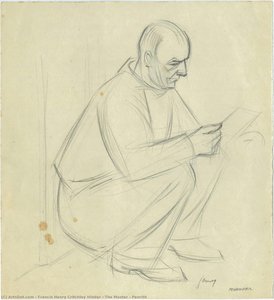
In the delicate, monochromatic strokes of Jerry, we are invited into a private sanctuary of the Australian mid-century avant-garde. Created in 1945 by the visionary Frank Hinder, this intimate drawing serves as more than just a portrait; it is a profound temporal window into a specific, vanished era of creative camaraderie. The subject, Gerald Lewers—a close friend and fellow pioneer of abstraction—is captured in a moment of stillness, seated with a stoic, contemplative gravity. Through Hinder’s masterful use of line and shadow, the viewer feels the weight of the post-World War II atmosphere, where the boundaries between domestic life and artistic pursuit were beautifully blurred.
The composition breathes with the lived-in energy of the Lewers household. While the central figure commands our attention through his steady gaze and grounded posture, the periphery of the work tells a story of communal existence. The presence of figures drifting in the background and the skeletal suggestion of a dining table evoke a sense of shared meals, quiet reading, and the rhythmic pulse of a close-knit circle of intellectuals and artists. It is a scene that celebrates the "art of living," where every corner of the home is infused with the spirit of creation.
Mastery of Line and Abstract Foundations
Technically, Jerry showcases Hinder’s ability to bridge the gap between representational sketching and the burgeoning language of modernism. Though the subject matter is figurative, there is an underlying structural tension in the way the forms are rendered. The interplay of light and dark creates a sculptural depth, hinting at Hinder's later mastery of abstract expressionism and his fascination with making philosophy visible through form. Each stroke carries a deliberate weight, capturing the texture of the fabric and the somber mood of the room with an economy of line that is both efficient and deeply emotive.
For the discerning collector or interior designer, this piece offers a sophisticated touch of historical gravity. The black and white palette provides a timeless elegance that integrates seamlessly into contemporary minimalist settings or classic, curated galleries. It acts as a focal point of quiet strength, inviting conversation about the roots of Australian modernism. To possess a reproduction of such a work is to hold a fragment of art history—a piece that does not merely decorate a wall but anchors a room with its profound sense of peace, intellect, and enduring human connection.



 Megtekintés
 Áttérés Nyomtatványra
 Küldés
 Megosztás
 Részletek

 Letöltés
 Hasonló darabok
 X-ray felvétel
 Diavetítés
 Statisztika


 Összes részlet megjelenítése






































 Az üvegkeretes opció csak 110 cm alatti méretben érhető el