A Life Interwoven: The Art of Francesco Clemente
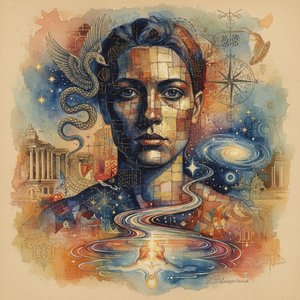
Francesco Clemente, a name synonymous with vibrant intensity and profound symbolism, emerged as one of the most significant figures in late 20th-century art. Born in Naples, Italy, in 1952, his artistic journey is not merely a chronicle of stylistic shifts but a deeply personal exploration—a restless seeking that led him from architectural studies to an immersion in the spiritual and aesthetic traditions of India, ultimately forging a globally recognized visual language. Clemente’s paintings are rarely simple representations; they are portals into realms where dream logic intertwines with ancient symbolism, where the human body is rendered as both vulnerable and transcendent. Early influences—the architectural rigor of Alighiero Boetti and the expressive freedom of Cy Twombly—provided a foundation, but it was his encounter with Eastern philosophies that truly ignited his unique visual voice. He wasn’t simply pursuing aesthetic novelty; he embarked on a profound quest to understand the human condition itself, a search reflected in every brushstroke and carefully chosen symbol.
The Transavanguardia & A Return to Narrative
Clemente's rise to prominence coincided with the Italian *Transavanguardia* movement of the late 1970s—a deliberate rebellion against the prevailing conceptual art and minimalist formalism that had dominated the preceding decade. This was a powerful return to figuration, to narrative, to the expressive power of paint itself. While many artists were stripping away layers of meaning, Clemente actively built them up, layering symbols and allusions drawn from personal mythology, Hindu iconography, and the collective unconscious. His participation in the 1980 Venice Biennale served as a crucial turning point, catapulting him onto the international stage. He wasn’t merely painting pictures; he was constructing worlds—fragile, enigmatic, and deeply evocative. This period saw Clemente grappling with themes of identity, spirituality, and the human condition, often depicting figures fragmented or distorted, reflecting an inner psychological landscape. The body, in his work, is rarely a static form but rather a threshold, a liminal space between the self and the universe.
This embrace of subjectivity and emotional resonance was a direct challenge to the cool detachment that had characterized much of the art world prior. Clemente’s paintings frequently feature surreal juxtapositions and ambiguous spaces, resisting easy interpretation—inviting viewers to engage in a dialogue with the work rather than passively receiving it.
India as Muse: A Profound Transformation
The artist's first journey to India in 1973 proved transformative. It wasn’t merely a geographical relocation; it was an immersion into a different way of seeing, of being. He spent extended periods living and working in Madras (now Chennai), studying Sanskrit, delving into Hindu and Buddhist literature, and collaborating with local artisans. This exposure profoundly shaped his artistic style, infusing it with the vibrant colors, intricate details, and symbolic richness of Indian miniature painting and folk art traditions. The influence is palpable—not as imitation, but as a deeply internalized aesthetic that reshaped his approach to composition, color, and subject matter. He absorbed the philosophical underpinnings of these ancient cultures, incorporating them into his exploration of consciousness and existence. This period wasn’t about appropriating another culture; it was about forging a synthesis between Eastern and Western perspectives, creating something entirely new.
The delicate precision of miniature painting found its way into Clemente’s work, alongside the raw emotionality he had cultivated in Italy. His time in India fostered a deep respect for spirituality and a fascination with the interconnectedness of all things—themes that would continue to permeate his art throughout his career.
A Continuing Legacy: Neo-Expressionism & Beyond
Clemente’s arrival in New York City in 1980 coincided with the rise of *Neo-Expressionism*—a movement that saw a resurgence of figurative painting and emotionally charged imagery. He quickly became a key contributor, his work resonating with an audience hungry for art that spoke to the human experience with raw honesty and vulnerability. His paintings from this period often feature dreamlike scenarios, surreal juxtapositions, and ambiguous spaces that resist easy interpretation. The recurring motif of the body—often fragmented, vulnerable, or in states of transformation—continues to be a central theme. Throughout his career, Clemente has consistently pushed boundaries, experimenting with different media—from oil paint and watercolor to fresco and sculpture—and collaborating with writers like Allen Ginsberg and Robert Creeley. His election to the American Academy of Arts and Letters in 2002 further solidified his standing within the art world, a testament to his enduring influence.
Clemente’s work is not easily categorized; it exists in a space between cultures, traditions, and artistic movements. He remains a vital and influential figure, constantly evolving and challenging our perceptions of art and reality.
A Bridge Between Worlds
The historical significance of Francesco Clemente lies in his ability to synthesize disparate cultural and artistic traditions into a cohesive and deeply personal vision. He didn’t simply borrow from Eastern or Western aesthetics; he *translated* them, creating a visual language that is both ancient and contemporary. His contributions to the Transavanguardia movement were crucial in revitalizing figurative painting at a time when conceptual art dominated. More than just an artist, Clemente is a cultural bridge—a conduit between worlds—whose work invites us to contemplate our place within the vast tapestry of human experience.
- His paintings are filled with symbolic imagery drawn from diverse sources.
- He masterfully blends traditional techniques with contemporary sensibilities.
- Clemente’s art explores universal themes of identity, spirituality, and mortality.
He continues to live and work between New York, Chennai, and Varanasi, constantly evolving and challenging our perceptions of art and reality.


 Kézzel festett másolat rendelése



 Megtekintés
 Küldés
 Megosztás
 Részletek
 Útmutató

 Letöltés
 Hasonló darabok
 X-ray felvétel
 Diavetítés
 Kérdések és válaszok
 Statisztika
 Összes részlet megjelenítése






































 Az üvegkeretes opció csak 110 cm alatti méretben érhető el


