


Szerezzen be nyomtatásra kész fájlt, amely messze túlmutat a webes előnézeten. Minden általunk értékesített digitális kép az adatbázisunkban található nagy felbontású mesterfájlból származik – általában 5 000 és 15 000 pixel szélességű –, így magabiztosan nyomtathat nagy méretben, sokat vághat a képen, vagy reprodukálhatja a legfinomabb részleteket is.
Stúdiómból egyetlen fájl sem távozik feltartózkodás nélkül. Egy digitális szakértő az eredeti festménnyel összehasonlítja a színeket, és szükség esetén korrigálja azokat, majd professzionális retusználó eszközökkel javítja a tisztaságot és a részletgazdagságot — miközben mindig hű marad a művész vonalvezetéséhez és stílusához. Az eredmény egy olyan kép, amely úgy néz ki, mint egy festmény, és nem úgy, mint egy szűrőzött szkenn.
A végső munka befejezése előtt jóvá kell hagynia a képet: szakértőnk 72 órán belül elküldi azt e-mailben ellenőrzésre. Nem tetszett? Kérhet javításokat vagy korrekciókat, illetve visszatérítést kérhet, amennyiben a minőség nem felel meg az elvárásoknak.
Ez az a minőség, amelyre a kiadók, a design stúdiók, a galériák és a nyomdaték megbízhatnak.
Töltsön le nagy felbontású fájlt személyes kiállításokhoz, nyomtatáshoz és kreatív projektekhez. ( Váltás nyomtatványra Kézzel festett másolat rendelése)
Amikor a WahooArt.com szolgáltatást választja, nem csupán egy képet kap – professzionálisan felmagasított digitális műalkotást kap, amely precizitással készült, és amelyet megelégsedési gwarancia tesz biztoslássá. Az alábbiakban automatikusan minden benne 】
A nagy felbontású digitális képmásolatát a megrendelést követő 72 órán belül e-mailben elküldjük Önnek – azonnal használható formátumban.
Műve professzionális módon kerül optimalizálásra fejlett mesterséges intelligencia eszközök és manuális szerkesztés segítségével, biztosítva a maximális részletességet, tisztaságot és színpontosságot.
Véletlenül törölted vagy elvesztetted a fájlodat? Ne aggódj – bármikor ingyen újra megküldjük neked.
Élvezze műalkotásait azonnal, vám, illeték vagy szállítási költség nélkül – a digitális letöltések mindig adamentesek.
Professzionális eszközök és színkezelés segítségével garantáljuk, hogy digitális képe a lehető legpontosabban tükrözze az eredeti színeket.
Ha nemມີ elégedett a digitális képével, 100 napon belül felülvizsgáljuk vagy 100% visszatérítjük az amountot – kérdés बिना.
Nem tetszett a vásárlás? 100 napon belül teljes visszatérítést garantálunk a digitális fájl megvételétől számítva – kérdés nélkül.
Vásároljon 3 képet, spóroljon 10%-et - Vásároljon 5-öt, spóroljon 15%-et - Vásároljon 10+ képet, spóroljon 20%-at. Kiváló kreatív projektekhez, galériákhoz és ügynökségekhez.

Cuthbert Hamilton Ellis, known affectionately to many as "Chip," was far more than a mere chronicler of locomotives; he was a poet of the industrial age. Born on June 29th, 1909, in Raynes Park, Surrey, his soul was irrevocably tethered to the rhythmic pulse of the railway from a tender age. His childhood memories of steam-powered journeys through the lush landscapes of Cornwall served as the foundational inspiration for a life dedicated to capturing the grandeur of the iron horse. This profound fascination would eventually blossom into a dual legacy as both a distinguished writer and a meticulous painter, making him one of the most significant figures in twentieth-century railway art.
His intellectual journey was marked by an eclectic blend of classical education and technical curiosity. Educated at the prestigious Westminster School, Ellis cultivated an appreciation for literature that would later inform his evocative prose, even as he developed a burgeoning interest in the mechanics of engineering. Although his time at Munich and Exeter College, Oxford, provided him with a broader academic horizon, he famously found the traditional rigors of Oxford somewhat unrewarding, a realization that perhaps liberated him to pursue a more visceral, hands-on engagement with the world of steam and steel.
Before his brushstrokes became widely celebrated, Ellis established himself as a formidable voice in railway journalism. His literary career began remarkably early, in 1922, when he joined the staff of Country Life. This period was crucial for honing his descriptive powers and building deep connections within the tight-knit community of railway enthusiasts and engineers. Through his work at publications such as Railway Gazette and Modern Transport, he became a respected commentator on industrial progress, possessing a rare ability to translate complex locomotive designs into narratives that resonated with both experts and laypeople alike.
The depth of his literary contribution is evidenced by the staggering output of thirty-six books, many of which remain essential reading for historians of the era. His debut novel, The Engineer-Corporal, published in 1939, showcased his ability to weave technical precision with human drama. Perhaps his most enduring literary achievement, The Trains we Loved, serves as a nostalgic and deeply moving tribute to a vanishing way of life. Even during the shadows of World War II, Ellis’s life took on cinematic proportions; while working under the guise of a journalist in Switzerland for Modern Transport, he was reportedly involved in clandestine operations for MI6, adding an element of high-stakes intrigue to his already storied biography.
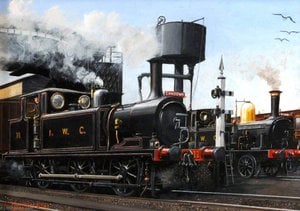
As an artist, Ellis’s style was defined by a profound commitment to realism, tempered by a lyrical sensibility that captured the romantic essence of the steam era. His paintings were not merely technical diagrams of engines; they were atmospheric studies of light, motion, and the interplay between man-made marvels and the natural world. Whether depicting the dramatic lighting of a locomotive at dusk or the quiet dignity of a train traversing the Kent countryside, his work possessed an unmistakable emotional resonance.
His technical mastery allowed him to render the heavy, metallic textures of locomotives with startling accuracy, yet he never lost sight of the "soul" of the machine. His oeuvre often features:
Through his dual mastery of the pen and the brush, Cuthbert Hamilton Ellis ensured that the majesty of the steam locomotive would not fade into the obscurity of history. He remains a pivotal figure whose work serves as a bridge between the raw power of the industrial revolution and the tender nostalgia of the twentieth century, preserving the heartbeat of the railways for generations to come.
1909 - 1987
 Megtekintés
 Küldés
 Megosztás
 Részletek
 Útmutató

 Letöltés
 Hasonló darabok
 X-ray felvétel
 Diavetítés
 Kérdések és válaszok
 Statisztika
 Összes részlet megjelenítése


