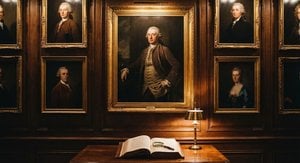
The Legacy of Charles Albert Ludovici: A Victorian Master of Portraiture
In the golden age of Victorian portraiture, few artists captured the quiet dignity and social complexity of the era as masterfully as Charles Albert Ludovici. Born in 1820 into a lineage of creative distinction—his father being a noted sculptor—Ludovici was destined for a life steeped in the fine arts. His journey was one of international refinement, bridging the artistic traditions of the Continent with the prestigious academic circles of London. This unique heritage allowed him to infuse his work with a cosmopolitan elegance that set him apart from many of his British contemporaries, establishing him as a painter capable of translating both physical likeness and psychological depth onto the canvas.
Ludovici’s formal education at the Royal Academy in London served as the bedrock of his technical prowess. Under the guidance of luminaries such as Sir George Watts and Frederic Leighton, he mastered the rigorous academic conventions of his time. Yet, even within these structured boundaries, a restless, emotive spirit began to emerge. Influenced by the sweeping drama of the Romantic movement and the evocative lighting of artists like Eugène Delacroix, Ludovici developed a style that moved beyond mere documentation. He sought to capture the very soul of his subjects, utilizing subtle nuances in gesture and expression to tell stories that resided beneath the surface of silk and lace.
Technique, Light, and the Art of Observation
The true magic of a Ludovici portrait lies in its luminous execution. A devotee of oil on canvas, he employed a sophisticated glazing method, layering thin, translucent coats of pigment to achieve a breathtaking depth of tone. This technique allowed light to penetrate the paint layers and reflect back, giving skin a lifelike radiance and fabrics a tactile, shimmering quality. His ability to manipulate light was not merely a technical feat but a narrative tool; he used theatrical shadows and soft highlights to direct the viewer's eye and evoke specific moods, ranging from the somber gravity of a scholar to the delicate innocence of a child.
His repertoire of subjects reflected the stratified elegance of 19th-century society. Ludovici became a sought-after portraitist for the era's most influential figures, including:
- Members of the Royal Family, capturing the formal majesty of Queen Victoria and Prince Albert.
- Intellectual Giants, such as the poet Lord Tennyson and the renowned scientist Sir William Crookes.
- The Pre-Raphaelite Circle, notably documenting the presence of Dante Gabriel Rossetti within his social orbit.
- The Aristocracy and Industrialists, providing enduring visual records of the families that shaped the British Empire.
A Lasting Impression on Art History
As the 19th century progressed, Ludovici’s work remained a steadfast pillar of realism amidst changing artistic tides. While later movements would push toward abstraction and impressionism, Ludovici stayed true to the power of the human form and the importance of meticulous detail. His legacy is not merely found in the museums that house his works, but in the way he documented a vanishing world—a period of profound transition where tradition met modernity. Through his brush, the faces of the past continue to gaze upon us with an unmistakable vitality, reminding us of the enduring human connection that fine art provides across the centuries.



 Megtekintés
 Kézzel festett másolat rendelése
 Küldés
 Megosztás
 Részletek

 Letöltés
 Hasonló darabok
 X-ray felvétel
 Diavetítés
 Statisztika


 Összes részlet megjelenítése






































 Az üvegkeretes opció csak 110 cm alatti méretben érhető el