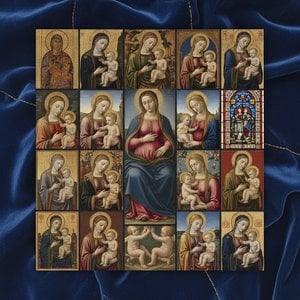
Carlo Dolci’s “Madonna in Glory”: A Window into Florentine Piety
“Madonna in Glory,” attributed to Carlo Dolci, offers a profound glimpse into the heart of 17th-century Italian Baroque art – specifically, the deeply felt piety that characterized his work. Painted around 1670, this captivating portrait transcends mere representation; it’s an intimate devotional experience captured on canvas. The image depicts the Virgin Mary in a pose of serene contemplation, her gaze directed upwards as if lost in prayer or reflection. Dolci's Florence was a city steeped in religious tradition, and his art served as a powerful conduit for spiritual connection, reflecting this profound faith.
The composition is strikingly simple yet remarkably effective. The focus rests entirely on the Virgin’s face and upper body, framed within a dark, atmospheric background punctuated by subtle starlight – an effect that lends a sense of mystery and timelessness to the scene. Dolci masterfully employs vertical lines through the framing and Mary's posture to draw the viewer's eye upwards, mirroring her contemplative gaze. The use of shallow perspective creates a feeling of immediacy, inviting us into this private moment of devotion.
A Symphony of Color and Light: Technique and Materials
Dolci’s technical skill is immediately apparent in the meticulous detail and luminous quality of the painting. He was renowned for his painstaking approach, often spending weeks on a single figure as described by Baldinucci. This dedication manifests in the smooth, polished surfaces achieved through layers of translucent glazes – a technique that allows light to penetrate and reflect from within the paint itself, creating an ethereal glow. The color palette is dominated by deep blues and purples, evoking a sense of solemnity and reverence, while strategically placed highlights of gold and pink accentuate her skin tones and the halo surrounding her head, symbolizing divine grace.
The artist’s choice of materials – oil paints on canvas – further contributes to the painting's rich texture and longevity. The careful application of paint allows for a remarkable level of detail, from the delicate folds of her robe to the subtle modeling of her face. Dolci wasn’t interested in dramatic theatricality; instead, he prioritized capturing the quiet dignity and inner peace associated with religious devotion.
Symbolism and Spiritual Depth
Beyond its aesthetic beauty, “Madonna in Glory” is laden with symbolic meaning. The halo, a ubiquitous feature of Marian depictions, unequivocally signifies her holiness and connection to the divine. Her upward gaze is often interpreted as representing contemplation, prayer, or perhaps even an acknowledgement of God’s presence. Dolci's work isn't about grand narratives; it’s about conveying a deeply personal experience of faith – a quiet communion between the earthly and the sacred.
Interestingly, Dolci’s artistic practice was characterized by repetition. He frequently painted the same compositions multiple times, often with slight variations, suggesting a meditative process rather than a purely commercial one. His daughter, Agnese, even assisted him in creating copies of his works, further emphasizing this dedication to faithfully representing religious subjects.
A Legacy of Florentine Piety
Carlo Dolci’s “Madonna in Glory” stands as a testament to the enduring power of Florentine Baroque art. It's more than just a portrait; it’s an invitation into a world of quiet contemplation and profound spiritual connection. Reproductions offered by WahooArt.com allow you to bring this exquisite work into your home, experiencing its beauty and symbolism firsthand. Consider how this piece might complement your interior design – its serene colors and contemplative subject matter creating a space of peace and reflection.
For further exploration, we encourage you to visit the WahooArt.com page dedicated to “Madonna in Glory”, where you can discover more about its creation and Dolci’s artistic legacy. You may also find inspiration in the artist's other works or by visiting the Chiesa di SS. Vittore e Carlo in Genoa, where many of his paintings are displayed.



 Megtekintés
 Kézzel festett másolat rendelése
 Küldés
 Megosztás
 Részletek

 Letöltés
 Hasonló darabok
 X-ray felvétel
 Diavetítés
 Statisztika


 Összes részlet megjelenítése






































 Az üvegkeretes opció csak 110 cm alatti méretben érhető el