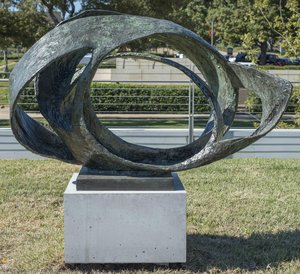
Single Form (Chûn Quoit): A Meditation on Neolithic Echoes
Barbara Hepworth’s “Single Form (Chûn Quoit)” is not merely a sculpture; it's an invitation into a dialogue with the ancient, a resonant echo of prehistoric ritual and the enduring power of form. Created in 1961, this arresting piece—a study in dark stone, meticulously carved and subtly textured—captures Hepworth’s signature style: a masterful blend of abstraction and deeply rooted connection to the natural world. The work immediately commands attention with its verticality, a stark yet graceful presence that speaks of both strength and vulnerability. It's a form that seems simultaneously grounded in the earth and reaching for something beyond – a visual embodiment of contemplation.
The sculpture’s genesis lies within the evocative landscape of Cornwall, specifically referencing the “quoit” chamber tombs found on the Penwith peninsula. These Neolithic structures, characterized by their distinctive circular openings, served as sacred spaces, imbued with layers of ritual and belief. Hepworth deliberately chose to evoke this ancient geometry, translating its essence into a contemporary form. The rough-hewn surface of the stone, achieved through careful carving and polishing, suggests the raw materiality of the original tombs while simultaneously hinting at the artist’s deliberate shaping – a delicate balance between preservation and reimagining.
Materiality and Technique: A Dance Between Stone and Light
Hepworth's choice of material—a dark, possibly bronze or similar stone—is crucial to the sculpture’s impact. The deep hue absorbs light, creating an immediate sense of weight and solidity. Yet, it is not a monolithic mass; subtle variations in texture – areas of roughness juxtaposed with polished surfaces – invite close inspection. This tactile quality encourages viewers to engage physically with the work, sensing its form through touch as much as sight.
The technique employed is one of painstaking refinement. Hepworth’s process involved a deliberate layering and shaping of the stone, guided by an intuitive understanding of its inherent qualities. The circular opening, piercing the upper portion of the sculpture, isn't simply a decorative element; it acts as a focal point, drawing the eye inward and suggesting a portal to another realm. The subtle gradations in tone, achieved through careful polishing and carving, create a sense of depth and volume, transforming what could have been a flat plane into a dynamic three-dimensional form.
Symbolism and Emotional Resonance
“Single Form (Chûn Quoit)” transcends its purely formal qualities to evoke profound symbolism. The reference to the Neolithic quoit tombs speaks to humanity’s enduring fascination with death, ritual, and the mysteries of the past. The sculpture can be interpreted as a meditation on time, memory, and the cyclical nature of existence – a reminder that we are all connected to those who came before us.
Furthermore, the work possesses an undeniable emotional resonance. Its austere beauty and contemplative form invite viewers to slow down, to breathe deeply, and to engage in a quiet dialogue with their own inner selves. The sculpture’s simplicity is deceptive; it holds within it a vastness of meaning, prompting reflection on themes of spirituality, mortality, and the enduring power of human creativity.
A Legacy of Modern Sculpture
Barbara Hepworth was a pivotal figure in 20th-century art, pioneering new approaches to sculpture that moved beyond traditional representational forms. “Single Form (Chûn Quoit)” stands as a testament to her innovative spirit and her profound connection to the natural world. Her work continues to inspire artists and collectors alike, offering a timeless exploration of form, space, and the human condition. Reproductions of this iconic piece provide a remarkable opportunity to bring Hepworth’s vision into any setting, adding a touch of contemplative elegance and historical significance.
Kérdések és válaszok
Milyen színpalettát és milyen hangulatot ábrázol a "Single Form (Chûn Quoit)"?
A „Single Form (Chûn Quoit)”, Barbara Hepworth alkotása Neutrals palettája harmonikában összhangban van a Reflective érzelmi hangulatával. A szín az egyik eszköze annak, ahogyan egy mű érzéseket közvetít.
Mely művészeti irányba tartozik a „Single Form (Chûn Quoit)”, Barbara Hepworth alkotása?
A „Single Form (Chûn Quoit)”, Barbara Hepworth alkotása a Modernism irányzat része. Ez az irányzat adja a mű stilisztikai kontextusát.
Mennyire erős a kontraszt a(z) „Single Form (Chûn Quoit)”, Barbara Hepworth alkotása alkotásban?
A „Single Form (Chûn Quoit)”, Barbara Hepworth alkotása Statement kontrasztot mutat a világos és sötét részek között.



 Váltás nyomtatványra
 Küldés
 Megosztás
 Részletek
 Útmutató

 Letöltés
 Hasonló darabok
 Diavetítés
 Statisztika


 Összes részlet megjelenítése