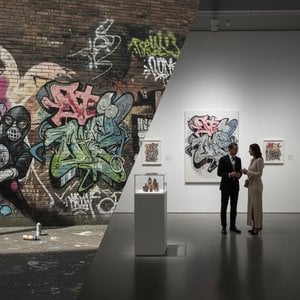
Banksy: A Biography
Early Life and Origins
Born around 1974 in Bristol, England, Banksy’s true identity remains unconfirmed. His early life is shrouded in mystery, though it's known he began as a freehand graffiti artist in the early 1990s, part of the city’s vibrant underground scene. He was influenced by artists like 3D, a founding member of Massive Attack, and developed his skills within the DryBreadZ Crew (DBZ). This period laid the foundation for his distinctive style and rebellious spirit.
Artistic Development & Techniques
Banksy’s artistic development moved from freehand graffiti to a signature stencil-based technique. This allowed for quicker execution of complex designs, crucial for illegal street art. His work quickly gained recognition for its satirical and subversive nature, often combining dark humor with poignant social commentary. He skillfully blends imagery and text, creating impactful statements that challenge the status quo.
Themes & Influences
Banksy’s work consistently tackles challenging themes including:
- Politics: Critiques of war, power structures, and political manipulation.
- Culture: Examination of consumerism, media influence, and societal norms.
- Ethics: Concerns about poverty, inequality, animal rights, and social justice.
His influences extend beyond the graffiti world, drawing inspiration from art history, popular culture, and current events.
Major Works & Projects
Banksy has created a vast body of work, both in public spaces and through limited-edition prints. Some notable examples include:
- Girl with Balloon: Perhaps his most iconic image, symbolizing hope and innocence.
- Bomb Hugger: A powerful juxtaposition of love and destruction.
- Think Tank Blur: A commentary on the complexities of modern conflict.
- The Walled Off Hotel: A fully functioning hotel in Bethlehem built adjacent to the Israeli West Bank barrier, offering a stark reflection on the political situation.
Activism & Public Interventions
Banksy is not merely an artist; he’s also a dedicated activist. He frequently uses his art to draw attention to social and political issues, often staging elaborate interventions in public spaces. His work on the Israeli West Bank barrier, adding images and messages to the concrete wall, is a prime example of his commitment to raising awareness about conflict and injustice.
Historical Significance & Legacy
Banksy has fundamentally altered perceptions of street art, elevating it from vandalism to a respected form of artistic expression. He’s challenged traditional notions of authorship, ownership, and the role of art in society. His work continues to provoke dialogue, inspire activism, and captivate audiences worldwide. He represents a powerful voice for dissent and a reminder that art can be a catalyst for change.



 Előnézet
 Váltás nyomtatványra
 Megosztás
 Megosztás
 Részletek
 Útmutató

 Letöltés
 Hasonló darabok
 X-ray felvétel
 Diavetítés
 Statisztika


 Tovább olvasom






































 Az üvegkeretes opció csak 110 cm alatti méretben érhető el