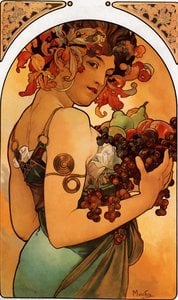
Early Life and Artistic Beginnings
Alphonse Maria Mucha, a name synonymous with the opulent beauty of Art Nouveau, was born on July 15, 1860, in the small Moravian town of Ivanačice. His early life, steeped in the traditions of his Czech homeland, laid the foundation for an artistic vision that would soon captivate Europe. From a young age, Alphonse displayed a remarkable talent for drawing – a gift nurtured by his family’s modest circumstances and a supportive local merchant who provided him with paper, a luxury at the time. This nascent skill blossomed into a passionate pursuit, leading him to study at the Academy of Fine Arts in Prague, though he quickly grew disillusioned with the academy's rigid adherence to classical conventions.
Seeking a more expressive and personal style, Mucha embarked on a journey to Paris in 1887. This move marked a pivotal moment, as it propelled him into the heart of the burgeoning Art Nouveau movement – a period characterized by its celebration of natural forms, flowing lines, and intricate ornamentation. Paris offered a vibrant artistic landscape, influenced by artists like Pierre-Auguste Renoir and Gustave Moreau, whose works subtly shaped Mucha’s developing aesthetic.
The Rise to Fame: Sarah Bernhardt and the “Mucha Style”
Alphonse Mucha's career took an extraordinary turn in 1894 when he was unexpectedly commissioned to design a poster for the play Gismonda, starring the legendary actress Sarah Bernhardt. This seemingly simple task ignited a phenomenal success that catapulted him to international fame. The poster, a masterpiece of Art Nouveau elegance featuring Bernhardt’s captivating image surrounded by swirling floral motifs, became an instant sensation and established what would become known as the “Mucha Style” – a distinctive blend of decorative beauty, stylized femininity, and graceful movement.
This collaboration with Bernhardt proved to be transformative. It launched a prolific period of poster design, magazine illustrations, and theatrical set designs, solidifying Mucha’s reputation as one of the foremost artists of his time. He continued to create stunning visuals for Bernhardt throughout the 1890s, further cementing his signature style.
The Universal Exhibition and International Recognition
The pinnacle of Mucha's early career arrived in 1900 with the invitation to decorate the Bosnia and Herzegovina Pavilion at the Universal Exposition in Paris. This prestigious commission brought him unprecedented international recognition. Alongside his work on the Bosnian pavilion, he collaborated on the Austrian Pavilion, showcasing his artistic versatility and expanding his influence across Europe. The sheer scale of these projects demonstrated Mucha’s ability to translate his distinctive style into grand, public displays – a testament to his growing reputation as a leading figure in the Art Nouveau movement.
The Slav Epic: A Monumental Undertaking
Following his success in Paris, Charles Richard Crane, an American industrialist and passionate supporter of Slavic culture, recognized Mucha’s unique talent and provided him with substantial financial backing. This generous patronage enabled Mucha to embark on a monumental project – The Slav Epic (1912-1930) – a series of twenty large-scale paintings depicting the history and mythology of all the Slavic peoples. This ambitious undertaking, spanning nearly two decades, became Mucha’s magnum opus and remains one of the most significant works in his oeuvre. The *Slav Epic* is not merely a historical chronicle; it's a vibrant tapestry of cultural identity, rendered with Mucha’s signature elegance and symbolic richness.
Legacy and Influence
Alphonse Mucha’s impact on art and design extends far beyond his individual creations. His distinctive Art Nouveau style profoundly influenced generations of artists, designers, and illustrators. His emphasis on decorative beauty, flowing lines, and idealized female figures continues to resonate today, evident in everything from graphic design to fashion. Furthermore, his work served as a powerful symbol of Czech national identity, particularly during the period of Czechoslovakia’s independence. Alphonse Mucha's legacy is not simply one of artistic brilliance; it’s a testament to the enduring power of beauty, symbolism, and cultural expression.



 Megtekintés
 Áttérés Nyomtatványra
 Küldés
 Megosztás
 Részletek

 Letöltés
 Hasonló darabok
 X-ray felvétel
 Diavetítés
 Statisztika


 Összes részlet megjelenítése