Megtekintés Műalkotás AR előnézete Áttérés Nyomtatványra Kézzel festett másolat rendelése Küldés
Részletek Kedvencekhez ad Letöltés Hasonló darabok X-ray felvétel Diavetítés Statisztika

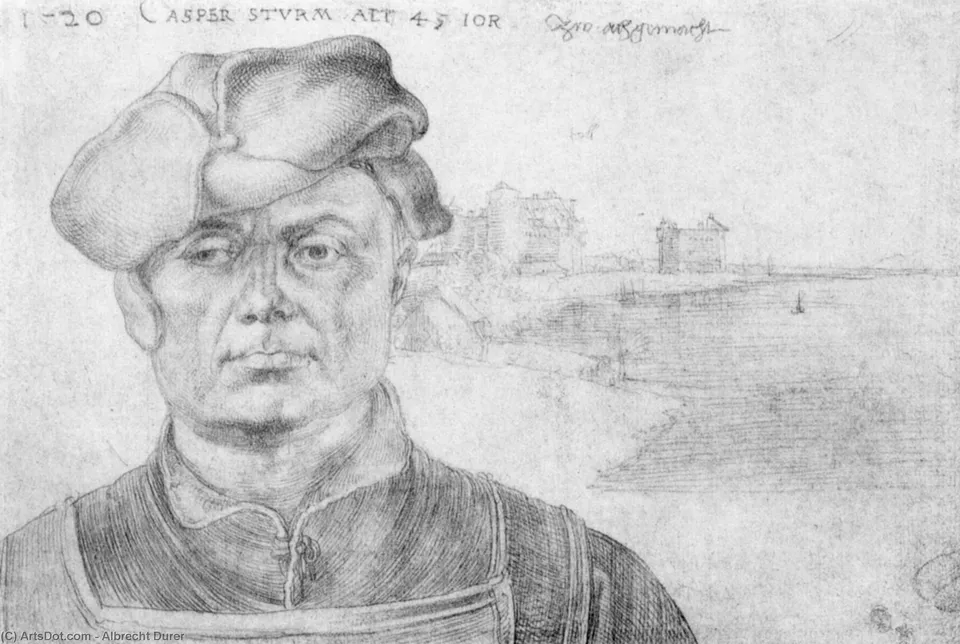
Caspar Sturm

This meticulously crafted silverpoint drawing by Albrecht Dürer portrays Caspar Sturm, showcasing his likeness against a subtle landscape backdrop. Known for unparalleled engraving technique and artistic observation, Dürer’s legacy continues through iconic prints like Melencolia I.

Fedezd fel Albrecht Dürer nagyszerű művészetét! Kézzel festett reprodukcióinkkal élj utólag a német reneszánszi mester ikonikus gravúráit, önportréit és a precíz alkotásait. WahooArt.

Vásároljon nagy felbontású, javított digitális képet, amely minőségében messze felülmúlja az online előnézetet.

Minden fájlt szakembereink a legmodernebb eszközök és precíz, kézi retusálás segítségével készítenek el aprólékosan. Gondoskodunk arról, hogy minden kép kivételes tisztasággal, pontos színhelyességgel és részletgazdag finomsággal rendelkezzen.

A végleges fájl 72 órán belül e-mailben megérkezik, professzionális, szerkesztői és nyomtatási környezetbe optimalizálva az azonnali használathoz. Ez ugyanaz a minőség, amelyben a legmeghatározóbb tervezőstúdiók, kiadók és galériák is megbízhatnak.

Digitális kép

Töltsön le nagy felbontású fájlt személyes kiállításokhoz, nyomtatáshoz és kreatív projektekhez. ( Áttérés Nyomtatványra Kézzel festett másolat rendelése)

Összesített ár

$ 24,90

Minden digitális kép rendeléséhez tartozó extrák

Szakértői digitális kézbesítés, garantáltan

Amikor a WahooArt.com szolgáltatást választja, nem csupán egy képet kap – professzionálisan felmagasított digitális műalkotást kap, amely precizitással készült, és amelyet megelégsedési gwarancia tesz biztoslássá. Az alábbiakban automatikusan minden benne 】

shipping_icon
Gyors e-mail teslimítés

A nagy felbontású digitális képmásolatát a megrendelést követő 72 órán belül e-mailben elküldjük Önnek – azonnal használható formátumban.

canvas_icon
MI-alapú digitális fejlesztésű fájl

Műve professzionális módon kerül optimalizálásra fejlett mesterséges intelligencia eszközök és manuális szerkesztés segítségével, biztosítva a maximális részletességet, tisztaságot és színpontosságot.

insurance_icon
Örök életű ingyenes újradelivery

Véletlenül törölted vagy elvesztetted a fájlodat? Ne aggódj – bármikor ingyen újra megküldjük neked.

tax_icon
Nincs importköltség – soha

Élvezze műalkotásait azonnal, vám, illeték vagy szállítási költség nélkül – a digitális letöltések mindig adamentesek.

color_icon
Színpontosság garantálása

Professzionális eszközök és színkezelés segítségével garantáljuk, hogy digitális képe a lehető legpontosabban tükrözze az eredeti színeket.

return_icon
100 napos elégedettségi garancia

Ha nemມີ elégedett a digitális képével, 100 napon belül felülvizsgáljuk vagy 100% visszatérítjük az amountot – kérdés बिना.

guarantee_icon
100% Pénzvisszatérítési garancia

Nem tetszett a vásárlás? 100 napon belül teljes visszatérítést garantálunk a digitális fájl megvételétől számítva – kérdés बिना.

discount_icon
Tömegrendelési kedvezmények

Vásároljon 3 képet, spóroljon 10%-et - Vásároljon 5-öt, spóroljon 15%-et - Vásároljon 10+ képet, spóroljon 20%-at. Kiváló kreatív projektekhez, galériákhoz és ügynökségekhez.

Gyors információk

  • Year: 1520
  • Subject or theme: Portraiture; Renaissance art
  • Title: Caspar Sturm
  • Dimensions: 127 x 189 cm
  • Medium: Silverpoint Drawing
  • Notable elements or techniques: Detailed etching; Fine lines
  • Influences: Michelangelo

Művészeti kvíz

Minden kérdésre csak egy helyes válasz létezik.

Kérdés 1:
What is the primary subject matter of "Caspar Sturm"?
Kérdés 2:
Which artistic technique was employed by Albrecht Dürer to create the image?
Kérdés 3:
In what historical period did "Caspar Sturm" originate?
Kérdés 4:
What is the significance of Dürer's signature in the lower right corner?
Kérdés 5:
Describe the overall mood conveyed by Dürer's use of lighting in "Caspar Sturm".

A Portrait Etched in Time: The Soul of Caspar Sturm

The image before you is not merely a depiction of a man; it is an embodiment of Renaissance ambition and artistic mastery. Albrecht Dürer’s silverpoint drawing, "Caspar Sturm," completed in 1520, holds within its delicate lines and subtle tonal variations a profound resonance that continues to captivate audiences centuries later. More than just a likeness, Sturm represents the pinnacle of humanist portraiture, reflecting Dürer's unwavering dedication to capturing the human form with unprecedented accuracy and psychological depth. As you gaze upon this monochrome masterpiece, you are invited into a silent dialogue with the past, where every fine stroke serves as a bridge between the sixteenth century and the modern collector.

The subject, Caspar Sturm, is presented with a somber expression that conveys a sense of seriousness and perhaps deep introspection. His gaze directly confronts the viewer, fostering a sense of intimacy and inviting contemplation about the sitter's inner life. This direct engagement is a hallmark of the Northern Renaissance style, where the artist sought to portray individuals as complex beings—capable of both intellect and emotion. The composition is masterfully centered, with Sturm occupying the foreground against a faintly sketched landscape that provides context without distracting from his commanding presence. For those looking to adorn a space with art that commands attention through quiet strength, this portrait offers an unparalleled sense of dignity.

The Alchemy of Silverpoint: Precision and Texture

Dürer’s choice of medium—silverpoint—was revolutionary for its time and remains one of the most demanding techniques in the history of drawing. Unlike oil paints or tempera, silverpoint relies on a stylus tipped with pure silver to draw directly onto a specially prepared surface. This method demanded an extraordinary level of skill and patience; each line must be meticulously crafted, as the medium allows for no corrections. The resulting surface possesses a distinctive granular texture that lends itself beautifully to high-quality reproduction, allowing collectors and designers alike to appreciate the subtle beauty of Dürer’s technique. As scholars have noted, this method is characterized by a remarkable level of detail and tonal gradation.

The technical brilliance of the piece lies in how Dürer utilizes fine, closely spaced lines to create shading and define the subject's features and heavy garments. The lighting appears soft and diffused, creating subtle gradations of tone across Sturm's face, which avoids harsh shadows in favor of a gentle, naturalistic glow. This mastery of light and shadow creates a sense of three-dimensional form on a two-dimensional plane, providing a tactile quality that makes the portrait feel almost alive. For interior designers, the monochromatic palette offers a sophisticated versatility, fitting seamlessly into both classical and contemporary minimalist settings.

A Legacy of Humanism for the Modern Collector

Rooted firmly in the humanist movement that flourished across Europe during the early 16th century, "Caspar Sturm" is a window into an era driven by rediscovered classical texts and an emphasis on human reason. Dürer, a titan of the German Renaissance, used his art to celebrate the individual, and this portrait stands as a testament to that era's intellectual awakening. The meticulous detail suggests a profound respect for the subject’s status, making it an ideal piece for those who value art with historical weight and narrative depth.

Whether you are an art historian drawn to the technical precision of the silverpoint or a decorator seeking a focal point that exudes timeless elegance, this reproduction of Dürer's work offers more than just decoration. It offers a connection to the very foundations of Western portraiture. Owning such a piece is an opportunity to bring the quiet, intellectual rigor of the Renaissance into the modern home, creating an atmosphere of cultured reflection and enduring beauty.


A művész életrajza

A Life Forged in Nuremberg: The Early Years and Apprenticeship

Albrecht Dürer, a name synonymous with the German Renaissance, emerged from the bustling artisan city of Nuremberg in 1471. His father, Albrecht Dürer the Elder, was a successful goldsmith who had immigrated from Hungary, bringing with him a lineage steeped in craftsmanship. It was within this environment—the scent of metal and the meticulous precision of handiwork—that young Albrecht’s artistic inclinations first took root. Though his father envisioned a similar path for him, apprenticing him initially in the family trade, it soon became undeniable that Albrecht possessed an exceptional gift for drawing. At thirteen, he transitioned to the workshop of Michael Wolgemut, Nuremberg's leading artist at the time. This was no mere technical training; it was immersion into a world of illuminated manuscripts, painted panels, and—crucially—the burgeoning art of woodcut illustration. The sheer volume of work produced by Wolgemut’s workshop, including the extensive illustrations for the *Nuremberg Chronicle*, provided Dürer with an unparalleled foundation in design, composition, and the mechanics of image-making. A remarkable silverpoint self-portrait from 1484, created when he was barely a teenager, stands as astonishing evidence of his precocious talent—a testament to a burgeoning artistic identity already taking shape. This early work demonstrates a keen eye for detail, an understanding of perspective, and a nascent desire to capture the essence of human form – qualities that would define his entire career.

The Italian Influence and Artistic Maturation

Dürer’s ambition extended far beyond the confines of Nuremberg. Driven by an insatiable curiosity and a desire to master the art of painting, he embarked on his first journey to Italy in 1494. This was not simply a sightseeing trip; it was a pilgrimage to the heart of the Renaissance. He encountered the works of masters like Raphael, Giovanni Bellini, and Leonardo da Vinci—artists who were redefining the possibilities of form, perspective, and human expression. The impact of this exposure was profound. Dürer absorbed the classical motifs, harmonious compositions, and subtle sfumato techniques that characterized Italian art, yet he never abandoned his Northern European sensibility for meticulous detail and symbolic depth. He was particularly fascinated by the use of light and shadow in Venetian painting, which would later influence his own work. A second sojourn to Italy between 1505 and 1507 further solidified these influences, allowing him to study ancient Roman ruins and refine his understanding of anatomy and proportion. This synthesis of Northern precision and Italian grace became the hallmark of Dürer’s unique artistic style. He returned from Italy not just with new techniques but also with a renewed sense of purpose – to synthesize the best elements of both traditions into a distinctly German Renaissance art.

Mastering the Mediums: Painting, Engraving, and Woodcut

Dürer was a master of multiple mediums, each offering him distinct avenues for creative expression. His paintings, though fewer in number than his prints, demonstrate a remarkable command of oil paint and an ability to capture both physical likeness and psychological depth. Works like the *Feast of the Rose Garlands* (1506) reveal a vibrant palette influenced by Venetian colorism, showcasing his growing mastery of layering pigments and creating luminous effects. However, it was in the realm of printmaking—particularly engraving and woodcut—that Dürer truly revolutionized artistic practice. He elevated these techniques from mere reproductive methods to independent art forms, capable of conveying complex narratives and profound emotions. The *Apocalypse* series (1498), a collection of fourteen woodcuts illustrating the Book of Revelation, showcased his mastery of this medium despite its inherent limitations – he skillfully used hatching and cross-hatching to create dramatic contrasts of light and shadow. Later engravings like *Melencolia I* (1514) and *Saint Jerome in His Study* (1514) are testaments to his unparalleled skill—intricate compositions filled with symbolic meaning and executed with breathtaking precision. He didn’t just depict reality; he imbued it with layers of intellectual and spiritual significance, transforming the printed image into a powerful vehicle for artistic expression.

A Theorist and Innovator: The Legacy of Albrecht Dürer

Dürer was not merely an artist; he was a scholar, a theorist, and an innovator who sought to understand the underlying principles governing artistic creation. He believed in the mathematical foundations of art and dedicated himself to establishing a scientific approach to representation. His treatises on geometry, proportion, and human anatomy—most notably *Four Books of Human Proportion* (1528)—were groundbreaking for their time, demonstrating his commitment to rigorous observation and rational analysis. These writings were not simply academic exercises; they were intended to elevate the status of artists from mere craftsmen to intellectual practitioners. Dürer’s work on perspective, in particular, laid the groundwork for future generations of artists and architects. He meticulously documented the rules of linear perspective, providing a systematic approach to creating realistic spatial illusions. His theoretical writings, combined with his artistic achievements, cemented his reputation as one of the most influential figures in the history of Northern Renaissance art. He remains, to this day, one of the most important figures in the history of Western art.

Influences and Enduring Impact

  • Michael Wolgemut: Dürer’s initial mentor, providing foundational skills in drawing, painting, and woodcut techniques.
  • Leonardo da Vinci: Inspired Dürer’s exploration of anatomy, perspective, and sfumato—the subtle blending of tones.
  • Raphael: Influenced Dürer’s compositional harmony and idealized forms.
  • Giovanni Bellini: Contributed to Dürer's understanding of color and Venetian painting traditions.

Dürer’s influence reverberates through centuries of art history. His meticulous realism, his innovative use of printmaking, and his theoretical writings continue to inspire artists and scholars alike. He demonstrated that art could be both technically masterful and intellectually rigorous—a legacy that continues to shape the artistic landscape today.

Albrecht Dürer

Albrecht Dürer

1471 - 1528 , Olaszország

Érdekességek

  • Artistic Movement Or Style: német reneszánszi
  • Artists Or Movements Influenced By This Artist:
    • Nördlingeni iskola
    • olasz reneszánszi
  • Artists Who Influenced This Artist:
    • Leonardo da Vinci
    • Raffaello
    • Giovanni Bellini
  • Date Of Birth: 1471. máj 21.
  • Date Of Death: 1528. ápr. 6.
  • Full Name: Albrecht Dürer
  • Nationality: német
  • Notable Artworks:
    • Apokalipszis
    • Melencolia I
    • Szent Jéremy
  • Place Of Birth: Nürnberget, Németország