

Djelo prikazano na ovoj stranici zaštićeno je autorskim pravima, što znači da zakonski ne možemo izraditi niti prodati identičnu reprodukciju. Ova se zaštita provodi u skladu s međunarodnim sporazumima kao što su Bernska konvencija i nacionalnim zakonima, uključujući i one koji su utvrđeni u Američki zakon o autorskom pravu – Title 17.
Ova metoda u potpunosti je usklađena s autorskim pravima jer ne uključuje kopiranje ili dupliciranje zaštićenih umjetničkih djela. Umjesto toga, riječ je o kreativnoj reinterpretaciji – novoj slici koja je dobila utjecaj na izvornik, ali nije identična njemu.
Giclée tisak muzejske kvalitete ili otisak na platnu uz brzu izradu i raznolike opcije završne obrade. ( Kupi ručno oslikano djelo Prebacite na digitalnu sliku)
Odaberite jednu od naših unaprijed definiranih veličina koje odgovaraju izvornim proporcijama umjetničkog djela.

Unesite potrebnu širinu i visinu kako bi odgovarali vašem okviru ili zidu. Print se može samo izrezati, nikada ne može biti veći od slike, stoga format s drugačijim omjerom stranica uzrokuje gubitak dijela slike. Prije bilo kakve štampe šaljemo vam digitalni prikaz (mockup) na odobrenje. Slika prikazana na ovoj stranici ne prikazuje stvarni rez — to prikazuje isključivo digitalni prikaz.
Dostava širom svijeta () u roku od 2 tjedna umjesto standardnih 4/5 tjedana. (11 Studeni)
Untitled
Veličina reprodukcije

Born in São Paulo in 1986, Thiago Mundano began finding his voice through street art in the early 2000s. His early work was marked by a directness that sought to engage with the city's public spaces and its political realities. One of his first notable moments of friction with authority occurred in 2007, when he painted graffiti on the legislative assembly plaque located in Ibirap_uera Park. This concrete block, usually a plain grey, became a site of quiet struggle; as the São Paulo prefeitura repainted the block grey to cover his work, Mundano returned to repaint it again. This cycle of painting and covering repeated twenty-five times, turning a simple piece of urban infrastructure into a persistent dialogue about visibility.
His approach to art has always been closely tied to the people who inhabit the margins of Brazilian society. In 2012, he started the Pimp My Carroca movement, an initiative that brought artists together to decorate the carts used by Brazilian trash collectors. By applying art to these working tools, he sought to improve the visibility and working conditions of those often overlooked in the urban landscape.
Mundano's work frequently moves beyond simple graffiti to address deep-seated social and environmental wounds. In São Paulo, he created the mural Workers of Brumadinho, a piece that acts as a memorial to the 270 miners who lost their lives during the dam burst in Minas Gerais. Through this work, the tragedy of the disaster is brought into the public eye, ensuring the loss is not forgotten by the city.
The artist also uses the very elements of environmental crisis to create his imagery. In 2021, he produced a large-scale mural titled The Forest Brigade, covering 1000 square metres in São Paulo. To make this work, he used ash collected from fires in the Amazon rainforest. This choice of medium allowed him to use the physical remains of deforestation to draw attention to the destruction of the forest. His practice demonstrates a commitment to using art as a way to confront the reality of ecological change.
Some of his notable works and movements include:

1986 - , Brazil

Elevate your hospitality projects with our expert trend forecast on luxury murals. From biophilic botanical jungles to opulent gold leaf geometry, discover how bespoke large-scale wall art and custom frescoes can transform hotel interiors into unforgettable architectural statements.
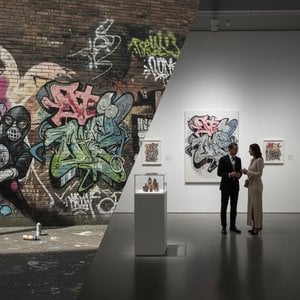
Explore the captivating journey of street art from urban walls to prestigious galleries. Discover how contemporary graffiti has evolved into a high-end collectible movement, redefining modern interior design and global art culture.
 Pregledaj u realnoj veličini
 Pošalji
 Podijeli
 Detalji o umjetničkom djelu
 Vodič
Vodič

 Preuzmi umjetničko djelo
 Slični predmeti
 Rentgenska snimka
 Slide show
 Pitanja i odgovori
 Statistika


 Prikaži više






































 Opcija stakla dostupna je samo za dimenzije manje od 110 cm


