The Luminous Breath of the Russian Landscape
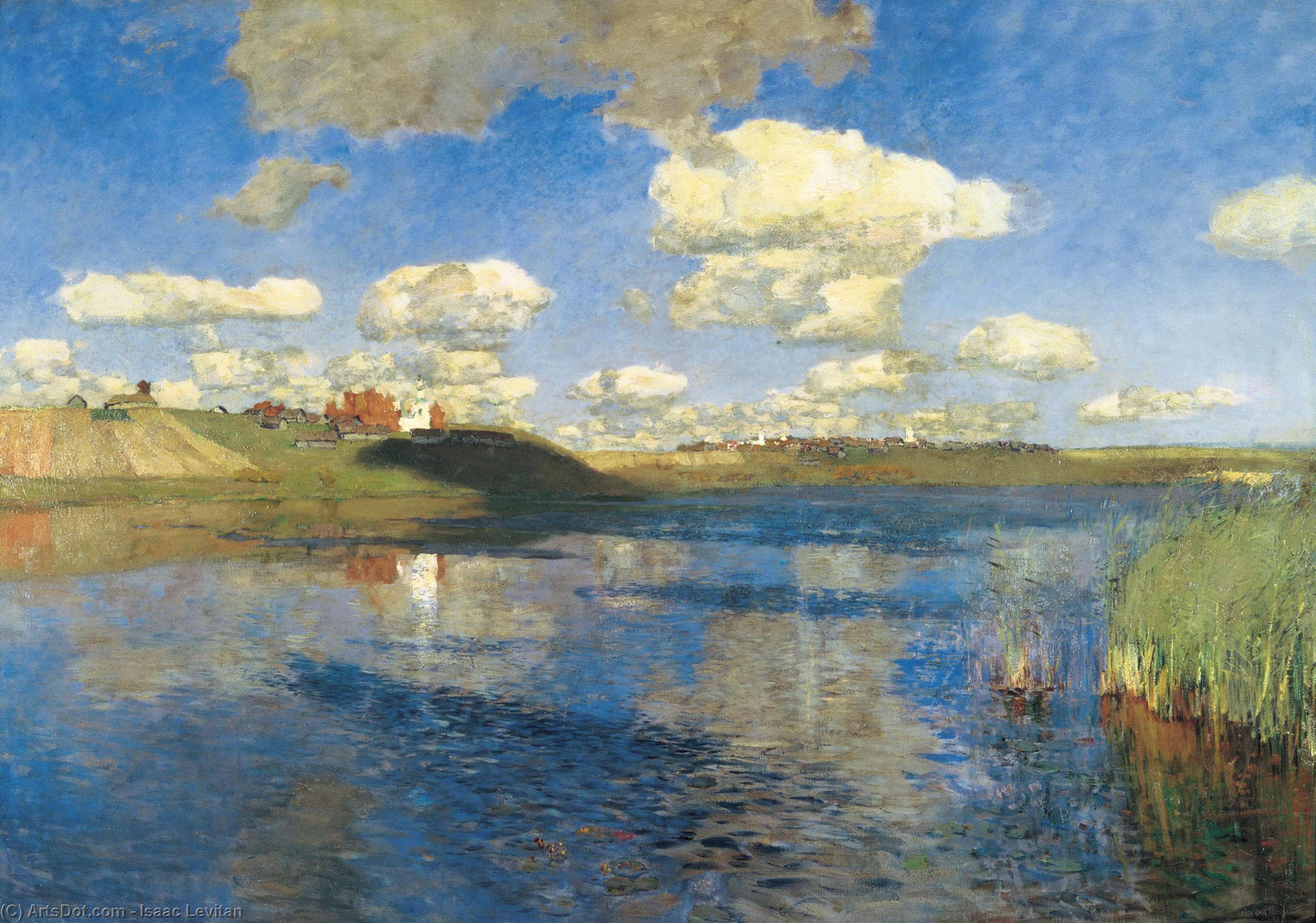
To stand before this depiction of "Lake" is to be enveloped by the very atmosphere of early twentieth-century Russia—a place where nature’s grandeur met the quiet persistence of human life. This painting, executed around 1900, captures a river scene under a vast, mutable sky. It is not merely a record of water and reeds; it is an immersion into a moment of profound, diffused light. The artist has masterfully translated the ephemeral quality of natural illumination onto canvas, inviting the viewer to breathe in the cool, damp air that seems perpetually suspended over the water’s surface.
An Impressionist Vision of Light and Water
The style employed here is a quintessential example of Impressionism, yet filtered through the unique sensibility of Isaak Ilyich Levitan. Observe how the artist eschews sharp outlines for the poetry of broken color. The composition unfolds in horizontal bands—the shimmering water mirroring the heavens above, the distant, softly defined shoreline punctuated by man-made structures, and the foreground anchored by whispering reeds. These elements do not compete; rather, they merge into a unified visual symphony. The technique relies on visible, loose brushstrokes, allowing the texture of the oil paint itself to contribute to the painting's palpable energy. It is through these short, broken strokes that Levitan achieves a sense of movement, making the water appear less like a solid body and more like captured light.
Echoes of Place and Poetic Longing
Understanding the context of Levitan’s life adds layers to this visual experience. Working during a period of immense social and personal upheaval in Russia, his art often carried an undercurrent of deep melancholy mixed with enduring hope. This landscape becomes a sanctuary—a place where the soul can find solace away from the complexities of urban existence or historical constraint. The interplay between the wild natural elements and the distant signs of civilization speaks to a universal human condition: our yearning for both untamed beauty and the comfort of community. It is a meditation on coexistence.
Symbolism of Serenity and Depth
The emotional resonance of this piece is one of profound tranquility. The blues and yellows, dominant in their variations across the canvas, do more than just describe color; they evoke feeling—the cool calm of deep water meeting the warm glow of reflected sunlight. Symbolically, the river itself has always represented the flow of time and life’s journey. Here, that journey is rendered gentle, cyclical, and deeply beautiful. For collectors and designers alike, this artwork offers more than mere decoration; it promises an infusion of serene contemplation into any space it graces.
A Masterclass in Technique for Reproduction
The materials—oil paints on canvas—are handled with a delicate touch that suggests layering thin washes to build luminosity. While the original possesses the unique patina of age, reproductions capturing this work must honor its technical brilliance. The goal is always to replicate not just the image, but the feeling of the artist’s hand at work: the visible texture, the atmospheric depth achieved through perspective, and that signature luminous quality that makes one feel as if the light itself has been trapped forever on the canvas.


 Pregledaj u stvarnoj veličini
 Kupi ručno naslikanu sliku
 Pošalji
 Podijeli
 Detalji o umjetničkom djelu

 Preuzmi
 Slični predmeti
 Rentgenska snimka
 Automatska prezentacija
 Statistika


 Prikaži više






































 Opcija stakla dostupna je samo za dimenzije manje od 110 cm


