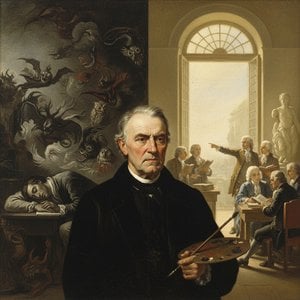
A Life Shaped by Light and History
Born in Jönköping, Sweden, on 26 August 1826, Johan Fredrik Höckert grew up with a natural inclination toward the visual arts. His early talent was recognized by his teacher, J. J. Ringdahl, who saw something special in the boy's drawings as early as age twelve. This early spark led him away from traditional schooling and into the halls of the Royal Swedish Academy of Arts in Stockholm between 1844 and 1845. He was not alone in his ambitions; he formed a lasting bond with fellow painter Johan Christoffer Boklund during these formative years.
His education continued far from home, as he traveled to Munich to study at the Royal Academy of Fine Arts from 1846 to 1849. In Germany, he began to refine his approach to figure painting and genre works. This period of intense study helped him develop a style that would later become deeply connected to Swedish national romanticism. He learned to use color and drama to tell stories, often looking back at the historical events of his own nation.
The Landscapes of Lapland and Paris
In 1850, Höckert returned to Sweden and spent a summer traveling through the northern reaches of Lapland. The scenery of this remote region left a mark on him, providing the inspiration for works like Inside a Laplander’s Tent in 1857. In this painting, he captured a quiet, domestic moment within a nomadic dwelling, focusing on the tender interaction between a mother and her infant amidst the shadows and furs of the tent. He had a way of finding the human element within harsh, rugged environments.
Seeking a broader audience, he moved to Paris in 1851. It was here that his work began to reach international notice. His painting Drottning Kristina och Monaldeschi earned him an honorable mention at the Paris Salon in 1853. Later, in 1855, he achieved significant recognition at the World's Fair in Paris with Gudstjänst i Lövmokks fjällkapell. This work was so well received that it was purchased by Napoleon III of France and placed in the art museum in Lille.
A Legacy in Swedish Art
Höckert’s career was marked by a deep commitment to his roots, even as he studied abroad. He often returned to themes of Swedish history, such as his 1860 work Gustaf Vasa och Tomt-Margit. His ability to blend academic precision with the emotional weight of historical narrative made him one of the most important painters in nineteenth-century Sweden. By 1864, his expertise was formally recognized when he was hired as a professor at the Royal Swedish Academy of Arts.
His life was cut short by health struggles, leading to his death on 16 September 1866. He left behind a body of work that remains held in important collections, including the National Museum of Arts in Stockholm. His paintings continue to be studied for their depiction of:
- The dramatic events of Swedish history.
- The daily lives and traditions of the people in Lapland.
- The technical mastery of academic oil painting.
प्रश्न और उत्तर
Johan Fredrik Höckert का जन्म किस शहर और देश में हुआ था?
Johan Fredrik Höckert का जन्म Jönköpings Kristina församling, Sweden में हुआ था।
Johan Fredrik Höckert की कलाकृतियाँ तकनीक के आधार पर कहाँ देखी जा सकती हैं?
किसी विशेष माध्यम में Johan Fredrik Höckert की सभी कलाकृतियाँ खोजने के लिए, कलाकार के सभी माध्यमों के अनुसार पेज पर जाएँ।
क्या Johan Fredrik Höckert द्वारा चित्रित सभी विषयों का कोई अवलोकन उपलब्ध है?
विषय सूची पेज विषय के आधार पर Johan Fredrik Höckert की कलाकृतियों को वर्गीकृत करता है।