The Enigmatic World of Jan Łaski
Jan Łaski remains a figure shrouded in the mists of art historical documentation, an artist whose life details are sparsely recorded yet whose impact resonates through his compelling engravings. While biographical specifics prove elusive – born and still living without widely available personal history – Łaski’s work speaks volumes, offering glimpses into a world steeped in moral contemplation and meticulous artistry. He is not to be confused with Jan Luyken, another prominent engraver of the period; however, both artists shared a dedication to narrative storytelling through visual means. The scarcity of information surrounding Łaski only adds to the intrigue of his oeuvre, inviting viewers to engage directly with the artwork itself as the primary source of understanding.A Master of Narrative Engraving
Łaski’s artistic practice centers around engraving, a demanding technique requiring both technical precision and creative vision. He excels in depicting scenes that often carry allegorical weight, frequently exploring themes of vanity, human folly, and the transient nature of earthly existence. His engravings are characterized by a remarkable attention to detail; intricate patterns adorn clothing, architectural elements are rendered with painstaking accuracy, and facial expressions convey a wealth of emotion. This dedication to realism isn’t merely aesthetic—it serves to heighten the impact of the moral lessons embedded within his compositions. The artist's style is marked by a delicate balance between fine linework and bold shading, creating images that are both visually captivating and intellectually stimulating.Themes and Symbolism in Łaski’s Work
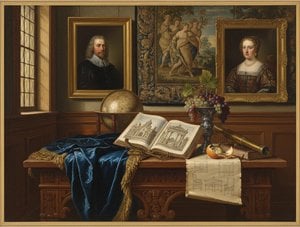
A recurring motif in Łaski’s engravings is the exploration of human vanity. Works like “The Progress of Vanity” – though often associated with Jan Luyken, similar themes are present in Łaski's portfolio – serve as visual parables, tracing the arc of a life consumed by superficial pursuits and ultimately leading to disillusionment. Symbols abound within these scenes: decaying flowers represent the fleeting nature of beauty, hourglasses signify the passage of time, and opulent settings contrast sharply with the spiritual emptiness of their inhabitants. Łaski doesn’t simply condemn vanity; he presents it as a universal human tendency, inviting viewers to reflect on their own values and priorities. The artist's ability to imbue everyday objects with profound symbolic meaning is central to his artistic power.Historical Context and Legacy
Łaski’s work emerged during a period of significant social and religious upheaval in Europe. The 17th and 18th centuries witnessed the rise of Enlightenment thought, challenging traditional beliefs and emphasizing reason and individualism. While not explicitly aligned with any particular philosophical movement, Łaski's engravings reflect a broader cultural preoccupation with morality, self-reflection, and the search for meaning in a changing world. His art can be seen as part of a larger tradition of didactic imagery—works intended to educate and inspire moral virtue. Although his name may not be as widely recognized as some of his contemporaries, Łaski’s engravings continue to captivate audiences with their technical brilliance, narrative depth, and enduring relevance.- Technical Skill: Masterful engraving technique characterized by fine detail and expressive shading.
- Moral Themes: Exploration of vanity, human folly, and the transient nature of life.
- Symbolic Language: Use of objects and settings to convey profound allegorical meaning.