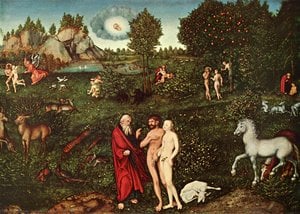
कलाकार का जीवन परिचय
Lucas Cranach the Elder: A Renaissance Master of Saxony
Lucas Cranach the Elder, born in Kronach, Germany around 1472, stands as a pivotal figure of the German Renaissance. His life unfolded during a period of immense religious and political upheaval, and his art became inextricably linked to both the burgeoning Protestant Reformation and the opulent courts he served. Initially trained by his father, Hans Maler, Cranach’s early artistic development remains somewhat shrouded in mystery, though influences from South German masters are evident in his evolving style. He quickly distinguished himself not merely as a skilled craftsman but as an artist capable of capturing psychological depth alongside technical precision – qualities that would soon draw the attention of powerful patrons. In 1504, he entered the service of Frederick III, Elector of Saxony, a relationship that would define much of his career and provide him with both stability and access to influential circles. This appointment as court painter in Wittenberg wasn’t simply about producing decorative works; it placed Cranach at the very heart of one of the most transformative movements in European history.
Early Life and Artistic Training
Lucas Cranach's formative years were spent honing his artistic skills under the tutelage of his father, Hans Maler—a respected painter known for his meticulous realism and masterful use of color. While details about Cranach’s early training remain scarce, scholars believe he absorbed influences from prominent South German masters who championed a style characterized by expressive brushwork and dramatic lighting – techniques that would become hallmarks of his later oeuvre. The workshop of Hans Maler fostered an environment conducive to artistic experimentation and innovation, encouraging Lucas to develop his own distinctive vision while grounding himself in established traditions. This early exposure to diverse artistic styles undoubtedly shaped Cranach’s aesthetic sensibilities and prepared him for the challenges of navigating the complex intellectual landscape of the Renaissance.
Service to Frederick III and Wittenberg
Cranach's ascension to court painter in Wittenberg marked a turning point in his career—and in the history of German art. Frederick III, Elector of Saxony, recognized Cranach’s exceptional talent and entrusted him with overseeing the artistic patronage of his court—a responsibility that extended far beyond commissioning portraits. Cranach skillfully utilized this position to elevate Wittenberg's cultural prestige, attracting scholars and artists from across Europe and fostering a vibrant intellectual atmosphere. He undertook ambitious architectural projects, transforming Wittenberg into a magnificent city adorned with monumental sculptures and elaborate frescoes—demonstrating his commitment to shaping the visual landscape of Saxony’s capital. Furthermore, Cranach’s role as Luther's court painter was profoundly significant: he created no fewer than eleven portraits of Martin Luther, each capturing the reformer’s unwavering conviction and intellectual brilliance. These images served not only as likenesses but also as carefully crafted symbols intended to convey Luther’s authority and piety—essential qualities for a leader challenging papal dogma during the Reformation.
Style and Technique: The Renaissance Vision
Lucas Cranach's artistic style embodies the core tenets of Northern Renaissance aesthetics—characterized by refined realism, luminous color palettes, and meticulous attention to detail. He skillfully blended techniques honed from South German masters with innovations born from his own creative impulses—resulting in a distinctive visual idiom that distinguishes him from many of his contemporaries. Cranach’s mastery of oil painting allowed him to achieve unparalleled tonal gradations and textural nuances—capturing the subtleties of human emotion and illuminating the grandeur of architectural spaces alike. His use of woodcut and engraving expanded his artistic reach, disseminating his images widely through affordable prints and fostering a broader engagement with visual culture. The composition of Cranach’s paintings often reflects principles derived from classical art—emphasizing balance, symmetry, and harmonious proportions. However, he never shied away from incorporating expressive brushwork and dramatic lighting—techniques that imbued his artworks with dynamism and psychological depth.
Legacy and Influence: Shaping Artistic Expression
Lucas Cranach the Elder died in 1553, leaving behind an unparalleled artistic legacy that continues to inspire artists and scholars today. His workshop flourished after his death, perpetuating his distinctive style and techniques for generations—ensuring that Cranach’s influence permeated the visual arts of Europe. Artists trained under Cranach's tutelage adopted his aesthetic sensibilities and embraced innovative approaches to painting and printmaking—contributing to the evolution of Northern Renaissance art. Moreover, Cranach’s depictions of biblical scenes challenged traditional Catholic iconography, advocating for a more personal engagement with scripture and fostering a renewed appreciation for humanist values. His portraits of Luther remain iconic representations of religious leadership—serving as enduring symbols of courage, conviction, and intellectual integrity. Lucas Cranach the Elder's artistic achievements cemented his place as one of the most influential figures of the German Renaissance—a testament to his unwavering dedication to craftmanship, innovation, and the pursuit of beauty. His legacy continues to resonate through centuries of art history—inspiring artists to explore new horizons while honoring the traditions of their predecessors.



 पूर्वावलोकन देखें
 हाथ से बनी पेंटिंग खरीदें
 साझा करें
 साझा करें
 विस्तृत विवरण

 डाउनलोड करें
 समान कलाकृतियाँ
 एक्स-रे
 स्लाइड शो देखें
 आंकड़े


 पूरा देखें






































 ग्लास का विकल्प केवल 110 सेमी से कम आकार में ही उपलब्ध है।