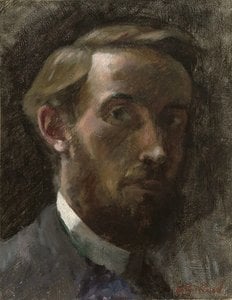
A Forest Reverie: Decoding Vuillard’s “Comedy”
Jean-Édouard Vuillard's 1937 painting, *Comedy*, is far more than a simple depiction of figures in a woodland setting; it’s an evocative exploration of human interaction with nature and a subtle commentary on the interwar period. The artwork invites viewers into a dreamlike space where reality blends seamlessly with fantasy, creating a captivating atmosphere of both joy and underlying melancholy.
Stylistic Roots & Nabis Influences
Vuillard was a key figure in *Les Nabis*, a group of Post-Impressionist artists who sought to elevate art beyond mere representation. While often categorized as Post-Impressionism, Vuillard’s style possesses unique characteristics. He embraced flattened perspectives, decorative patterns, and an intimate scale – qualities influenced by Japanese prints and his own exploration of interior spaces. Unlike the bold brushstrokes of Van Gogh or Cézanne, Vuillard favored a more delicate touch, building up layers of color to create luminous effects. This approach shares some affinities with Naive Art/Primitivism, as seen in the work of artists like Maria Primachenko, though Vuillard’s sophistication and compositional skill set him apart.
Decoding the Composition & Technique
The composition is deliberately crowded yet harmonious. Several figures – adults and what appear to be fantastical beings (perhaps sprites or fairies) – populate a dense forest. Two dogs and a bird add further dynamism, suggesting movement and life within the scene. Vuillard’s technique relies heavily on oil paint applied with loose, visible brushstrokes. He masterfully manipulates light and shadow, creating dappled effects that enhance the painting's dreamlike quality. The flattened perspective draws the viewer *into* the scene rather than offering a traditional, distanced viewpoint. The color palette is dominated by greens and browns, punctuated by touches of yellow and pink, contributing to the overall sense of enchantment.
Symbolism & Emotional Resonance
While seemingly idyllic, *Comedy* carries subtle symbolic weight. The presence of mythical creatures hints at a longing for escape or a return to a more innocent state of being. The figures’ interactions – conversations, quiet contemplation, shared moments – suggest the complexities of human relationships and the search for connection. The forest itself can be interpreted as a metaphor for the subconscious mind, a place of mystery, growth, and hidden truths. The painting evokes a sense of wistful nostalgia, perhaps reflecting the anxieties and uncertainties of the pre-war era. It’s not boisterous laughter, but rather a quiet, reflective *comedy* – a gentle observation of life's absurdities and fleeting joys.
Historical Context & Vuillard’s Legacy
Created in 1937, *Comedy* reflects the artistic climate between the World Wars. Vuillard continued to develop his unique style throughout his career, moving away from purely decorative works towards more narrative compositions like this one. He was a master of capturing fleeting moments and intimate atmospheres, influencing subsequent generations of artists. His work bridges the gap between Impressionism and early Modernism, paving the way for movements like Cubism.
Collecting & Interior Design Considerations
A reproduction of *Comedy* would be a stunning addition to any art collection or interior space. Its harmonious color palette and evocative atmosphere make it particularly well-suited for bedrooms, living rooms, or studies. The painting’s intimate scale lends itself to smaller spaces, while its rich textures and subtle symbolism provide endless opportunities for contemplation. Its blend of realism and fantasy makes it a versatile piece that complements both traditional and contemporary décor styles.
- Style: Post-Impressionism with Nabis influences
- Key Features: Flattened perspective, decorative patterns, luminous color palette, intimate scale.
- Emotional Impact: Evokes a sense of wistful nostalgia, enchantment, and quiet contemplation.
- Consider pairing this artwork with natural materials like wood and linen to enhance its connection to the forest setting.



 पूर्वावलोकन देखें
 हाथ से बनी पेंटिंग खरीदें
 भेजें
भेजें साझा करें
 विवरण देखें
 मार्गदर्शिका

 डाउनलोड करें
 समान वस्तुएं
 एक्स-रे
 स्लाइड शो देखें
 आंकड़े

 और पढ़ें






































 ग्लास का विकल्प केवल 110 सेमी से कम आकार में ही उपलब्ध है।