A Golden Vision of the Dutch Golden Age
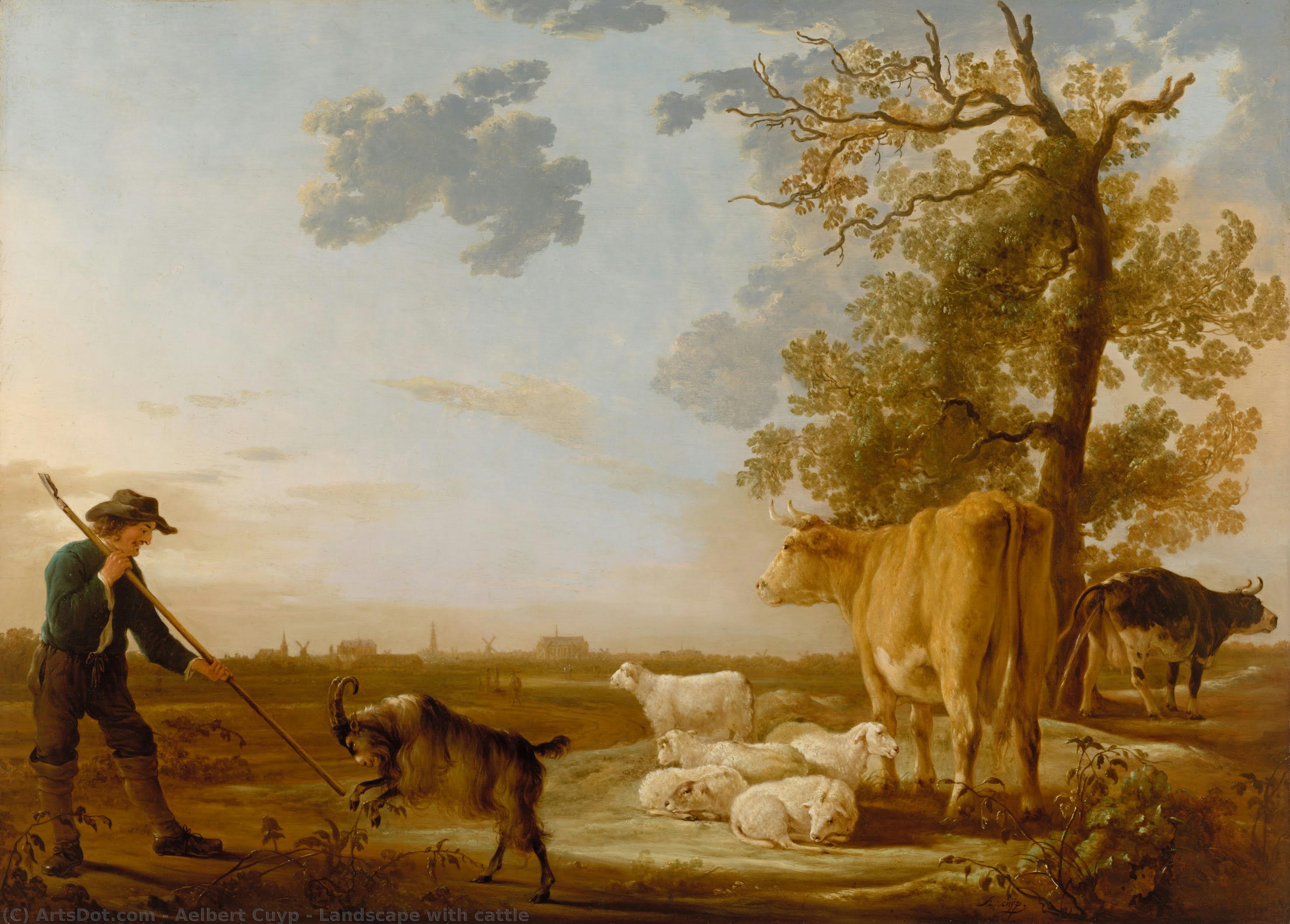
In the heart of the seventeenth century, as the Dutch Republic ascended to unprecedented heights of maritime power and economic prosperity, a new kind of visual poetry emerged from the studios of Dordrecht. Aelbert Jacobsz Cuyp, a titan of the Dutch Golden Age, captured this era not through grand historical battles or royal portraits, but through the quiet, breathing majesty of the countryside. His masterpiece, Landscape with Cattle, serves as a luminous window into a world defined by peace and abundance. The painting invites the viewer to step into a pastoral tableau where time seems to suspend itself, held in the amber glow of a setting sun.
The scene unfolds with a masterful use of atmospheric perspective, drawing the eye across a lush, undulating landscape. In the foreground, the heavy, rhythmic forms of cattle and sheep graze with a profound sense of contentment, their textures rendered with such sensitivity that one can almost feel the soft wool and the warmth of their hides. A shepherd and his faithful dog move through the meadow, adding a touch of human connection to the wilder elements of nature. As the gaze wanders toward the horizon, the landscape softens into a hazy, ethereal distance, where the silhouette of a town—anchored by the recognizable spire of the Marekerk church—emerges from the mist, suggesting a civilization in perfect harmony with its environment.
The Alchemy of Light and Technique
What truly distinguishes Cuyp’s work is his unparalleled ability to act as an interpreter of light. Influenced by the tonal mastery of Jan van Goyen and the luminous, Mediterranean-inspired glow of Jan Both, Cuyp developed a signature style that many have compared to the classical elegance of Claude Lorrain. In Landscape with Cattle, he employs a palette dominated by earthy ochres, deep mossy greens, and soft cerulean blues, all unified by a pervasive, golden radiance. This light is not merely an illumination; it is a character in itself, bathing the entire composition in a warmth that suggests the fleeting, magical moments of dawn or dusk.
The technique behind this illusion is one of meticulous blending and subtle gradations. Using oil on canvas, Cuyp achieved a seamless transition between light and shadow, creating a sense of depth that feels infinitely expandable. The brushstrokes are smooth and deliberate, eschewing harsh outlines in favor of soft, organic shapes that mimic the natural diffusion of light through moisture-laden air. For the discerning collector or interior designer, this technique offers a remarkable versatility; the painting possesses a structural strength that anchors a room, while its soft textures and warm tones provide an inviting, tranquil atmosphere that complements both classical and contemporary decor.
Symbolism and the Spirit of Prosperity
Beyond its aesthetic splendor, Landscape with Cattle is a profound meditation on the values of the Dutch Golden Age. The healthy, well-tended livestock are far more than mere pastoral subjects; they serve as potent symbols of the nation's burgeoning dairy industry and the economic optimism of the era. To a contemporary viewer, the scene represents a tangible emblem of prosperity and the fruits of diligent stewardship. There is an inherent dignity in the way Cuyp depicts the relationship between man, animal, and land—a triad of existence that feels both stable and sacred.
For those seeking to bring a piece of art history into their personal spaces, this reproduction offers more than just decoration; it offers an emotional sanctuary. The painting evokes a deep sense of nostalgia for a lost Eden, a place of quietude and rhythmic simplicity that resonates deeply in our modern, fast-paced world. Whether placed in a sunlit library or as a focal point in a sophisticated living area, this work continues to inspire awe, inviting all who behold it to pause, breathe, and find solace in the eternal beauty of the natural world.


 पूर्वावलोकन देखें
 Switch to Print
 साझा करें
 साझा करें
 विस्तृत विवरण

 डाउनलोड करें
 समान कलाकृतियाँ
 एक्स-रे
 स्लाइड शो देखें
 Stats
Stats


 पूरा देखें






































 ग्लास का विकल्प केवल 110 सेमी से कम आकार में ही उपलब्ध है।


