Aperçu en situation Aperçu en RA Passer au format impression Passer au format image numérique Partager
Détails Guide imprimable Ajouter aux favoris Télécharger Articles similaires Radiographie Voir le diaporama Statistiques

Sally Etting

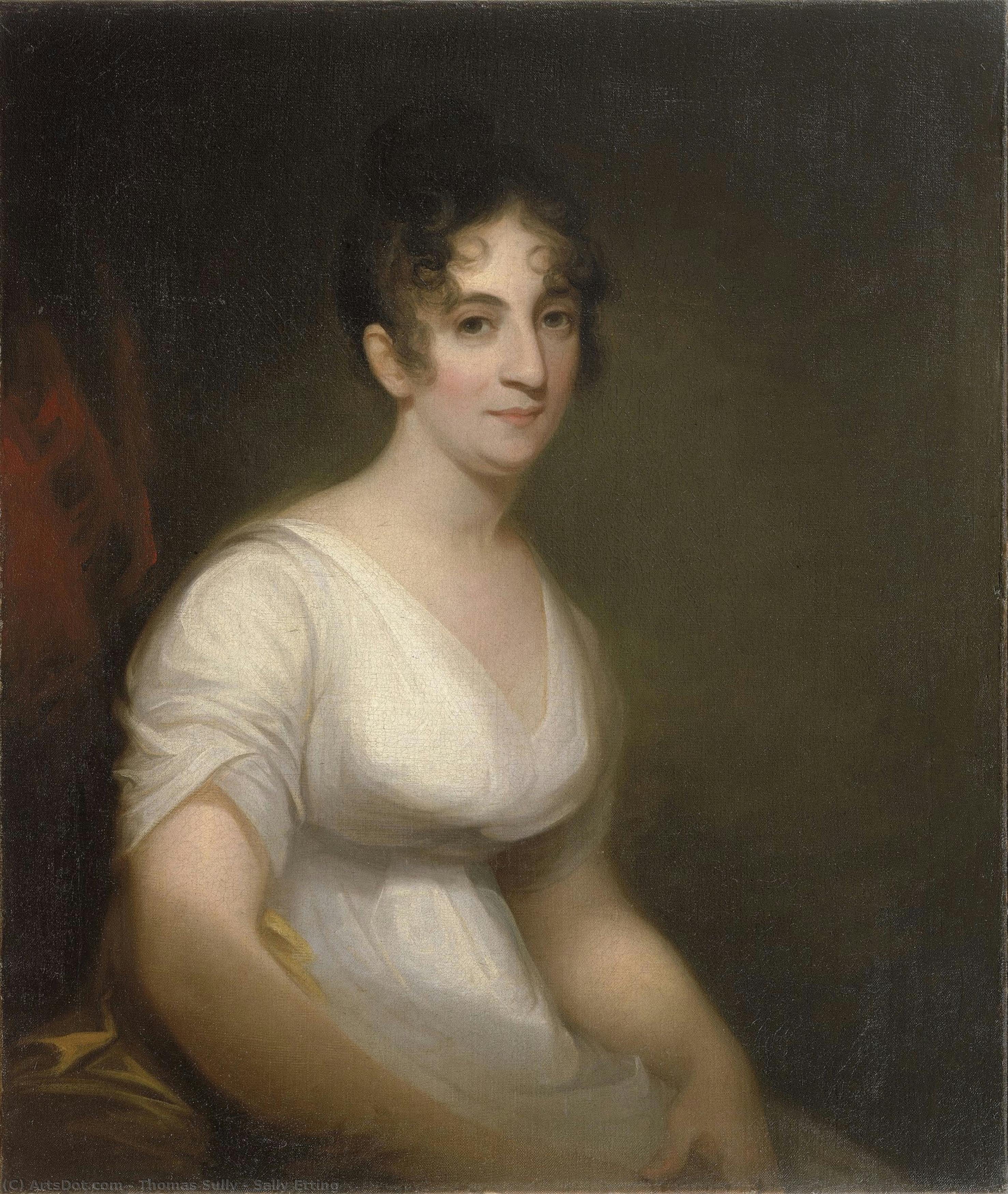
Thomas Sully’s Sally Etting captures the serene elegance of neoclassical portraiture, depicting a contemplative young woman amidst Republican ideals. Executed in 1808, this masterful oil painting showcases balanced composition and luminous texture—a timeless piece to adorn your home.

Découvrez Thomas Sully (1783-1872), portraitiste américano-britannique ! Explorez ses portraits de Jefferson, Adams et Lafayette, et son œuvre 'Passage du Delaware'. Art romantique & néoclassique.

Reproduction à l'huile faite à la main

Huile sur toile peinte à la main, avec cadre et dimensions personnalisés, réalisée sur commande par nos artistes. ( Passer au format impression Passer au format image numérique)

Corner sample of the P118B picture frame: moulded polystyrene, 5 cm wide and 3 cm thick
P118B 10
Corner sample of the P118H picture frame: moulded polystyrene, 5 cm wide and 3 cm thick
P118H 10
Corner sample of the P118W picture frame: moulded polystyrene, 5 cm wide and 3 cm thick
P118W 10
Corner sample of the P438Z picture frame: moulded polystyrene, 5.5 cm wide and 3.5 cm thick
P438Z 10
Corner sample of the P508JH picture frame: moulded polystyrene, 7 cm wide and 3.5 cm thick
P508JH 12
Corner sample of the P508YH picture frame: moulded polystyrene, 7 cm wide and 3.5 cm thick
P508YH 12
Corner sample of the P805H picture frame: moulded polystyrene, 5 cm wide and 3.5 cm thick
P805H 10
Corner sample of the P805Z picture frame: moulded polystyrene, 5 cm wide and 3.5 cm thick
P805Z 10
Corner sample of the P919BZ picture frame: moulded polystyrene, 7 cm wide and 3.5 cm thick
P919BZ 10
Corner sample of the P919G picture frame: moulded polystyrene, 7 cm wide and 3.5 cm thick
P919G 10
Corner sample of the P919XJ picture frame: moulded polystyrene, 7 cm wide and 3.5 cm thick
P919XJ 10
Corner sample of the P959ZH picture frame: moulded polystyrene, 5 cm wide and 3 cm thick
P959ZH 10
Corner sample of the P968JZ picture frame: moulded polystyrene, 6 cm wide and 4 cm thick
P968JZ 12
Corner sample of the W106C picture frame: solid wood, 5 cm wide and 3 cm thick
W106C 8
Corner sample of the W218G picture frame: solid wood, 5 cm wide and 3 cm thick
W218G 10
Corner sample of the W218JH picture frame: solid wood, 5 cm wide and 3 cm thick
W218JH 8
Corner sample of the W218Y picture frame: solid wood, 5 cm wide and 3 cm thick
W218Y 10
Corner sample of the W307PJ picture frame: solid wood, 6 cm wide and 3 cm thick
W307PJ 10
Corner sample of the W316G picture frame: solid wood, 6 cm wide and 3 cm thick
W316G 10
Corner sample of the W316PJ picture frame: solid wood, 6 cm wide and 3 cm thick
W316PJ 8
Corner sample of the W316Y picture frame: solid wood, 6 cm wide and 3 cm thick
W316Y 10
Corner sample of the W398PJ picture frame: solid wood, 5 cm wide and 3 cm thick
W398PJ 8
Corner sample of the W4111J picture frame: solid wood, 6.5 cm wide and 3.5 cm thick
W4111J 10
Corner sample of the W500HY picture frame: solid wood, 7 cm wide and 5 cm thick
W500HY 15
Corner sample of the W500JH picture frame: solid wood, 7 cm wide and 5 cm thick
W500JH 15
Corner sample of the W692G picture frame: solid wood, 8 cm wide and 4 cm thick
W692G 12
Corner sample of the W849H picture frame: solid wood, 5 cm wide and 3 cm thick
W849H 8
Corner sample of the W940BG picture frame: solid wood, 7.5 cm wide and 4.5 cm thick
W940BG 15
Corner sample of the W953PJ picture frame: solid wood, 6 cm wide and 3.5 cm thick
W953PJ 8

Format standard
personnalisé
CM
INCH

Choisissez parmi nos formats prédéfinis qui respectent les proportions originales de l’œuvre.

largeur
hauteur

Vous pouvez saisir vos propres dimensions pour l'adapter à un cadre ou à un espace spécifique. Si la taille sélectionnée ne correspond pas aux proportions de l'image d'origine, nous recadrerons l'œuvre ou prolongerons la peinture avec des éléments peints à la main supplémentaires. Une maquette numérique vous sera envoyée pour approbation avant le début de la production.
Veuillez noter que l'aperçu à l'écran ne reflète pas le recadrage ou l'extension réels. Seule la maquette montrera fidèlement la composition finale.
Bien que des tailles personnalisées soient disponibles, nous vous recommandons de sélectionner une dimension dans la liste prédéfinie afin de préserver les proportions d'origine.

Exemples de personnalisation possibles : remplacer un visage par la photo du client ; ajouter un animal de compagnie (par exemple, remplacer un chat par un chien) ; inclure un message caché en arrière-plan ; modifier le paysage ou les éléments de l'arrière-plan.
Après la commande, l’équipe WahooArt.com contactera le client par e-mail pour recueillir ses instructions et lui fournira une maquette d’aperçu

Livraison dans le monde entier () en 3 à 4 semaines au lieu des 5 semaines habituelles. (9 octobre). Aucun compromis sur la qualité.

Livraison express gratuite dans le monde entier
Toile de lin de haute qualité
Assurance transport complète
Garantie de remboursement des droits de douane
Garantie de fidélité des couleurs
Garantie de retour de 100 jours (uniquement en cas de défaut)
Garantie de remboursement à 100%
Tarifs dégressifs sur quantité

Prix total

€ 234

Sally Etting

Technique de reproduction

Format de la reproduction

-

Prix total final

€ 234

L'essentiel de l'œuvre

  • Artist: Thomas Sully
  • Subject or theme: Portrait
  • Movement: Neoclassical
  • Notable elements or techniques: Portraiture
  • Medium: Oil on canvas
  • Location: Philadelphia, United States
  • Artistic style: Romantic

Quiz d'art

Chaque question ne comporte qu'une seule bonne réponse.

Question 1:
What is the predominant artistic style of this painting?
Question 2:
In what historical period was Sally Etting painted?
Question 3:
What is the primary subject matter of this portrait?
Question 4:
What material was used to create Sally Etting?
Question 5:
Who commissioned this portrait?

A Vision of Grace: The Timeless Allure of Sally Etting

In the quiet, luminous depths of Thomas Sully’s 1808 masterpiece, Sally Etting, one finds more than a mere likeness of a young woman; one encounters a window into the soul of early American refinement. As the young nation sought to define its own identity amidst the echoes of revolution, Sully captured a moment of profound stillness and dignity. The portrait presents Sally, a daughter of prominent Pennsylvania lineage, draped in an elegant white gown that seems to catch the very essence of light. Her gaze, directed softly away from the viewer, suggests a state of deep contemplation, inviting those who stand before the canvas to share in her silent, intellectual reverie. It is a painting that does not demand attention through dramatic movement, but rather commands it through an undeniable, serene presence.

The technical brilliance of Sully’s execution serves to elevate this portrait from a social record to a work of high art. Utilizing oil on canvas, the artist employed meticulous brushwork to create a surface texture that feels almost tactile. The way the light dances across the delicate folds of her white dress and the subtle sheen of her pearl necklace demonstrates a mastery of neoclassical technique. Sully’s ability to manipulate light and shadow—a hallmark of his training under the great Benjamin West—allows for a luminous quality that breathes life into the subject. The composition is anchored by a rich, deep red curtain in the background, a classic device that provides a striking color contrast to the pristine white of the sitter's attire, adding a layer of theatrical depth and warmth to the overall scene.

Symbolism and the Spirit of an Era

Beyond its aesthetic splendor, Sally Etting is steeped in the symbolic language of the Federal period. The neoclassical style, characterized by balance, restraint, and idealized beauty, was a deliberate choice for an era striving for stability and moral virtue. Every element, from the carefully rendered drapery to the poised posture of the subject, speaks to the aspirations of a burgeoning American aristocracy that valued lineage, education, and grace. The presence of the red curtain suggests a stage-like setting, perhaps nodding to Sully’s own theatrical roots, yet it also serves to frame Sally as a figure of importance, cocooned in an atmosphere of sophisticated privacy.

For the discerning collector or interior designer, this artwork offers a profound emotional resonance. It possesses the rare ability to anchor a room with its sense of history and quiet strength. Whether placed in a sunlit gallery or a stately study, the painting brings an air of sophistication and intellectual depth to any environment. As a high-quality reproduction, it allows the splendor of Sully’s brushwork and the evocative mood of the early 19th century to be integrated into modern living spaces, providing a timeless connection to the artistry that helped shape the American visual identity.

Questions et réponses

Quelle technique a été utilisée pour « Sally Etting » et quand a-t-elle été créée ?

« Sally Etting » a été créé en 1808 avec la technique du Oil On Canvas. Le matériau et la date décrivent comment et quand l'original a été réalisé.

Quel usage et quel espace sont recommandés pour «Sally Etting» de Thomas Sully ?

L'utilisation (Accent) et l'espace (Living Room) sont les deux recommandations enregistrées pour «Sally Etting» de Thomas Sully.

Quelle est la tonalité émotionnelle de «Sally Etting» de Thomas Sully ?

Le ton émotionnel relevé pour «Sally Etting» de Thomas Sully est Reflective. Il résume le sentiment exprimé par l'œuvre.

Quel âge avait Thomas Sully lors de la création de « Sally Etting » ?

Lorsque « Sally Etting » a été créé en 1808, Thomas Sully — né(e) en 1783 — était âgé(e) de 25 ans.

Qui a créé "Sally Etting" ?

« Sally Etting » est attribué à Thomas Sully.

En quelle année "Sally Etting" a-t-il été réalisé ?

L'œuvre «Sally Etting» de Thomas Sully date de 1808.

«Sally Etting» de Thomas Sully est-elle une œuvre lumineuse ou sombre ?

En termes de luminosité perçue, «Sally Etting» de Thomas Sully est deep_shadow.


Biographie de l'artiste

Un pionnier de la peinture portrait

Thomas Sully, né en Angleterre et devenu peintre portrait américain, a laissé une marque indélébile sur le monde de l'art grâce à ses œuvres captivantes. Né en 1783 à Horncastle, dans le Lincolnshire, en Angleterre, le parcours artistique de Sully témoigne de sa persévérance et de son talent inné.

Première vie et formation

L’introduction de Sully aux arts a commencé à l'âge de 11 ans lorsqu'il était acrobate à Charleston, en Caroline du Sud. Il a ensuite été apprenti auprès d'un courtier d'assurance qui a reconnu son potentiel artistique, ce qui l'a conduit à étudier la miniature et la peinture décorative sous la direction de son beau-frère Jean Belzons. Cette période brève mais formatrice a jeté les bases du succès futur de Sully.

Œuvres notables et collaborations

Influences artistiques et développement

L’œuvre de Sully est influencée par plusieurs mouvements artistiques clés :
  • Romantisme: Sully a intégré l'expression émotionnelle et le drame caractéristiques du romantisme dans ses portraits, créant des œuvres vibrantes et captivantes.
  • Néo-classicisme : L’influence du néo-classicisme est visible dans la composition soignée et l'attention portée aux détails de ses portraits, reflétant un idéal d'équilibre et d'harmonie.
Son style a évolué au fil des ans, passant d'une approche plus formelle à une représentation plus expressive et naturaliste des sujets.

Héritage et importance historique

L’influence de Sully sur l’art américain est indéniable. Son travail, caractérisé par sa profondeur émotionnelle et sa précision technique, a été un sujet de fascination pour les amateurs d'art et les érudits. En tant que membre fondateur de la Société du fonds musical, les contributions de Sully au monde de la musique et de l'art sont multiples. Son importance historique réside dans :
  • Sa contribution à l’établissement d’une tradition américaine de peinture portrait.
  • Sa capacité à capturer non seulement la ressemblance physique mais aussi la personnalité et le caractère de ses sujets.

Conclusion

La vie et l'œuvre de Thomas Sully témoignent du pouvoir transformateur de l'art. Son héritage, désormais partie intégrante du patrimoine culturel américain, continue d’inspirer les artistes et les amateurs d’art. Pour en savoir plus sur les œuvres de Sully et d’autres artistes notables, visitez la page de Thomas Sully sur WahooArt.com.
  • Découvrez davantage sur Sarah Bernhardt, contemporaine de Sully, et son influence sur le monde du théâtre.
  • Explorez la période de Paris à la Belle Époque, qui a vu l’essor de divers mouvements artistiques, dont ceux influencés par le travail de Sully.
En savoir plus sur les œuvres de Newhailes House, au Royaume-Uni, un témoignage de l’héritage durable de la peinture portrait.
Thomas Sully

Thomas Sully

1783 - 1872 , Royaume-Uni

En bref

  • Artistes Influents:
    • Benjamin West
    • Jean Belzons
  • Date De Décès: 1872
  • Date De Naissance: 1783
  • Influences Artistiques:
    • Romantisme
    • Néo-classicisme
  • Lieu De Naissance: Horncastle, Royaume-Uni
  • Mouvement Artistique: Romantisme, Néo-classicisme
  • Nationalité: Britannique-Américaine
  • Nom Complet: Thomas Sully
  • Oeuvres Notables: ['Passage of the Delaware']
Explorez des œuvres d'art classées par thèmes, styles et caractéristiques.