A Cornish Prodigy Ascends: The Life and Art of John Opie
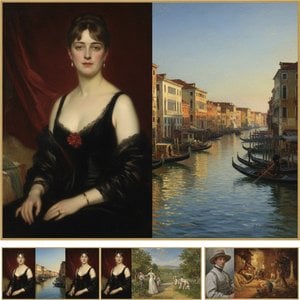
John Opie, born in the humble surroundings of Harmony Cottage, Trevellas, Cornwall in 1761, emerged as one of the most remarkable artistic figures of his generation. His story is a compelling narrative of raw talent nurtured against the odds, rising from a carpenter’s son to become a celebrated portraitist and history painter, a Royal Academician, and an influential voice within the British art world. Opie's early life was marked by a precocious aptitude for both drawing and mathematics – a duality that perhaps informed his meticulous approach to composition and form. Even as a young boy, he demonstrated an independent spirit, establishing an evening school to teach reading, writing, and arithmetic to local children while simultaneously mastering Euclid’s geometry. This thirst for knowledge, coupled with his artistic inclination, was initially met with resistance from his father, who insisted on an apprenticeship in carpentry. However, fate intervened in the form of Dr. John Wolcot, known as Peter Pindar, a physician and satirist whose discerning eye recognized the extraordinary potential within the young Opie. Wolcot became Opie’s champion, securing his release from the carpentry apprenticeship and providing him with invaluable guidance, encouragement, and crucial introductions. This mentorship proved pivotal in launching Opie's career. In 1781, they journeyed to London together, where Wolcot shrewdly presented Opie as a self-taught prodigy – a “Cornish wonder” untouched by formal artistic training. This narrative captivated the London art scene, drawing comparisons to masters like Caravaggio and Velázquez from none other than Sir Joshua Reynolds himself. The initial success was swift and dazzling. Commissions poured in, including portraits of members of the British royal family—the Duke and Duchess of Gloucester, Lady Salisbury, and Mary Delany among them. Opie’s residence on Castle Street became a hub of fashionable society, his talent commanding attention and admiration. However, the partnership with Wolcot eventually dissolved as Opie asserted his independence, seeking to forge his own path without the constraints of their profit-sharing agreement. This period solidified Opie's reputation, establishing him as a leading portraitist capable of capturing not only physical likeness but also the character and social standing of his sitters.Mentorship, London, and Royal Patronage
Reynolds recognized Opie’s talent immediately, praising his “natural genius” and comparing him favorably to Rembrandt. He championed Opie's cause, securing him a place at the Royal Academy and fostering his artistic development. Reynolds’ influence extended beyond mere encouragement; he instilled in Opie a profound understanding of artistic technique—particularly the use of dramatic lighting—a stylistic hallmark that would characterize Opie’s later works. This dedication to mastering Rembrandt’s chiaroscuro – the interplay between light and shadow – became a defining feature of Opie's oeuvre, elevating his paintings beyond mere representation to convey emotion and psychological depth. The Royal Academy’s patronage ensured Opie’s continued success and provided him with access to influential circles within London’s artistic community.Beyond Portraiture: Historical Paintings and Academic Recognition
Opie’s ambition transcended the realm of portraiture; he longed to engage with grand historical narratives, seeking to establish himself as a painter of significant subjects. This aspiration led him to explore history painting, culminating in works like *The Assassination of James I* (1786) and *The Murder of Rizzio* (1787). The latter proved particularly impactful, earning him immediate election as an Associate of the Royal Academy and full membership the following year. These historical paintings demonstrated a growing mastery of composition, dramatic lighting—often referencing Rembrandt’s style—and a commitment to conveying emotional intensity. Opie's meticulous attention to detail—evident in his depiction of textures and fabrics—further distinguished his work from many of his contemporaries. He skillfully employed techniques honed during his apprenticeship to achieve remarkable realism and expressive power.A Legacy of Artistry and Thought
Opie’s later life was marked by both professional success and personal challenges. His first marriage ended in divorce, leaving him heartbroken. However, he found lasting happiness with Amelia Alderson, a writer and abolitionist whom he married in 1798. Their partnership fostered mutual support and intellectual stimulation. Opie's unwavering belief in the transformative power of art extended beyond his own practice; he actively advocated for the establishment of a national gallery—a visionary undertaking that would ultimately realize his lifelong ambition. He eloquently articulated his convictions on artistic education and championed the importance of fostering creativity within society. John Boydell’s Shakespeare Gallery provided Opie with an invaluable platform to showcase his talent and disseminate his ideas, cementing his position as a respected figure among artists and intellectuals alike. His lectures delivered in 1806 and published posthumously in 1809 revealed a thoughtful and articulate mind deeply engaged with the principles of artistic creation—a testament to the enduring legacy of John Opie RA.Questions et réponses
Puis-je parcourir les œuvres de John Opie par palette de couleurs ?
Les œuvres de John Opie peuvent être parcourues par palette de couleurs sur la page Par palettes de l'artiste.
Puis-je parcourir les œuvres de John Opie par ambiance ?
La page L'ambiance par émotion de l'artiste présente les œuvres de John Opie classées par atmosphère.
À quelle période historique John Opie a-t-il exercé ?
John Opie a œuvré durant la période L'époque moderne. Cette période situe l'activité de l'artiste dans l'histoire.