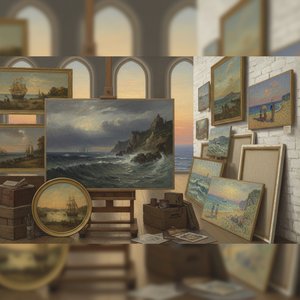
Aperçu en situationAperçu en situation Aperçu en RAAperçu en RA Passer au format impression Passer au format impressionPasser au format image numérique Passer au format image numérique PartagerPartager
DétailsDétails Ajouter aux favoris Ajouter aux favoris TéléchargerTélécharger Articles similairesArticles similaires RadiographieRadiographie Voir le diaporamaVoir le diaporama StatistiquesStatistiques

Long Hope Orkney

Sir John Lavery's "Long Hope Orkney" captures the rugged beauty of the Scottish island coast. This evocative oil painting, painted in 1917, showcases Lavery’s impressionistic style and wartime context – a stunning reproduction.

Sir John Lavery (1856-1941) : peintre irlandais de portraits élégants et de scènes de guerre, capturant l'époque édouardienne avec talent et sensibilité.

Reproduction à l'huile faite à la main

Huile sur toile peinte à la main, avec cadre et dimensions personnalisés, réalisée sur commande par nos artistes. (Passer au format impression Passer au format impressionPasser au format image numérique Passer au format image numérique)

P118B $10
P118H $10
P118W $10
P438Z $10
P508JH $12
P508YH $12
P805H $10
P805Z $10
P919BZ $10
P919G $10
P919XJ $10
P959ZH $10
P968JZ $12
W106C $8
W218G $10
W218JH $8
W218Y $10
W307PJ $10
W316G $10
W316PJ $8
W316Y $10
W398PJ $8
W4111J $10
W500HY $15
W500JH $15
W692G $12
W849H $8
W940BG $15
W953PJ $8

Format standard
personnalisé
CM
INCH

Choisissez parmi nos formats prédéfinis qui respectent les proportions originales de l’œuvre.

largeur
hauteur

Vous pouvez saisir vos propres dimensions pour l'adapter à un cadre ou à un espace spécifique. Si la taille sélectionnée ne correspond pas aux proportions de l'image d'origine, nous recadrerons l'œuvre ou prolongerons la peinture avec des éléments peints à la main supplémentaires. Une maquette numérique vous sera envoyée pour approbation avant le début de la production.
Veuillez noter que l'aperçu à l'écran ne reflète pas le recadrage ou l'extension réels. Seule la maquette montrera fidèlement la composition finale.
Bien que des tailles personnalisées soient disponibles, nous vous recommandons de sélectionner une dimension dans la liste prédéfinie afin de préserver les proportions d'origine.

Exemples de personnalisation possibles : remplacer un visage par la photo du client ; ajouter un animal de compagnie (par exemple, remplacer un chat par un chien) ; inclure un message caché en arrière-plan ; modifier le paysage ou les éléments de l'arrière-plan.
Après la commande, l’équipe WahooArt.com contactera le client par e-mail pour recueillir ses instructions et lui fournira une maquette d’aperçu

Livraison dans le monde entier () en 3 à 4 semaines au lieu des 5 semaines habituelles. (13 septembre). Aucun compromis sur la qualité.

why_choose_icon
Livraison express gratuite dans le monde entier
why_choose_icon
Toile de lin de haute qualité
why_choose_icon
Assurance transport complète
why_choose_icon
Garantie de remboursement des droits de douane
why_choose_icon
Garantie de fidélité des couleurs
why_choose_icon
Garantie de retour de 100 jours (uniquement en cas de défaut)
why_choose_icon
Garantie de remboursement à 100%
why_choose_icon
Tarifs dégressifs sur quantité

Prix total

$ 322

reproduction

Long Hope Orkney

Technique de reproduction

Format de la reproduction

-

Prix total final

$ 322

L'essentiel de l'œuvre

  • Notable elements: Visible brushwork
  • Medium: Oil on canvas
  • Influences: Whistler
  • Title: Long Hope Orkney
  • Artistic style: Impressionistic
  • Movement: Impressionism

Quiz d'art

Chaque question ne comporte qu'une seule bonne réponse.

Question 1:
What is the primary subject matter depicted in Sir John Lavery’s ‘Long Hope Orkney’?
Question 2:
The visible brushstrokes and loose lines in ‘Long Hope Orkney’ are characteristic of which artistic movement?
Question 3:
Considering the date of creation (1917), what historical context is most strongly suggested by ‘Long Hope Orkney’?
Question 4:
What is the dominant color palette used in ‘Long Hope Orkney’?
Question 5:
The use of perspective in ‘Long Hope Orkney’ is primarily achieved through:

A Coastal Symphony: Long Hope Orkney by Sir John Lavery

Sir John Lavery’s “Long Hope Orkney,” painted in 1917, isn't merely a depiction of a windswept coastline; it’s a poignant meditation on resilience, isolation, and the enduring spirit of a people shaped by both the sea and the shadows of war. This evocative landscape captures a pivotal moment – likely during the tumultuous years of World War I – as evidenced by the presence of military vessels subtly integrated into the scene. Lavery masterfully employs Impressionistic techniques to convey not just what he saw, but also the atmosphere and emotional resonance of the Orkney Islands.

The painting’s palette is dominated by a restrained symphony of blues, greys, and whites, mirroring the often-overcast skies typical of this northern region. These muted tones aren't depressing; instead, they create a sense of quiet contemplation, emphasizing the vastness of the sea and the rugged beauty of the land. Visible brushstrokes—loose, gestural, and layered—are central to Lavery’s style, lending an immediacy and dynamism to the scene. The artist doesn’t strive for photographic realism but rather captures the fleeting effects of light and weather, imbuing the landscape with a palpable sense of movement. The composition itself is carefully balanced: the expansive sky occupies roughly one-third of the canvas, drawing the eye upwards while the water dominates the middle ground, its surface rippling with an implied current. The foreground—a cluster of buildings, docks, and figures – anchors the scene, grounding us in a tangible reality.

The Weight of History & Lavery’s Vision

Understanding “Long Hope Orkney” requires acknowledging the historical context within which it was created. Lavery, a prominent figure in Edwardian society, skillfully navigated the shifting social and political landscape of his time, often depicting scenes of both opulent leisure and the grim realities of war. The inclusion of military vessels strongly suggests this latter element; Orkney’s strategic location made it a vital area for naval operations during WWI. However, Lavery doesn't simply portray conflict. Instead, he imbues the scene with a sense of melancholy and introspection – perhaps reflecting on the impact of the war on the lives of ordinary people, or the enduring connection between humanity and the natural world.

Further research reveals that Lavery’s artistic journey was deeply intertwined with Scottish Impressionism. Influenced by artists like William Burrell, he embraced a looser brushstroke and an emphasis on capturing fleeting moments in time. His portraits of notable figures – Winston Churchill, H.H. Asquith – demonstrate his ability to capture the essence of his subjects, while his wartime scenes offer a stark contrast, revealing a sensitivity to human suffering. The painting’s composition echoes elements found in John Kyffin Williams' landscapes of Wales, sharing a similar focus on capturing atmospheric conditions and the rugged beauty of the British Isles.

Decoding Symbolism & Artistic Technique

Beyond its historical context, “Long Hope Orkney” is rich with symbolic potential. The distant shoreline, shrouded in mist, evokes feelings of isolation and uncertainty – themes frequently explored by artists during periods of upheaval. The figures on the land, indistinct yet present, represent the human element, suggesting a community grappling with challenges while maintaining a connection to their heritage. Lavery’s masterful use of perspective—size diminution as objects recede into the distance—creates a convincing sense of depth and space, drawing the viewer into the scene.

The painting's technique is equally noteworthy. Lavery employs layering and blending colors to create an atmospheric effect, simulating the diffused light characteristic of coastal environments. The visible brushwork adds texture and dynamism, while the loose lines capture the movement of water and clouds. The choice of oil paint on canvas allowed for a rich, luminous finish—a testament to Lavery’s skill as a colorist. The use of muted tones, combined with the expressive brushstrokes, creates a powerful emotional impact, inviting viewers to contemplate the beauty and fragility of the natural world.

Bringing “Long Hope Orkney” Home

WahooArt offers meticulously hand-painted reproductions of Sir John Lavery’s “Long Hope Orkney,” allowing you to experience this remarkable artwork in stunning detail. Each reproduction is created using archival-quality materials and techniques, ensuring that it will retain its beauty and vibrancy for generations to come. Whether displayed as a statement piece in your living room or incorporated into an interior design scheme, this painting’s evocative imagery and historical significance will undoubtedly captivate and inspire.


Biographie de l'artiste

Sir John Lavery : Une Vie Dédiée au Portrait et à la Société

  • Né: Belfast, Irlande (1856)
  • Décédé: 1941

Sir John Lavery RA était un peintre irlandais très respecté, renommé pour ses portraits captivants et ses représentations évocatrices de scènes de guerre. Né à Belfast, il a démontré un talent artistique dès son plus jeune âge, fréquentant l'Académie Haldane à Glasgow dans les années 1870 avant d'affiner davantage ses compétences à l'Académie Julian à Paris au début des années 1880.

Débuts de Carrière et Influences

Après son retour à Glasgow, Lavery s’est associé aux artistes de la School of Glasgow. Un moment décisif est survenu en 1888 lorsqu'il a reçu une commande pour peindre la visite d'État de la reine Victoria à l'Exposition Internationale de Glasgow. Cet engagement prestigieux a lancé sa carrière en tant que peintre mondain recherché, ce qui l’a incité à déménager à Londres peu après.

  • Influences Précoces : Lavery a été notablement influencé par James McNeill Whistler, comme en témoigne son style artistique et son approche du portrait.
  • Association avec la School of Glasgow : Son passage au sein de la School of Glasgow a favorisé une sensibilité esthétique distinctive qui a informé ses œuvres ultérieures.

Représentations de Guerre et Reconnaissance Officielle

Comme William Orpen, Lavery a été nommé artiste officiel pendant la Première Guerre mondiale. Cependant, des problèmes de santé persistants et un grave accident de voiture résultant d'un raid de Zeppelin l'ont empêché de servir sur le front occidental. Au lieu de cela, il s’est concentré sur la documentation des scènes de guerre au sein de la Grande-Bretagne, capturant des bateaux, des avions et des dirigeables.

  • Artiste Officiel : Malgré ses limitations, les contributions de Lavery en tant qu'artiste officiel ont fourni des archives visuelles précieuses d’une nation en guerre.
  • Œuvres Notables de Guerre : Sa série comprenait "Salle de Guerre – dépeint la reddition de la haute mer en 1918", "Munitions, Newcastle, 1917" et “Une Défense Côtière – un canon antiaérien de 18 livres, Tyneside, 1917.”

Vie Ultérieure et Héritage

Après la guerre, Lavery a été anobli et élu à la Royal Academy en 1921. Sa vie personnelle s'est entrelacée avec des événements historiques importants ; lui et sa femme, Hazel, ont joué un rôle discret dans la Guerre d'Indépendance irlandaise et la Guerre civile, mettant leur maison londonienne à disposition des négociateurs irlandais. Il a immortalisé Michael Collins avec son tableau "Michael Collins, Amour de l’Irlande", qui est maintenant exposé à la Hugh Lane Municipal Gallery.

  • Relations Anglo-irlandaises : L'implication des Lavery reflétait une relation complexe entre la Grande-Bretagne et l'Irlande pendant une période de bouleversements politiques intenses.
  • L’Influence de Hazel Lavery : Hazel Lavery, son épouse, est devenue un sujet fréquent dans ses peintures et a servi de figure allégorique de "l'Irlande" sur les billets de banque irlandais de 1928 à 1975.
  • Mécénat Généreux : Lavery a fait des dons importants de ses œuvres au Musée d’Ulster et à la Hugh Lane Municipal Gallery, consolidant ainsi son héritage dans l'art irlandais.

Style Artistique et Œuvres Clés

Le style artistique de Lavery mêlait des éléments de l'impressionnisme à un sens aigu pour capturer la personnalité et l’atmosphère. Ses portraits sont célébrés pour leur réalisme, leur élégance et leur portraitage perspicace du caractère. Il était également habile dans le fait de représenter des paysages et des scènes de la vie quotidienne.

  • Œuvres Clés : "L'Ouverture des Modernes Galeries d'Art Étranger et Sargent à la Tate Gallery, le 26 juin 1926," “Sur le Loing : Une Conversation dans l’Après-midi (également connu sous le nom de Sous le Cerisier),” "Un Visiteur au Studio", "Eileen, Sa Première Communion."
  • Thèmes Récurrents : Les portraits de figures importantes, les scènes de la société britannique et les représentations d’expériences de guerre étaient centraux dans son œuvre.
Sir John Lavery

Sir John Lavery

1856 - 1941 , Irlande

En bref

  • Artistic Movement Or Style: Impressionnisme
  • Artists Who Influenced This Artist: ['James McNeill Whistler']
  • Date Of Birth: 20 mars 1856
  • Date Of Death: 10 janvier 1941
  • Full Name: Sir John Lavery
  • Nationality: Irlandais
  • Notable Artworks:
    • Michael Collins, Love of Ireland
    • Summer on the River
    • War Room – depicts surrender
    • Lady Lavery
    • The Artist’s Studio
    • A Visitor to the Studio
    • On the Loing: An Afternoon Chat
  • Place Of Birth: Belfast, Irlande
Explorez des œuvres d'art classées par thèmes, styles et caractéristiques.