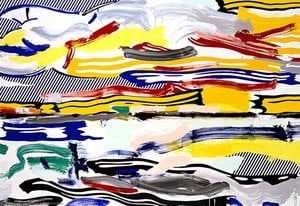
Roy Lichtenstein’s ‘Bull (2)’ – A Pop Art Icon of Boldness and Contemplation
Roy Lichtenstein's “Bull (2),” created in 1973, is more than just a depiction of an animal; it’s a potent distillation of the artist’s signature Pop Art style—a vibrant explosion of color, simplified forms, and a deliberate engagement with the visual language of advertising and comic books. This particular iteration, part of a series exploring the motif of the bull, stands as a testament to Lichtenstein's ability to imbue seemingly mundane subjects with layers of meaning and emotional resonance. The painting immediately commands attention through its striking use of yellow and red – colors traditionally associated with energy, passion, and even danger – creating a dynamic visual tension that draws the viewer in.
The composition itself is deceptively simple. A stylized bull dominates the canvas, rendered in broad, flat areas of color rather than meticulously detailed brushstrokes. This technique, borrowed directly from Ben-Day dots used extensively in commercial printing, gives the image a graphic, almost mechanical quality. The repetition of these small squares creates an illusion of depth and texture, mimicking the effect of printed images. It’s a deliberate move away from traditional representational painting, signaling Lichtenstein's rejection of academic art conventions and his embrace of the visual culture surrounding him.
The Genesis of a Pop Visionary: Context and Influences
To fully appreciate “Bull (2),” it’s crucial to understand the context in which it was created. The 1970s were a period of significant social and cultural change, marked by consumerism, mass media saturation, and a growing skepticism towards established institutions. Pop Art emerged as a direct response to this environment, challenging traditional notions of artistic value and exploring the relationship between art and everyday life. Roy Lichtenstein’s work was deeply influenced by artists like Andy Warhol, who similarly appropriated imagery from advertising and popular culture. However, Lichtenstein's approach differed in its deliberate use of Ben-Day dots and his exploration of themes beyond mere replication – he sought to imbue these borrowed images with a sense of narrative and psychological depth.
Born in Manhattan in 1923, Roy Fox Lichtenstein’s artistic journey began with an interest in realistic drawing and painting. His early training at the Art Students League and subsequent studies at Ohio State University provided him with foundational skills, but it was his encounter with Reginald Marsh, a pioneering realist painter, that truly shaped his approach. Marsh's emphasis on direct observation and capturing the essence of subjects through simplified forms proved to be a key influence on Lichtenstein’s later work. His marriage to Dorothy Herzka (née Lichtenstein), also an artist and art historian, further enriched his intellectual and artistic life.
Decoding the Symbolism: Beyond the Surface
While superficially resembling a commercial print, “Bull (2)” invites deeper interpretation. The bull itself is a potent symbol – often associated with strength, virility, and aggression, but also with fertility and protection. In this context, it can be seen as representing primal forces or perhaps even the anxieties of a rapidly changing society. The vibrant yellow and red colors intensify these associations, creating a sense of urgency and dynamism. The simplified form, devoid of intricate detail, suggests an emotional state rather than a literal representation.
Interestingly, Lichtenstein’s exploration of the bull motif coincided with his interest in mythology and folklore. He frequently referenced ancient stories and symbols in his work, adding layers of historical and cultural significance to his Pop Art images. The series as a whole can be viewed as an investigation into the enduring power of archetypal imagery – how these fundamental symbols continue to resonate across time and cultures.
A Timeless Masterpiece: Reproduction and Interior Design
WahooArt offers meticulously crafted, hand-painted reproductions of “Bull (2)” that capture the essence of Lichtenstein’s original work with remarkable fidelity. Our artists utilize traditional oil painting techniques to faithfully recreate the bold colors, graphic textures, and dynamic composition of this iconic piece. Whether you're a seasoned art collector or seeking to add a touch of Pop Art flair to your interior design scheme, our reproductions provide an authentic and affordable way to bring Lichtenstein’s vision into your home or office.
The scale and color palette of “Bull (2)” make it exceptionally versatile for various settings. Consider pairing it with complementary neutrals to allow the artwork's vibrancy to truly shine, or juxtapose it with more muted tones for a sophisticated contrast. Explore our range of sizes and framing options to find the perfect fit for your space – and experience the enduring appeal of this Pop Art masterpiece.



 Aperçu en situation
 Acheter la peinture faite à la main
 Partager
 Partager
 Détails
 Guide imprimable

 Télécharger
 Articles similaires
 Radiographie
 Voir le diaporama
 Statistiques

 Afficher la suite






































 L'option verre n'est disponible que pour les dimensions inférieures à 110 cm.