Aperçu en situation Aperçu en RA Passer au format impression Acheter la peinture faite à la main Partager
Détails Guide imprimable Ajouter aux favoris Télécharger Articles similaires Radiographie Voir le diaporama Statistiques

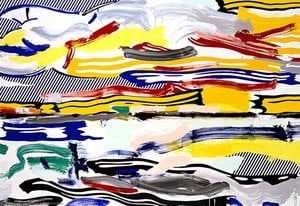
Bull (2) (1973)

Experience Roy Lichtenstein’s ‘Bull (2)’ (1973) – a dynamic Pop Art screenprint bursting with bold yellow and red hues. A captivating study of form, color, and iconic imagery by a modern art master.

Roy Lichtenstein (1923-1997) était une figure américaine majeure de l’art Pop, connu pour ses peintures emblématiques à la manière des bandes dessinées explorant le consumérisme et l'art classique. Découvrez 'Whaam!', 'Drowning Girl', et bien d'autres.

Acquérez une image numérique haute résolution et optimisée, d'une qualité bien supérieure à l'aperçu en ligne.

Chaque fichier est méticuleusement préparé par nos spécialistes internes à l'aide d'outils avancés et d'une retouche manuelle experte. Nous garantissons que chaque image possède une clarté exceptionnelle, une précision des couleurs irréprochable et un niveau de détail fin.

Le fichier final est livré par e-mail sous 72 heures, optimisé pour une utilisation immédiate dans des contextes professionnels, éditoriaux et d'impression. Il offre la même qualité de confiance que celle utilisée par les plus grands studios de création, éditeurs et galeries.

Image numérique

Téléchargez un fichier haute résolution pour votre usage personnel, l'impression et vos projets créatifs. ( Passer au format impression Acheter la peinture faite à la main)

Prix total

$ 24,90

Inclus avec chaque commande d'image numérique

Livraison numérique experte, garantie.

En choisissant WahooArt.com, vous n'obtenez pas seulement une simple image : vous recevez une œuvre numérique sublimée avec professionnalisme, conçue avec précision et accompagnée d'une garantie de satisfaction. Voici tout ce qui accompagne automatiquement votre commande :

shipping_icon
Livraison rapide par e-mail

Votre fichier d'image numérique haute résolution vous sera envoyé par e-mail sous 72 heures après votre commande — prêt à un usage immédiat.

canvas_icon
Fichier numérique optimisé par l'IA

Votre œuvre d'art bénéficie d'une optimisation professionnelle grâce à des outils d'IA avancés et une retouche manuelle, garantissant un niveau maximal de détail, de clarté et de fidélité chromatique.

insurance_icon
Réexpédition gratuite à vie

Vous avez accidentellement supprimé ou perdu votre fichier ? Pas d'inquiétude — nous vous le renverrons gratuitement, quand vous le souhaitez.

tax_icon
Aucuns frais de douane — À jamais

Profitez de votre œuvre d'art instantanément sans frais de douane ni de livraison — les téléchargements numériques sont toujours exonérés de taxes.

color_icon
Garantie de fidélité des couleurs

Nous garantissons que votre image numérique reproduit les couleurs de l'original aussi fidèlement que possible grâce à des outils professionnels et une gestion rigoureuse des couleurs.

return_icon
Garantie de satisfaction de 100 jours

Si vous n'êtes pas satisfait de votre image numérique, nous la retoucherons ou vous rembourserons 100% sous 100 jours — sans poser de questions.

guarantee_icon
Garantie de remboursement à 100%

Pas satisfait ? Obtenez un remboursement intégral dans les 100 jours suivant la réception de votre fichier numérique — sans aucune question posée.

discount_icon
Remises sur les commandes groupées

Achetez 3 images, économisez 10% - Achetez 5, économisez 15% - Achetez 10+, économisez 20%. Idéal pour les projets créatifs, les galeries et les agences.

L'essentiel de l'œuvre

  • Notable elements: Bold colors
  • Title: Bull (2)
  • Artistic style: Pop Style
  • Year: 1973
  • Subject or theme: Bull Image
  • Movement: Pop Art

Quiz d'art

Chaque question ne comporte qu'une seule bonne réponse.

Question 1:
What artistic movement is Roy Lichtenstein most closely associated with?
Question 2:
The dominant colors in 'Bull (2)' are primarily:
Question 3:
Based on the image description, what is the subject of the painting?
Question 4:
Which of the following best describes the style evident in 'Bull (2)'?
Question 5:
Roy Lichtenstein often drew inspiration from which of the following sources?

Roy Lichtenstein’s ‘Bull (2)’ – A Pop Art Icon of Boldness and Contemplation

Roy Lichtenstein's “Bull (2),” created in 1973, is more than just a depiction of an animal; it’s a potent distillation of the artist’s signature Pop Art style—a vibrant explosion of color, simplified forms, and a deliberate engagement with the visual language of advertising and comic books. This particular iteration, part of a series exploring the motif of the bull, stands as a testament to Lichtenstein's ability to imbue seemingly mundane subjects with layers of meaning and emotional resonance. The painting immediately commands attention through its striking use of yellow and red – colors traditionally associated with energy, passion, and even danger – creating a dynamic visual tension that draws the viewer in.

The composition itself is deceptively simple. A stylized bull dominates the canvas, rendered in broad, flat areas of color rather than meticulously detailed brushstrokes. This technique, borrowed directly from Ben-Day dots used extensively in commercial printing, gives the image a graphic, almost mechanical quality. The repetition of these small squares creates an illusion of depth and texture, mimicking the effect of printed images. It’s a deliberate move away from traditional representational painting, signaling Lichtenstein's rejection of academic art conventions and his embrace of the visual culture surrounding him.

The Genesis of a Pop Visionary: Context and Influences

To fully appreciate “Bull (2),” it’s crucial to understand the context in which it was created. The 1970s were a period of significant social and cultural change, marked by consumerism, mass media saturation, and a growing skepticism towards established institutions. Pop Art emerged as a direct response to this environment, challenging traditional notions of artistic value and exploring the relationship between art and everyday life. Roy Lichtenstein’s work was deeply influenced by artists like Andy Warhol, who similarly appropriated imagery from advertising and popular culture. However, Lichtenstein's approach differed in its deliberate use of Ben-Day dots and his exploration of themes beyond mere replication – he sought to imbue these borrowed images with a sense of narrative and psychological depth.

Born in Manhattan in 1923, Roy Fox Lichtenstein’s artistic journey began with an interest in realistic drawing and painting. His early training at the Art Students League and subsequent studies at Ohio State University provided him with foundational skills, but it was his encounter with Reginald Marsh, a pioneering realist painter, that truly shaped his approach. Marsh's emphasis on direct observation and capturing the essence of subjects through simplified forms proved to be a key influence on Lichtenstein’s later work. His marriage to Dorothy Herzka (née Lichtenstein), also an artist and art historian, further enriched his intellectual and artistic life.

Decoding the Symbolism: Beyond the Surface

While superficially resembling a commercial print, “Bull (2)” invites deeper interpretation. The bull itself is a potent symbol – often associated with strength, virility, and aggression, but also with fertility and protection. In this context, it can be seen as representing primal forces or perhaps even the anxieties of a rapidly changing society. The vibrant yellow and red colors intensify these associations, creating a sense of urgency and dynamism. The simplified form, devoid of intricate detail, suggests an emotional state rather than a literal representation.

Interestingly, Lichtenstein’s exploration of the bull motif coincided with his interest in mythology and folklore. He frequently referenced ancient stories and symbols in his work, adding layers of historical and cultural significance to his Pop Art images. The series as a whole can be viewed as an investigation into the enduring power of archetypal imagery – how these fundamental symbols continue to resonate across time and cultures.

A Timeless Masterpiece: Reproduction and Interior Design

WahooArt offers meticulously crafted, hand-painted reproductions of “Bull (2)” that capture the essence of Lichtenstein’s original work with remarkable fidelity. Our artists utilize traditional oil painting techniques to faithfully recreate the bold colors, graphic textures, and dynamic composition of this iconic piece. Whether you're a seasoned art collector or seeking to add a touch of Pop Art flair to your interior design scheme, our reproductions provide an authentic and affordable way to bring Lichtenstein’s vision into your home or office.

The scale and color palette of “Bull (2)” make it exceptionally versatile for various settings. Consider pairing it with complementary neutrals to allow the artwork's vibrancy to truly shine, or juxtapose it with more muted tones for a sophisticated contrast. Explore our range of sizes and framing options to find the perfect fit for your space – and experience the enduring appeal of this Pop Art masterpiece.


Biographie de l'artiste

jeune vie et éducation

roy fox lichtenstein, un artiste pop américain de premier plan, est né le 27 octobre 1923 à New York. Il a grandi dans une famille juive de milieu-classe supérieur, son père étant courtier en immobilier et sa mère femme au foyer. L'intérêt de Lichtenstein pour l'art et le design a commencé comme un passe-temps pendant ses années scolaires.

carrière artistique

Après avoir terminé sa scolarité secondaire au Dwight School en 1940, Lichtenstein a étudié à l’Art Students League of New York sous la tutelle de Reginald Marsh. Il a ensuite obtenu une licence en arts plastiques de l'Ohio State University, interrompue par un service militaire de trois ans pendant la Seconde Guerre mondiale.
  • look mickey (1961, National Gallery of Art, Washington, D.C.), l'une des premières œuvres pop de Lichtenstein, a marqué le début de sa carrière influente.
  • Son travail était fortement influencé par la publicité et les styles de bandes dessinées populaires, avec des œuvres notables telles que Wham!, drowning girl et oh, jeff...i love you, too...but...
  • La pièce la plus chère de Lichtenstein, Masterpiece, a été vendue pour 165 millions de dollars en janvier 2017.

enseignement et influences

Lichtenstein a enseigné dans diverses institutions, notamment l'université d'État de New York à Oswego et l'université Rutgers. Son travail a été influencé par Allan Kaprow, un collègue professeur à Rutgers, ce qui a ravivé son intérêt pour les images proto-pop. Expositions notables :
  • the museum chambre de commerce (Toulouse, France), présentant diverses œuvres d'art, y compris celles du mouvement pop art.
  • Le travail de Lichtenstein a été exposé à la Leo Castelli Gallery à New York, avec sa première exposition personnelle en 1962 ayant été entièrement achetée par des collectionneurs influents avant l'ouverture.

héritage et impact

Roy Lichtenstein est décédé le 29 septembre 1997, laissant derrière lui un héritage en tant que figure de proue du mouvement pop art. Son œuvre continue d’être célébrée pour son mélange innovant d’art haut et d’art populaire, ce qui la rend accessible à un public plus large. Références :
Roy Lichtenstein

Roy Lichtenstein

1923 - 1997 , États-Unis d'Amérique

En bref

  • Artistes Influents:
    • Reginald Marsh
    • Allan Kaprow
  • Date De Décès: 29 septembre 1997
  • Date De Naissance: 27 octobre 1923
  • Lieu De Naissance: Manhattan, États-Unis
  • Mouvement Artistique: Pop Art
  • Nationalité: Américaine
  • Nom Complet: Roy Lichtenstein
  • Oeuvres Notables:
    • Look Mickey
    • Whaam!
    • Drowning Girl
    • Masterpiece