Aperçu en situation Aperçu en RA Acheter la peinture faite à la main Passer au format image numérique Partager
Détails Guide imprimable Ajouter aux favoris Télécharger Articles similaires Radiographie Voir le diaporama Statistiques

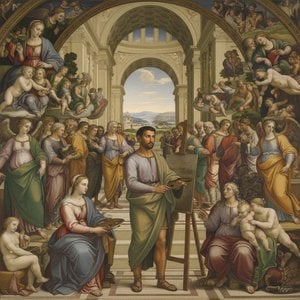
La Transfiguration ( détail)

Magnifique tableau de Raphaël représentant la Transfiguration du Christ ! Admirez les détails raffinés et la beauté classique de cette œuvre emblématique du Siècle de Michelangelo. Découvrez-la chez WahooArt.!

Découvrez Raphaël (1483-1520), le maître de la Renaissance italienne réputé pour son élégance, sa clarté et ses compositions harmonieuses. Explorez les œuvres emblématiques telles que 'La Scuola di Atene', les Madones et les fresques qui définissent la beauté classique. #ArtRenaissance #Italie

Giclées et impressions d'art

Impressions giclées ou sur toile de qualité musée, avec une production rapide et des finitions au choix. ( Acheter la peinture faite à la main Passer au format image numérique)

Corner sample of the P118B picture frame: polystyrène moulé, 5 cm wide and 3 cm thick
P118B €10
Corner sample of the P118H picture frame: polystyrène moulé, 5 cm wide and 3 cm thick
P118H €10
Corner sample of the P118W picture frame: polystyrène moulé, 5 cm wide and 3 cm thick
P118W €10
Corner sample of the P438Z picture frame: polystyrène moulé, 5.5 cm wide and 3.5 cm thick
P438Z €10
Corner sample of the P508JH picture frame: polystyrène moulé, 7 cm wide and 3.5 cm thick
P508JH €12
Corner sample of the P508YH picture frame: polystyrène moulé, 7 cm wide and 3.5 cm thick
P508YH €12
Corner sample of the P805H picture frame: polystyrène moulé, 5 cm wide and 3.5 cm thick
P805H €10
Corner sample of the P805Z picture frame: polystyrène moulé, 5 cm wide and 3.5 cm thick
P805Z €10
Corner sample of the P919BZ picture frame: polystyrène moulé, 7 cm wide and 3.5 cm thick
P919BZ €10
Corner sample of the P919G picture frame: polystyrène moulé, 7 cm wide and 3.5 cm thick
P919G €10
Corner sample of the P919XJ picture frame: polystyrène moulé, 7 cm wide and 3.5 cm thick
P919XJ €10
Corner sample of the P959ZH picture frame: polystyrène moulé, 5 cm wide and 3 cm thick
P959ZH €10
Corner sample of the P968JZ picture frame: polystyrène moulé, 6 cm wide and 4 cm thick
P968JZ €12
Corner sample of the W106C picture frame: bois massif, 5 cm wide and 3 cm thick
W106C €8
Corner sample of the W218G picture frame: bois massif, 5 cm wide and 3 cm thick
W218G €10
Corner sample of the W218JH picture frame: bois massif, 5 cm wide and 3 cm thick
W218JH €8
Corner sample of the W218Y picture frame: bois massif, 5 cm wide and 3 cm thick
W218Y €10
Corner sample of the W307PJ picture frame: bois massif, 6 cm wide and 3 cm thick
W307PJ €10
Corner sample of the W316G picture frame: bois massif, 6 cm wide and 3 cm thick
W316G €10
Corner sample of the W316PJ picture frame: bois massif, 6 cm wide and 3 cm thick
W316PJ €8
Corner sample of the W316Y picture frame: bois massif, 6 cm wide and 3 cm thick
W316Y €10
Corner sample of the W398PJ picture frame: bois massif, 5 cm wide and 3 cm thick
W398PJ €8
Corner sample of the W4111J picture frame: bois massif, 6.5 cm wide and 3.5 cm thick
W4111J €10
Corner sample of the W500HY picture frame: bois massif, 7 cm wide and 5 cm thick
W500HY €15
Corner sample of the W500JH picture frame: bois massif, 7 cm wide and 5 cm thick
W500JH €15
Corner sample of the W692G picture frame: bois massif, 8 cm wide and 4 cm thick
W692G €12
Corner sample of the W849H picture frame: bois massif, 5 cm wide and 3 cm thick
W849H €8
Corner sample of the W940BG picture frame: bois massif, 7.5 cm wide and 4.5 cm thick
W940BG €15
Corner sample of the W953PJ picture frame: bois massif, 6 cm wide and 3.5 cm thick
W953PJ €8

Format standard
personnalisé
CM
INCH

Choisissez parmi nos formats prédéfinis qui respectent les proportions originales de l’œuvre.

largeur
hauteur

Saisissez la largeur et la hauteur souhaitées pour qu'elles s'adaptent à votre cadre ou à votre mur. Une impression ne peut être que découpée, elle ne peut jamais être agrandie au-delà de l'image originale ; ainsi, un format de forme différente entraînera la perte d'une partie de l'image. Nous vous envoyons une maquette numérique pour approbation avant toute impression. L'image présentée sur cette page ne montre pas le recadrage réel — seule la maquette le permet.

Livraison dans le monde entier () en 2 semaines au lieu des 4/5 semaines habituelles. (22 octobre)

Livraison express gratuite dans le monde entier
Toile de lin de haute qualité
Assurance transport complète
Garantie de remboursement des droits de douane
Garantie de fidélité des couleurs
Garantie de retour de 100 jours (uniquement en cas de défaut)
Garantie de remboursement à 100%
Tarifs dégressifs sur quantité

Prix total

€ 59

La Transfiguration ( détail)

Giclées et impressions d'art

Format de la reproduction

-

Prix total final

€ 59

L'essentiel de l'œuvre

  • Title: La Transfiguration
  • Subject or theme: Événement biblique
  • Medium: Huile sur panneau
  • Year: 1520
  • Artistic style: Réalisme classique

The Transfiguration (detail) : A Symphony of Light and Faith

Raphael’s “The Transfiguration,” completed between 1517 and 1520, stands as an unparalleled achievement of High Renaissance art—a testament to the artist's mastery of form and color, and a profound meditation on divine majesty. Currently housed in the Pinacoteca Vaticana, this monumental fresco continues to captivate viewers centuries later with its breathtaking beauty and layered symbolism.

Introduction to Raphael : The Trinity of Renaissance Brilliance

Born March 28 or April 6, 1483, in Urbino, Italy, Raffaello Sanzio Da Urbino—commonly known as Raphael—was a cornerstone figure amongst the triumvirate of artistic geniuses that defined the High Renaissance alongside Leonardo da Vinci and Michelangelo. His distinctive style characterized by serene grace, meticulous detail, and harmonious composition cemented his place among history’s most revered painters.

The Painting : A Masterpiece of Composition and Technique

Executed on panel in oil paint, “The Transfiguration” exemplifies Raphael's exceptional skill in capturing human grandeur while maintaining an unwavering clarity of form. The fresco depicts Jesus ascending into heaven accompanied by Saint Peter, Saint John the Evangelist, and Moses—a scene drawn directly from Matthew 17:1-8. Raphael skillfully employs pyramidal composition to create a sense of stability and balance, guiding the viewer’s eye upwards towards the radiant glory of God.

  • Color Palette : Raphael utilizes a luminous palette dominated by golds, blues, and reds—colors traditionally associated with divinity and spiritual illumination.
  • Brushwork : Delicate brushstrokes contribute to the painting's ethereal quality, capturing subtle nuances of light and shadow that imbue the figures with palpable realism.
  • Perspective : Raphael’s masterful use of linear perspective enhances the illusionistic depth of the scene, transporting viewers into the otherworldly realm of Mount Tabor.

Significance of The Transfiguration : Neoplatonic Ideals Embodied

"The Transfiguration" transcends mere depiction; it embodies Neoplatonic ideals—a belief that God permeates all creation and seeks to unite humanity with divine perfection. The painting’s serene atmosphere reflects the contemplative spirit of Renaissance humanism, inviting contemplation on themes of faith, transcendence, and spiritual transformation.

Throughout the 16th century, “The Transfiguration” was regarded as the pinnacle of artistic achievement—the world's most renowned oil painting. Its visual splendor captivated audiences and inspired artists for generations to come. For a deeper understanding of this iconic artwork, explore Wikipedia.

Sources : Artistic Inspiration and Historical Context

Discover exquisite handmade oil paintings reproductions of “The Transfiguration” on WahooArt.com and elevate your interior décor with a timeless masterpiece.

Questions et réponses

Quelle technique et quel style caractérisent «La Transfiguration ( détail)» de Raphaël ?

Dans « La Transfiguration ( détail) », la technique du Acrylique sur toile rencontre le mouvement High Renaissance.

Quelle technique a été utilisée pour «La Transfiguration ( détail)» de Raphaël ?

Raphaël a utilisé la technique du Acrylique sur toile pour "La Transfiguration ( détail)". Cette technique définit la nature matérielle de l'œuvre originale.

L'œuvre « La Transfiguration ( détail) » est-elle plutôt claire ou plutôt sombre dans l'ensemble ?

Les valeurs enregistrées pour «La Transfiguration ( détail)» de Raphaël sont : une luminosité de éclatant, une luminance de Équilibre lumineux.


Biographie de l'artiste

**Jeunesse et formation**

Raphaël (Raffaello Sanzio da Urbino), un peintre et architecte italien renommé, est né entre le 28 mars et le 6 avril 1483, dans la petite mais culturellement significative ville d'Urbino. Son père, Giovanni Santi, était peintre de cour du duc, lui offrant une exposition précoce au monde artistique. Après le décès de son père à l’âge de onze ans, Raphaël a vraisemblablement géré l’atelier familial, consolidant ainsi sa base artistique.

**Carrière artistique et influences**

Le parcours artistique de Raphaël peut être divisé en trois phases distinctes, chacune marquée par un style unique :
  • Premières années à Umbrie : caractérisée par l'influence de son père et l'ambiance culturelle d’Urbino.
  • Période florentine (1504-1508) : absorbant les traditions artistiques de Florence, qui a considérablement façonné son style.
  • Période romaine (1508-1520) : travaillant pour deux papes et leurs associés, produisant certaines de ses œuvres les plus célèbres, notamment l’école des Athènes dans la stanza della segnatura du Vatican.

**Œuvres notables et héritage**

Certaines des œuvres notables de Raphaël comprennent :

**Influence et héritage**

L'influence de Raphaël sur l'art est profonde, avec son œuvre constituant un pilier du grand Siècle. Son style serein et harmonieux a servi de modèle à la peinture néoclassique, comme le note l’historien d’art Johann Joachim Winckelmann. Malgré l'influence ultérieure du style de Michel-Ange, Raphaël reste l'un des artistes les plus vénérés de l'histoire. Voir le profil de Raphaël sur WahooArt
Raphaël

Raphaël

1483 - 1520 , Italie

En bref

  • Artistes Influents:
    • Giovanni Santi
    • Pietro Perugino
  • Date De Décès: 6 avril 1520
  • Date De Naissance: 28 mars 1483
  • Influences Artistiques: Peinture néoclassique
  • Lieu De Naissance: Urbino, Italie
  • Mouvement Artistique: Haute Renaissance
  • Nationalité: Italienne
  • Nom Complet: Raphaël (Raffaello Sanzio)
  • Œuvres Notables:
    • L'École d'Athènes
    • Madone Esterházy
    • La Transfiguration
    • Les Stanze Vaticanes
Explorez des œuvres d'art classées par thèmes, styles et caractéristiques.